Sunday, September 30, 2012

Social Media Improves Customer Service

A new post on Mashable this weekend details Why Social Media Makes Customer Service Better. In the post, Henry Rollason explains:

  • It targets both current and potential future customers
  • It addresses existing customer service needs, such as measurement, reach, and conversion
Rollason points to two presentations, from UPS and KLM, on how they have utilized social media to improve their customer service programs. One of the highlights of the UPS presentation is that social media allows brands to have a 2nd chance with their customer--if a customer has a bad initial customer service experience and broadcast this on social media platforms, UPS can find that customer and discover what went wrong and how they can improve it. This level of interaction was previously impossible before social media channels, and makes UPS more effective at customer service over time.

While social media allows these interactions to occur, some brands are far better at this strategy than others. Rollason notes that a recent A.T. Kearny study found that of the top 50 brands, 56% did not respond to customer complaints on their Facebook page. Recently, I had several horrible customer service experiences with H.P., and finally decided to vent about it on forums and social networks. While an H.P. representative did reach out to me to assure me that they would solve my problem, they then fed me back to the same representative I had spoken to previously--the source of my complaint. I am now convinced I would not buy an H.P. product again or refer it to any of my friends due to this failed communication and service. This is a clear example of how brands can misuse or underutilize the power of social media channels, and signals that the brands who use social media properly may be the ones who succeed.

Full Link: http://mashable.com/2012/09/29/social-media-better-customer-service/
Airlines Take Mobile Services Beyond Check-In
http://www.emarketer.com/Article.aspx?R=1009335

Airlines are increasingly using mobile check-in services, which is expected to free up more time at the airport for customer service interactions. The article points out that airlines are looking to implement additional services by 2015, such as bag mishandling services and onboard entertainment. Allowing customers to access onboard entertainment from their mobile devices would allow for more targeted messaging to customers. Importantly, this could potentially lower the cost for airlines to upgrade/repurpose entertainment systems periodically as onboard technology evolves over time.

I think this process is quite interesting. Personally, having access to my mobile device during a flight would be great. If I had the option to pick and choose onboard entertainment from my smartphone, that may make me more inclined to purchase certain services. I think the targeted messaging and offers (due to use of my personal phone) would be extremely valuable from the airlines' perspective. It's pretty amazing what insights the airlines were able to get just from starting to offer a mobile check-in process. There are plenty of opportunities to take advantage of--it will be interesting to see what services are offered first and which airlines are most effective at using the additional digital options in flight (and consequently how they use the data thereafter).

Saturday, September 29, 2012

Location-based mobile ads deliver high-end experience for luxury marketers

Location-based mobile is becoming a must have for luxury brands, especially in key locations.
But luxury brands have luxury consumers to deal with: high espectations are a daily issue and the risk to dilute the brand equity is right behind the corner.
So location-based mobile must be handled with great care. If so, it can be a powerful weapon to engage customers at the highest possible leve. As the article mentions, taking a comment from Mark Elfenbein, CBDO of Mood Media:
“There is an inherent expectation of quality, a high level of service and guaranteed experience with luxury brands,” [...] “Luxury customers demand a better experience, and location-based mobile ads, carefully designed and executed, are consistent with those expectations.
The challenge is basically to create a tailored personal shopper experience for each customer. THis can be easily done through analytical tools but human mind, in my opinion, should always be there, especially for key accounts, to control the effectiveness of the campaign.

Check this article (here below an extract).
For the full article copy and paste the following link:
http://www.luxurydaily.com/location-based-mobile-ads-deliver-high-end-experience-for-luxury-marketers/

Location-based mobile ads deliver high-end experience for luxury marketers

By

September 28, 2012

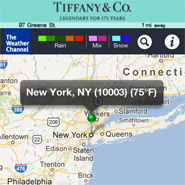
Tiffany ad on the Weather Channel app
Location-based mobile ads allow luxury marketers to deliver a highly-personalized, geo-targeted experience for consumers, effectively giving them a high-end environment that correlates with the luxury brand image.
Marketers including Tiffany & Co., Lexus, Vertu and Nordstrom have all used location-based mobile ads in applications or on mobile sites to deliver relevant, targeted information to affluent consumers in a specific area. In addition to aligning with the luxury image, high-end brands benefit from these ads because they can get consumers on-the-go and on the marketers’ own terms.
“There is an inherent expectation of quality, a high level of service and guaranteed experience with luxury brands,” said Mark Elfenbein, chief business development officer of Mood Media, Los Angeles. “Luxury customers demand a better experience, and location-based mobile ads, carefully designed and executed, are consistent with those expectations.
“It is also important to recognize that many luxury buyers expect a personal, VIP experience, and there are powerful associations with a high-end experience when interacting with technology,” he said. “Well-designed mobile ads can support that experience, creating a virtual personal shopper that creates a specialized experience for the user and helps to rationalize the buying decision.” 

Friday, September 28, 2012

Three types of Mobile Ads that actually work

       The growth of smartphones and tablets has ignited a debate about the future of mobile advertising and which forms of ads will prove most effective. While mobile devices account for 10% of all online activity, mobile ads represent only 2% of total spending on digital advertising, leaving significant opportunity for growth. A recent article in the Wall Street Journal, titled "Mobile Ads: What works and doesn't work " explores which types of mobile ads work best.
        The article explores several categories of mobile ads. Currently, the most prevalent ads in mobile are search ads, which account for more than half of mobile advertising. A specific type of search ad known as Click to Call whereby users can use search results to initiate a call on their phone has proven especially effective. Among the least effective, are Spray and Pray ads which are basically web style banner ads  adopted to mobile. Other forms that work well are Non-Ad Ads which provide relevant information or coupons to the user. Additional ad forms such as Big is Beautiful which are full screen ads inserted between multipage articles or in nontraditional places such as Kindle's lock screen are a good fit with the smaller screens used in phones and tablets. It will be interesting to see which type of ads win out in mobile and what new forms will be developed in this expanding segment. Most likely, it will be ads that integrate key features of mobile devices such as location-based services or other elements such as social networking and gamification that will prove most effective.

FTC on Web Privacy + Children

The New York Times is reporting that "Federal regulators are about to take the biggest steps in more than a decade to protect children online."  While regulators are conscerned about privacy, and the ability to even track and locate individual children, given the recent explosion in handheld devices owned by children, digital marketers are concerned, arguing that the new restrictions will cause companies to reduce their marketing targeted at chidlren.

Read more about the controversy and proposed new regulations here:

http://www.nytimes.com/2012/09/28/technology/ftc-moves-to-tighten-online-privacy-protections-for-children.html?ref=technology&_r=0

Digital Marketing in the AWS (Amazon Web Service) Cloud - New York, NY


Amazon Web Service is hosting an event dedicated to Digital Marketing in NY. In nutshell, you will learn how to utilize the AWS to crunch the large amount of data, also called Big data in an agile way. If anyone is interested, the registration is free.

Here is the link to detail regarding the event -
http://aws.amazon.com/digital-marketing-in-the-aws-cloud/ny

How to engage with customers on Facebook

Today, retailers are still learning on how to best leverage social media, especially Facebook, in order to engage with their customers. I find it interesting that most of them apparently keep on using the same old ways to do marketing while social media require to re-think the way we do marketing from scratch.
For example, only 11% of companies’ posts on Facebook are made during week-ends (Saturday and Sunday) while interaction rates with people are much higher during this part of the week. Similarly, it appears that interactions are much more numerous after 8pm or when companies’ posts remain synthetic (below 80 characters). These recommendations seem obvious but I find it interesting that few companies are actually applying these best practices to maximize their interaction rates and really engage with their customers in the way they want to be approached.
http://mashable.com/2012/09/28/marketers-facebook-wrong/

Apple's Maps Apology


I was really surprised to see Apple’s open letter apologizing for the maps fiasco.  Maybe I underestimated the severity of the issue, but the letter brought the issue to another level for me.  I was especially surprised to see that in the letter Apple CEO Tim Cook even suggest downloading other maps programs. 

My first knee-jerk reaction was “Steve Jobs would never have let this happen.”  In am no Steve Jobs groupie but we all know he was a perfectionist.  The Atlantic reminded me though that this is not the first mistake followed by an open apology from Apple.  They cite examples including the signal issues of iPhone 4 and the $200 drop in price of the iPhone just two months after it went on sale (which surprisingly has not discouraged early adopters of future models).    

Here is a link to the letter and The Atlantic’s commentary.  

Emoticons on a Sunday and other keys to effective wall posts

There were two interesting articles on Mashable today about a report from Buddy Media exploring how effective brands are at using social media (Facebook and Twitter). Overall the study found, "marketers are still posting too little on weekends and at night and when they do post, they’re way too verbose." I found some of these findings to be very helpful especially in contrast to my understanding of best practices in email marketing. Namely, when I was doing email marketing I had been taught that you will get better open rates if you send an email on Wednesday mornings but this study found that Wednesday is the worst day to post on social (interactions on Wednesday are 7.4% lower than average). Another surprise was the big boost they recorded with the use of emoticons including that posts containing emoticons receive 52% higher interaction rates and that :D is the most effective emoticon garnering a 2.4X higher response rate than other emoticons.

Most interesting to me are the differences between Twitter and Facebook illustrated in the graphic below. The study found that Tweets published during "busy hours" 8am-7pm had 30% higher engagement rates than Tweets published from 8pm-7am. While on Facebook posts during "non-busy hours" had a 17% higher engagement rate.


Visit two Mashable articles on the study http://mashable.com/2012/09/28/marketers-facebook-wrong/
and http://mashable.com/2012/06/26/marketers-failing-twitter-study/
The full text of the studies on effective wall posts and effective tweeting can be found at 
http://www.buddymedia.com/newsroom/2012/06/buddy-media-twitter-tweeting-best-practices/

Thursday, September 27, 2012

Facebook Mobile Ads

http://techcrunch.com/2012/09/27/cheapest-way-to-buy-facebook-fans/

A really great read from Tech Crunch today about the value of Facebook mobile feed ads. It turns out it's an incredibly "cheap" and effective way to buy likes. I know I've recently been noticing a number of sponsored posts in my feed lately, most notably Samsung and TD Bank. I've even seen many of my friends like these companies. It remains to be seen though if this effectiveness is sustainable as more companies and marketers begin to flood our Newsfeeds. Will we reach a point of saturation where it's a complete turn-off to see sponsored tweets and users are less compelled to "like" when they're facing a barrage of marketing messages?

For marketers, it's a fantastic way to increase brand awareness. While the value of a "like" has been hotly debated over the recent months - most marketers agree, there is a large value in "likes." Consumers are more likely to increase spend on that brand, have more positive perceptions, and visit the corporate Facebook page. On the most simplistic level, it's reaching a broader audience of consumers that you can communicate with on a regular basis.

What do you think - is this efficiency sustainable as this channel grows?

http://techcrunch.com/2012/09/27/cheapest-way-to-buy-facebook-fans/

-Lindsay


Campbell heats up its digital efforts

As somebody who used to work in the CPG industry, I found this article on Campbell's digital efforts particularly interesting. Campbell's Soup hired its first digital and social media director four months ago to put Campbell's on a digitally fast track. Their philosophy is to invest in people, rather than just increasing the spend on marketing. Campbell's Soup intends to focus on churning out on-demand content and custom experiences. The CPG company also provides hands-on training to employees interested in learning from its approach to digital marketing. Interestingly, Campbell's has modeled Apple's Geniuses with its own Digital Fitness Specialists to help employees build their own personal digital fitness plans. It will be interested to see how successful this 143-year old company is in the digital space!

Here's the full article: http://www.dmnews.com/campbell-heats-up-its-digital-efforts/article/260750/

Airlines Moving Beyond Mobile Check-In

As someone who is about to get on a plane tomorrow, this article from eMarketer caught my eye.  In February 2012, SITA and Airline Business published the "Airline IT Trends Survey 2012," which showed that only half of the surveyed airlines offered mobile check-in services.

For those that do offer it though, they are moving beyond check-in to include other services such as tracking missing baggage or re-booking flights.  There is also an opportunity for airlines to use passengers' personal smartphones and tablets for in-flight entertainment, reducing the cost necessary for an airline to maintain its own in-flight entertainment equipment and packages.

Beyond making passengers' lives easier (which is certainly helpful from an airline customer satisfaction perspective), using mobile devices for check-in and other services or for in-flight entertainment, allows airlines to open up ad space for advertising partners.  This ad space could be very targeted, based on what time of day it is, where the flight is going, and what type of passengers tend to be on the flight (e.g. business or leisure travelers).  These passengers are a captive audience, and being able to interact with them on a more personal level and incorporate some advertising might bring some extra revenue to the ailing airline industry.

On a personal note, one company that I think has a particularly good mobile app is Delta.  I was in San Francisco in January and woke up to a text message that my flight later that day had been cancelled.  I opened the Delta app to find the customer service number to call, and found that the app had already rebooked me on another flight, and had put me in business class.  While I think the business class upgrade was a fluke, I was pleased to see how easy the app made it to deal with what could have been a pretty thorny situation.

eMarketer.com article: Airlines Take Mobile Service Beyond Check-In

Wednesday, September 26, 2012

Men Are Larger Mobile Consumers Than Women

According to research results from online market research company uSamp, men are heavier mobile purchasers than women. This trend applied across many different product categories like digital content, consumer electronics, movies/ticket events, and computer equipment. Women lead the category for only health and beauty items. However, while men are more avid mobile shoppers, women are much more likely to use their phones for product research, couponing and deal searching.

This has interesting implications for retailers as they consider who their target demographic is, and through which mediums they should use to engage potential customers.

Full article here: http://www.emarketer.com/Article.aspx?R=1009374&ecid=a6506033675d47f881651943c21c5ed4

- Vi Nguyen

BRICs. An opportunity for online travel sales

BRIC: Brazil, Russia, India and China. Analysts foresee that these four emerging countries will represent more than 50% of the world's economic growth in the short term. Apart from offline business development potential, these markets also represent important opportunities for online and e-commerce. If we look at online travel sales CAGR 2011-2016 estimations, BRICs will be among the 5 highest growing countries (the other one is South Korea), according to eMarketer's article: http://www.emarketer.com/Article.aspx?R=1009376&ecid=a6506033675d47f881651943c21c5ed4


However, to seize the opportunity, companies should understand consumer habits and characteristics in these countries in order to tailor their marketing strategy.

Tuesday, September 25, 2012

The Growing Importance of Video Content

On September 25th, Ad Age reported, "Digital Agency Definition 6 Acquires NewsMarket Parent Company for $25 Million."  Synaptic Digital, a video content producer and distributor, was acquired by Definition 6 as more and more industry attention is given to the value of interactive content.  Definition 6 "has had success getting so-called 'earned media' for its clients on blogs and social networks. But TheNewsMarket.com and other Synaptic products will now let Definition 6 distribute the video content it creates for brands to thousands of what he referred to as 'true journalists' or mainstream news outlets."

This acquisition demonstrates the growing need for business to business companies that produce and manage video content. The demand for these services is due to industries' acceptance that such content can be a powerful way to reach the customer, and is becoming more and more necessary to compete.  In fact, the article mentions that video content is "something that brands are asking for as more and more think of themselves as publishers..."  It is also interesting that the trend is moving towards traditional news outlets and not just social platforms.  Its seems boring text ads aren't just a thing of the past for traditional newspapers but also for those papers' 21st Century websites.

Check this article on how to coordinate digital and traditional marketing through new technologies, main challenges and existing hurdles.
It is really interesting to note how, according to the article, SMS remain still the easiest way to adopt non traditional marketing, from a company perspective. Indeed, as mentioned in the article,
“When you look at all the different types of mobile marketing, SMS marketing is, hands down, the easiest to implement and has the highest consumer adoption,” said Derek Johnson, CEO of Tatango, Seattle.
“It’s a no-brainer that SMS should be the starting point for advertisers looking to incorporate mobile marketing with their out-of-home marketing techniques,” he said.
On the other hand, I think this is also the most intruisive and sometimes annoying way of using mobile for marketing purposes and should be targeted very carefully.
Another interesting point are QRs. People have been talking a lot about it, as well as for RFID. At full potential, this little great feature could really revolutionize shopping. But there are still some hurdles. For instance, Zegna, the famous formal brand, tried to incorporate them into the suits fabrics but it created problems for washing and ironing, as well as aesthetics.
In the end, this seems to be a highly potential but still premature technology.

Here is the link:
http://www.luxurydaily.com/out-of-home-marketing-still-on-the-fence-with-mobile/

Below the text of the article:

Out-of-home marketing still on the fence with mobile

By

September 25, 2012

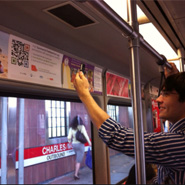
Mobile QR code in out-of-home ad
Equipping out-of-home collateral with mobile can be a great way for marketers to marry online and real-world experiences. However, the combination can be tricky to pull off with mediums including mobile bar codes and SMS.
According to some mobile experts, the key with using mobile in out-of-home marketing is to integrate it into the campaign’s overall initiatives. Simply slapping a call-to-action on a billboard or poster that does not think about the user first does not cut it anymore.
“Mobile can’t be added on at the end of a campaign,” said David Krupp, president of Kinetic U.S., New York.
“We need to think about it not as a standalone at the end – we need to integrate it into a campaign’s architecture,” he said.
“Mobile needs to be considered from the standpoint of ‘what the value of it as part of the overall strategy?’ These types of campaigns are more successful and the adoption from consumers is significantly higher.”
Pick your channel
Mobile can be great to help marketers elevate posters, billboards and signage. However, it is not suited for every medium, per Mr. Krupp.
Putting the engagement at eye level with a consumer will most likely yield the strongest results.
Although newer technology such as augmented reality and near-field communication can be effective if used correctly, the purpose always needs to come back to an overall objective.
“Whether it is pushing out content, a sweepstakes, utilizing a bus shelter to do a treasure hunt, making a static ad come to life or using a phone to tag a location or another opportunity with mobile, it needs to come back to the overarching goal that is trying to be achieved,” Mr. Krupp said.
NFC could be particularly interesting with out-of-home marketing by letting users physically interact with marketing by tapping it. However, adoption is still relatively low, especially in the United States.
Additionally, integrating mobile into in-store signage and marketing has strong implications for retailers to leverage an engaged mobile shopper to drive commerce both in and outside of a store.
Mobile challenge
Marketers still take a gamble with incorporating mobile into out-of-home initiatives, though. Compared to other mediums such as television and print that grab a consumer’s attention for a longer period of time, a billboard or poster only has a few seconds to target a consumer.
Given its wide reach, SMS continues to be one of the most effective way for marketers to take advantage of out-of-home marketing.
“When you look at all the different types of mobile marketing, SMS marketing is, hands down, the easiest to implement and has the highest consumer adoption,” said Derek Johnson, CEO of Tatango, Seattle.
“It’s a no-brainer that SMS should be the starting point for advertisers looking to incorporate mobile marketing with their out-of-home marketing techniques,” he said.
“We stress that clients keep things simple when launching a mobile marketing campaign. Advertisers have to realize that a good percentage of consumers are not as familiar with their mobile phones as the technology elite is. If an advertiser ignores this fact, they’re going to quickly alienate a significant amount of their current and future buyers.”
Asking a consumer to text in a keyword to a short code can be effective on certain marketing collateral such as billboards in high-traffic areas. In order for this to work though, the call-to-action has to be simple. For example, copy should only include a few benefits of signing up for the program, and the keyword and short code needs to be easy to remember.
QR dos and don’ts
Marketers plaster QR codes every static medium nowadays. Consumer awareness is gaining traction, but out-of-home remains a tricky place to use them, according to some mobile experts.
“The biggest challenge is probably giving people relevant information that will get them to take action,” said Mike Wehrs, president/CEO of ScanLife, New York. “Most outdoor media is not planned around action – but mobile can help deliver on that.”
For instance, Bloomingdale’s used mobile bar codes on its print ads on phone booths. The code directed users to a video that included an offer that encouraged users to come in-store (see story).

The Bloomingdale’s mobile-enabled ads
On the other hand, media placed underground is not suited for mobile with a lack of data connections. Nonetheless, marketers do continue to roll out poorly-executed campaigns in these places.
For example, Fox recently used subway ads to promote the new season of the network’s show “The New Girl.”

The Fox ads with a QR code in the bottom left-hand corner
The ads featured a tiny QR code that consumers are likely to not see while quickly passing by.
The ad also lacks a call-to-action for why a consumer should scan the code, which is critical to out-of-home marketing, according to Ed Knudson, executive vice president of sales and marketing at Digimarc, Portland, OR.
In July, Digimarc worked with House Beautiful on a campaign to promote the magazine’s Kitchen of the Year event in New York’s Rockefeller Plaza. The company’s technology let consumers scan signage to pin products displayed at the event to their Pinterest boards.
The mobile tie-in gave users an incentive to directly spread the word via social media to friends and family.
“Don’t link just for the sake of linking,” Mr. Knudson said. “The consumer should feel rewarded for the scan, such as a coupon/discount, sweepstakes entry, buy-now opportunity or to find nearest retail location.”
Final Take
Lauren Johnson is associate reporter on Mobile Marketer, New York

In Social Media, People Expect Coupons from Brands...Unless It's Booze


In the consumer products industry, conventional wisdom would hold that customers interact with brands and products online / in social media in large part to score discounts or get a coupon. A recent article in e-marketer showed that this was true – 67% of social network users in the U.S. “like” or follow personal care brands to get coupons or discounts; 63% for food brands; 50% for nonalcoholic beverages. Interestingly, this does not hold true for alcoholic beverages. Only 26% of social network users like or follow these brands to get such discounts.  Users cite as nearly equally important that they “identify with the brand” or “get advice on purchases” for alcohol products.

This could be because they are not expecting such discounts (and legal/regulatory issues make it difficult to give them) and because people often stick to what they know when it comes to wine, beer, and spirits…they identify with a brand and will seek recommendations from friends, but won’t follow a brand with a transactional expectation.

I worked in the wine industry this past summer and saw this dynamic at play. Our fans and followers responded less to invitations to events or promotions and more to pictures that represented the “lifestyle” of the brand and emphasized its personality and emotional resonance. They also liked and shared tips, recipes, and pairing advice vs. deals at wine shops. Given that alcoholic beverages should be highly social…and people are often intimidated by the choices and complexity, marketers should see social media as a great opportunity for these brands. They have a chance to build a fan base with those who know them and then to expand this fan base among their enthusiasts’ networks – without a transactional or monetary expectation online. While more difficult to measure the effects, these efforts can reinforce loyalty from consumers and give them channels in which to share their affinity with others. Cheers to that!


-Rebecca Canan

Monday, September 24, 2012


If you are wondering how google make $37 billion last year and who bought the most google Adwords, then this infographic is for you.
InfoGraphic: What Industries Contributed the Most to Google's Earnings in 2011?
Despite the recent recession, Finance and insurance industries topped the list and spent 4 billion dollar which was more than 10% of google revenue.

Top spenders are Lowe's ( $59M), amazon.com ($55M) and home depot ($50M). Lowe's and hoe depot's whopping spending on google Adword surprised me.  It explains the connection between the Internet and physical world. We are going online to research and search and buying either online or in store.

One of the highest cost per click keyword is "self employed health insurance" which was auctioned at $43.39. Some of the companies have been spending well over 100k a day just on adword keywords.

WordStream compiled these revenue estimates by using it's own trillion-keyword database and the Google Keyword Tool to determine the top 10 million most popular search queries in 2011, as well as their average cost-per-click prices as paid by advertisers.  WordStream used it's own PPC technologies to categorize the huge keyword list by industry, such as “Finance & Insurance,” then applied a model that weighed the relative percentages of each industry’s revenue (keyword volume * average cost per click) to Google’s 2011 revenues, excluding non-advertising revenues.

For further reading - http://www.wordstream.com/blog/ws/2012/01/23/google-revenues

Nailing the Timing & Frequency of Social Media Updates


HubSpot's Dan Zarrella conducted extensive research on the topic of social media timing. He examined a database of more than 100,000 accounts to determine what timing and frequency resulted in the greatest outcomes for social shares. This blog not only summarizes the research result but also gives helpful tips on how marketers should also conduct their own research to see what is most effective for their particular audience.

Finding the right timing and frequency to blast out newsletters/social media posts was actually one of the projects I spearheaded last summer when I was working as a digital marketing consultant for a marketing research agency in the Netherlands. We are living in a time of information overdose where our inboxes are flooded everyday with way too much chatter. Generating relevant content alone will not get you heard - we need to be smart about how/when to deliver that valuable content in the most effective manner. Check out the article for some tips:

http://blog.hubspot.com/blog/tabid/6307/bid/33601/A-Marketer-s-Guide-to-Nailing-the-Timing-Frequency-of-Social-Media-Updates.aspx

The Next Wave of Tech IPOs: Business Software (WSJ)

Interesting article in the Wall Street Journal today about the changing image of B2B software firms.  Contrasting the image of Mark Zuckerberg in his hoodie is that of Marketo founder Phil Fernandez in his 2002 Honda Civic.  The article suggests that the IPO troubles of some marquee B2C tech firms (Zynga, GroupOn, etc.) has diverted attention from the business SAAS space, which has been quietly creating some really impressive products.  Interesting stuff.  Surely a company that sells marketing automation suites is never going to describe itself in the grandiose, world-changing terms of Google or Facebook.  But as we will see when we use some of this software for our products, these products create immense value for their customers, and in some cases, have market caps that are approaching those of some premium tech brands.  In general the article focuses maybe a little too much on Silicon Valley culture than about the businesses it references, but it's still an interesting read to learn a bit more about the shifting attention in the IPO and venture capital markets.  It also makes a case that it could be just as cool to work for a company with a name like ServiceNow or Guidewire Software as it could be to land at Facebook.