I found this article that talks about how schools are dropping out of the US News school rankings system that we all know and love. I personally like to check out the school rankings and see where we are this year, or help shape my opinion of other schools based on some publication's opinion that I otherwise have no use for in the least. I love Columbia University, I will always support my people that have gone through the business school gauntlet. However, it is pretty easy to see that Columbia has enjoyed being at the top of the US News school rankings for far too long based on the user-friendliness of its website. I remember as a virtual student my first term looking at the website and wondering what it would be like once I was there in person for classes. I took the virtual tour and check out the pictures of campus on the website and that was about it. In true Columbia fashion, the website is a labyrinth of random pages that lead to someplace you never wanted to end up. I wonder if Columbia outspent its competition on digital marketing how that would affect its rankings in the US News publication. Regardless, Columbia should be investing seriously in the potential student experience on their website and probably would do well to overhaul most of their crazy systems in place like giving students two email addresses, one of which goes away forever. I digress. The main takeaway here is that digital marketing has the potential to compete with the old ways of doing things like the US News school rankings and allow for a shakeup on top of the leaderboard, if universities and colleges fail to invest in a targeted digital presence.
Friday, March 10, 2023


The Rise of Retail Digital Marketing: Instacart as a Case Study
https://digiday.com/sponsored/retailers-have-become-premium-suppliers-of-ad-inventory/
A trend in digital advertising is the power of the retailer. Instacart is an example of a company that has
reaped the benefits of this trend. In
January 2022, Instacart set forth a strategy to grow via ad revenue (https://www.adexchanger.com/online-advertising/heres-how-instacart-plans-to-become-a-major-ad-platform/). An article on AdExchanger explains how the
grocery industry is one with thin margins, but a focus on ads would allow for
Instacart to grow without needing to grow in terms of staffing. In late February 2023, the Instacart was
showing growth as a result of this initiative.
Per the Wall Street Journal, the company recently announced a 50% increase
in revenue for 4Q’22 compared to 4Q’21. (https://www.wsj.com/articles/instacart-sees-revenue-profit-boost-ahead-of-public-listing-1d7891d). While the company “has struggled to increase
order volume at the same pace it did during the height of the Covid-19 pandemic,”
they have found success in advertising.
Per Digiday, spend in retail “is expected to account for 19.3%
of digital advertisers’ allotments in 2023.”
Given that platforms have first hand access to consumers’ data, this
trend makes sense. Per Digiday, “retailers’
rich first-party data procured from audiences’ sources has allowed them to become
premium suppliers of ad inventory in a relatively short time.” This is the very reason why Amazon’s ad
business is growing.
It is interesting to watch the transformation of companies such
as Wal-Mart. This business was a
traditional brick and mortar operation. Over
time, they expanded to an online platform as well. Today, they too have an online advertising
revenue stream. While Google will likely
remain the winner in digital for years to come, it will be interesting to see
how other companies grow profits in the digital ad arena.
Tuesday, March 07, 2023
The Future of Virtual Influencers
*** I USED CHATGPT TO WRITE THIS!***
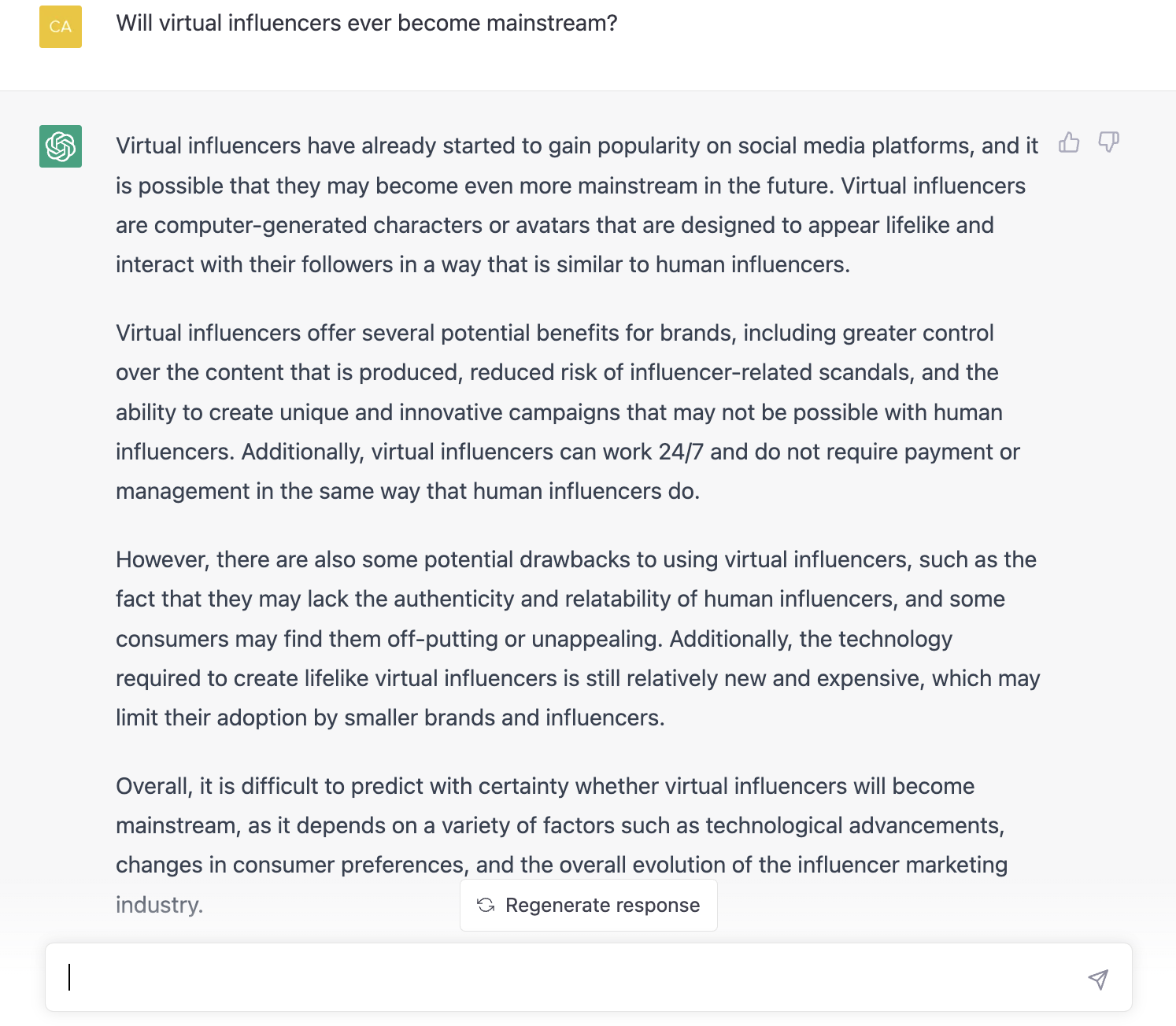
The prompt I put in can be found at the end. I wanted to do some research on virtual influencers (or “vinfluencers”) because our last class was the first time I’d ever heard of them (even though I work in influencer marketing…), so I wanted to learn more.
Virtual influencers have already started to gain popularity on social media platforms, and it is possible that they may become even more mainstream in the future. Virtual influencers are computer-generated characters or avatars that are designed to appear lifelike and interact with their followers in a way that is similar to human influencers.
Virtual influencers offer several potential benefits for brands, including greater control over the content that is produced, reduced risk of influencer-related scandals, and the ability to create unique and innovative campaigns that may not be possible with human influencers. Additionally, virtual influencers can work 24/7 and do not require payment or management in the same way that human influencers do.
However, there are also some potential drawbacks to using virtual influencers, such as the fact that they may lack the authenticity and relatability of human influencers, and some consumers may find them off-putting or unappealing. Additionally, the technology required to create lifelike virtual influencers is still relatively new and expensive, which may limit their adoption by smaller brands and influencers.
Overall, it is difficult to predict with certainty whether virtual influencers will become mainstream, as it depends on a variety of factors such as technological advancements, changes in consumer preferences, and the overall evolution of the influencer marketing industry.
I agree with all of the pros and cons that ChatGPT mentioned, but I would probably add the role that virtual influencers will play in web3 and the metaverse. I believe that is where their adoption will be the most widespread, and then it will eventually trickle down into our real universe. I also think the technology will need to evolve in order for them to really catch on within mainstream marketing because right now they look…unsettling. On the other hand, however, I think any brands willing to make a big bet on virtual influencers might eventually benefit from the “first mover advantage,” allowing it to become a dominant player in the largely untapped space for years to come.
I am also curious about how programmers/developers will handle aging with vinfluencers—for example, Lil Micquela was 19 when she first created her Instagram account in 2016, and her Instagram bio still says that she is 19 seven years later. I think this could be a rare opportunity for brands since this is something humans cannot do. I think it would be interesting for brands to use a vinfluencer who doesn’t age in order to acquire audiences from every generation rather than have him/her “grow up with” the people they attract. I am very eager to see how brands will handle this in the future!
Source: https://www.instagram.com/lilmiquela/
In my first prompt I actually referred to them as “vinfluencers” like I heard in class, and ChatGPT thought they were wine influencers! See below:

Monday, March 06, 2023
CHATGBT compared Go Charlie ! What a world of difference ! Romancing The AI What Can Artificial Intelligence Do For Digital Marketing?
Chat GBT -->
First, let's talk about personalization. AI can analyze data on customer behavior and preferences to create hyper-personalized ads. Gone are the days of generic ads that don't resonate with anyone. Now, we have ads that are so specific, they feel like they were made just for you. It's almost as if the AI knows you better than you know yourself! But don't worry, I'm sure there's nothing creepy about that.
Next, let's talk about chatbots. AI-powered chatbots are becoming increasingly common in customer service. They can answer common questions, provide recommendations, and even complete transactions. This means that humans are no longer necessary for these tasks. So, if you're a customer service representative, you might want to start looking for a new job. Unless, of course, you want to become friends with a chatbot.
Finally, let's talk about predictive analytics. AI can analyze vast amounts of data to predict future trends and behavior. This can be incredibly helpful in digital marketing, as it allows businesses to anticipate the needs and wants of their customers. But let's not forget that AI isn't perfect. Just because a machine predicts that a certain trend will be popular, doesn't mean it will actually be popular. So, if your business suddenly starts selling a bunch of products that nobody wants, you can blame the AI.
In conclusion, AI is having a huge impact on digital marketing, and it's both exciting and a little bit scary. On the one hand, it's amazing that machines can analyze data and make predictions that were once impossible. On the other hand, it's a little unsettling to think about a world where machines are making all the decisions. But hey, as long as the machines keep making us laugh with their weird and wonderful ads, I think we'll be okay.
GO Charlie --> Romancing The AI What Can Artificial Intelligence Do For Digital Marketing?
Digital marketing is a rapidly growing field that is constantly evolving. With the help of AI, marketers can automate tasks and improve the overall quality of their campaigns. Below, we will take a look at how AI can be used in digital marketing to boost reach and engagement.
When it comes to reaching potential customers, AI can be used to automate customer segmentation. This means that you can automatically target different groups of people with different ads and content. By identifying which groups are most likely to convert, you can better target your campaigns and ensure that your messages are reaching the people who need them most.
Similarly, AI can be used to optimize websites for better performance. By using machine learning algorithms, marketers can identify which pages are performing poorly and make necessary changes to improve traffic flow. This allows you to provide a better user experience while also boosting ROI.
Beyond improving website optimization, AI has the potential to enhance data analysis from multiple sources. For example, you could use AI to identify which social media platforms are being used most frequently by your target audience and tailor your posts accordingly. This would allow you to provide more engaging content that would keep users coming back for more (and hopefully convert more leads into customers).
Last but not least, one of the biggest benefits of using AI in digital marketing is its ability to personalize ads at scale. By using machine learning algorithms, marketers can identify customer trends and preferences – even those customers who have never interacted with your company before! This allows you to provide superior customer experiences by anticipating their needs rather than hoping they'll stumble across your content organically.
Overall, embracing the AI revolution is essential for better reach and engagement with your customers online. By using technologies such as Generative AI, marketers can streamline their processes while also providing more relevant content that appeals directly to consumers' interests.
Sunday, March 05, 2023
Email remains the best channel for business leads
Email marketing remains one of the most effective channels for generating business leads. According to research, email marketing has an average return on investment (ROI) of 42:1, meaning that for every $1 spent on email marketing, businesses can expect an average return of $42.
Emails allow businesses to communicate with their target audience in a
personalized and targeted way, which can result in higher engagement rates and
more conversions. Additionally, email marketing offers a wide range of tools
and techniques that can help businesses track and analyze their campaigns,
including open rates, click-through rates, and conversion rates.
However, while email marketing can be highly effective, it's important to
note that it's just one of many channels available to businesses for generating
leads. Depending on the industry, target audience, and specific goals of a
business, other channels like social media advertising, content marketing, or
search engine optimization may be equally effective or even more effective than
email marketing. Ultimately, the best approach will depend on a variety of
factors, and businesses should consider a range of channels and tactics when
developing their lead generation strategy.
Chat GPT or real?
Saturday, February 11, 2023
Superbowl Ads
https://digiday.com/marketing/what-a-7m-super-bowl-ad-buy-can-purchase-in-digital-media-in-2023/amp/
This is an interesting article that shows the digital equivalent
to a $7 million superbowl ad. Further
research shows that the total viewing audience for superbowl is estimated at
208M P2+ individuals (https://www.nfl.com/news/super-bowl-lvi-total-viewing-audience-estimated-at-over-208-million).
In comparison in digital impressions, for $7M, the stats
in the article are
Instagram Reels – 2.3B impressions
TikTok – 1.64B impressions
Twitter – 2.3B impressions (+$250 ad credit)
YouTube – 2.21B impressions
Newsletters – 280M impressions
Friday, February 10, 2023
Bing Taking a Bite out of Google’s Pie
With the introduction of ChatGBT into the Bing search engine, is this now the race to the bottom in terms of pricing just like what Amazon Web Services (AWS) did for compute and storage servers?
This is the first major innovation in years to the search market. Microsoft is hoping its investment into ChatGBT as the critical knife point that would enable Bing to take a bite out of Google’s dominance as the world’s search engine. Microsoft’s CEO “Nadella said he was willing to accept any “demonetisation” of the search business” in order to lessen Google’s slice of the pie. In response, Google has had a blunder filled week with the error prone first impression of Bard, Google’s response to ChatGBT. Yet, Bing’s new search result layout is eerily similar to Google’s. This leaves the reader to wonder, is the real battle a preference over a product or will the AI enabled search truly be a lasting innovation or is it just another fad? I personally believe that this may be a fad in search but the larger impact on automating jobs like cold email or drafting emails will forever change. With the major impact of AI is still unknown, I look forward to the disruption that will be taking place in the near future.
Thursday, February 09, 2023
Podcast Advertising is Becoming a Pretty Big Deal
Podcast Marketing Stats for Businesses
I am not sure this is exactly digital marketing, but I think there is something to this whole podcast marketing deal. I listen to a total of two podcasts, and I only listen to one of them regularly. I can however, recite most of the ads on both of them by heart. It's a lot like influencer social media marketing for your ears I guess and after reading the article, I realized that I have paid a lot more attention to the ads from my podcasts than from pretty much anywhere else I see or hear ads. Magic Spoon, Vuori joggers, Helix Mattresses, Alamo Drafthouse, Bob's Steak and Chophouse, Eatzi's Market & Bakery, I can recite all of their ads and the only place I hear them are on my two podcasts. I'm not saying this is the future of advertising, but I remember them for some reason and I couldn't tell you the last commercial I saw or the last ad I clicked on intentionally. I bring this to this forum to raise the question, what role should podcast advertising play in a CMO's plan to drive sales?
Whether you buy it or not about podcasts, this little article was a bit of content provided by a digital marketing agency as an ad in the hopes that you will consider using them to help you fill out your content strategy etc. This article/ad was included in a daily newsletter that was sent to me by another digital marketing agency in the hopes that I will want to use them because they send me daily content. Pretty slick.
Monday, February 06, 2023
Will TikTok Replace Google as Gen Z’s Go-To Search Engine?
Will TikTok Replace Google as Gen Z’s Go-To Search Engine? By Paige Carlotti
ChatGPT isn’t the only thing threatening Google’s dominance in the search market. Not only did TikTok become the most visited web domain in the world as of 2021, but according to one Google exec, 40% of Gen Z consumers report turning to TikTok and Instagram for search before Google. The trend is so pervasive that TikTok even made a video about it (but posted it on YouTube, which I found interesting and slightly ironic). In other words, social is the new search engine.
I think this trend (or perhaps it is a permanent shift) further underscores the generation’s suspicion of corporations and the value of personalized recommendations. While some people may be tempted to say it’s because the generation is “lazy” or “doesn’t want to read,” I simply think they would rather hear from a person talking about their experience using a new product as opposed to the company telling them how great it is, and take pleasure in putting a face to the person who is explaining how to baste the perfect Thanksgiving turkey. Whether the platform is actually conducive to this change in behavior or not, I believe that if social search has the potential to be profitable, TikTok will shift its strategy in order to capture that value. I am eager to see how this could potentially prove the power of following the consumer!
Sources:
https://www.wired.com/story/tiktok-search-google/
https://www.youtube.com/watch?v=SaE1z4dZ4As
https://mashable.com/article/tiktok-search-engine-ad-google
Sunday, February 05, 2023
QR codes to potentially flood the Super Bowl 2023 commercials
There is lots of talk about how all brands could be
leveraging QR codes in their ads this year for the Super Bowl. Coinbase did this particularly well in last
year’s Super Bowl – so well that it nearly crashed the app it got so much
traffic.
This is a clever tactic to drive customers right to a brand’s
site. Once they are there, the brand
knows exactly from what entry point they entered the site, and they can then
start collecting data about them.
Ideally they could ask for their email, and once collected start 1:1
communications with them and introduce them to the brand and start their
journey through the marketing funnel.
It seems that once brands caught on to the success that Coinbase,
and other brands had with this method, many other brands jumped on the
bandwagon as well. I’ll be curious to see
how many QR codes are shown in ads this year.
In an ever increasingly digital world, the Super Bowl continues to be a
major event to collect millions of eyes.
This is an extremely clever way of digitizing that reach and providing a
call to action to do more than collect impressions, but to potentially collect
and convert customers as well.
Saturday, January 28, 2023
Will the Virtual Influencer ruin it all?
In the past 10 years, the rise of social media influencers has dramatically shifted how brands interact with new and younger demographics. It has gotten to the point where one does not need to be a celebrity before then, they could be famous simply for having a lot of likes and a lot of opinions online. Although many of these influencer/brand deals may save some money from traditional advertising routes, many of these influencers have gone on to create challenges for these brands. As these influencers are human, scandals come to light or, they may simply go out of favor for their audiences. Depending on the agreements these brands have with influencers, this can cause extreme damage to the brand's reputation.
Brands are now looking for alternative ways to connect to these younger audiences (gen z and younger millennials) who are not easily swayed by traditional marketing campaigns. An alternative to this is a virtual influencer/brand ambassador. We have seen them for years, Lil Miquela, Guggimon, and others but what if, the brand had their own dedicated influencer. Cancel proof, no travel, no crazy schedules, no usage fees, or extensive contracts. Some brands are starting to opt for it. Olmeca presented Maria Margarita and Samsung unveiled G-Nusmas last year.
A lot of the downsides to "real" influencers are what may make a brand go for a virtual influencer. But, what are the pros of a virtual influencer that are not dependent on the "real" influencers? In many ways, we are just cycling back to traditional marketing under a new name. Although some brands have been very happy with their virtual influencers, when a character/person is so heavily associated with just one brand, the younger demographics may not see this as inauthentic. It is a bet these brands are willing to take and they will need to figure out what really sets these virtual influencers apart from the "real" ones. Otherwise, the "real" influencers will be here to stay for a very long time.
sources:
https://www.forbes.com/sites/forbescommunicationscouncil/2022/10/18/the-rise-of-virtual-influencers-and-what-it-means-for-brands/?sh=83bf17e6b56c
https://news.samsung.com/global/an-out-of-this-world-whimsical-employee-meet-samsungs-newest-virtual-avatar-gnusmas
https://whiskeyraiders.com/article/maria-margarita-virtual-influencer-olmeca-tequila/
Friday, January 27, 2023
Amazon Ads
https://www.vox.com/recode/2022/11/10/23450349/amazon-advertising-everywhere-prime-sponsored-products
In class, we discussed Amazon
as a destination for digital advertising.
Reading this article, I found the size and scope of Amazon's ad unit to
be quite astounding, especially the quote that says "Amazon's ad revenue
surpassed the money it makes from Prime, Prime Video, and its other audio and
e-book subscriptions combined."
It is interesting how vast a
portfolio of advertising placement Amazon has; in addition to ads on the site
when shopping on Amazon, there are ads on digital prosperities such as Twitch,
advertising in digital video content (including Thursday Night Football), and
then on top of that, advertising placement on physical boxes sent out by
Amazon.
Amazon is a company known for its
leadership principles
(https://www.amazon.jobs/content/en/our-workplace/leadership-principles) - and
at the top of the list is that they are "customer centric." The
other business units - Prime, Prime video, audio, and e-book subscriptions are
just that: customer centric. These are all areas of the business meant to
attract and retain customers. Advertising, however, is historically not customer
friendly, as most people don't like ads. The article highlights this
struggle as it described friction between the ad division and the customer
experience division.
However, given the huge
profitability of the Ad Unit, it seems likely that this business will only
continue to grow. It will be interesting to see if "Customer
Centric" continues to stay as the top Leadership Principle as this growth
continues.
(Additional link: https://advertising.amazon.com/solutions/industries/automotive-marketing - an interesting link that shows how Amazon positions it to advertisers in different industries, in this case the automotive industry)
Voice assistants’ effects on search
I am curious to see how Alexa and Google Home will change
search. Seeing as how Search makes its
money on ads these days, will commerce in the future still use search as the
interface between buyers and sellers or will voice assistants now take care of
those transactions? If yes, how will
they monetize those transactions taking place through voice assistants? Will advertising still be relevant, or a
sustainable model? Would voice
assistants recommend ways/brands/companies to purchase a product? If so, would those recommendations still be
an auction model, with those who bid highest for those ads getting the featured
spot?
As voice assistants become more popular and more accurate, I’m
curious what other features they will deliver that may change the ways of how
big tech companies currently do business.
I’m also curious about what opportunities beyond BAU they present. While currently they seem to fall in to the
category of predictive analytics (answering a question given to them) in the
future I’m sure they will fall into deep learning (presenting the questions and
the answers without needing to be asked).
I wonder what that will look like and how consumers will treat or react
to that type of service.
Niche Marketing via Influencers: How Real Estate is Adapting
The United States is a society that prides itself on the “brand” of the individual while Americans fall into the need for conformity. Luxury real estate developers are tapping into this ethos with the recent NYT pieces on niche influences that gain access to specific buildings and views in exchange for free advertising. Marketing is moving away from the general trendsetter into niche influence that reflects the “brand” of the individual who is rejecting mass conformity for the individual aesthetic. By tapping into niche influencers, luxury real estate is finally hyper-targeting a specific audience that often is difficult to engage.
While this may seem like guerrilla marketing, this exclusivity for engagement benefits both the account posting and the product they are promoting. It is a sophisticated exchange of services for view ( in the case of the NYT article) that will no longer be available for the majority of the public once the apartment sells. In combination with the tone at the end of the piece about a South Bronx property fueling gentrification as the exchange of benefits is tried to justify the end by adapting themselves as a local member of the community via the niche influencer introductions.
Thursday, January 26, 2023
Horizon Media Launches an AI Tool That Promises to Optimize Ad Spends
While many marketers have been thinking about how AI could potentially replace writers and designers, the folks at Horizon Media are thinking about how it could potentially replace ad buyers, too. After two and a half years of development, they’ve finally launched Neon, an AI tool that promises to help advertisers optimize their ad spend across major retail media networks like Amazon, WalMart and Albertsons. They’ll use artificial intelligence to predict critical KPIs like ROAS (Return on Ad Spend), analyze the results of competitors (which was previously impossible for advertisers) and leveraging data used in previous marketing mix models.
As the popular argument goes, I still believe that tools like Neon should remain just that—tools. I don’t think that society will (or should ever) be in a place where AI can replace humans entirely. I believe that tools like Neon can make well-informed recommendations, but a human should always have to be the person who presses the “launch” button when a campaign is ready to go live. For example, if a major retailer is suddenly going through a scandal, an AI bot would miss those cultural cues and run the ad not knowing the PR ramifications associated with doing that. I am a firm believer that AI can enhance processes by improving the efficacy of an advertisers’ marketing dollars, but I would be surprised to see it replace the (human) workforce altogether.
Sources:
Wednesday, January 25, 2023
Google being sued by the DOJ for monopolizing digital ad tech
So this dropped and I wonder if it will have any teeth. Does Google have anything to fear and would we all really be much better off with other options? I guess competition is good for the consumer, but what does a solution really look like? I have more questions than commentary on what looks to be a real threat to Google's dominance. Is it a real threat though? They've beaten the rap before and they certainly have the technology, money, and power to fight the case. I wouldn't want to bet against Google even though I 100% believe that they have a somewhat monopolistic stronghold on the digital advertising business. Time will tell, but this case could change the game in digital advertising.
Saturday, January 21, 2023
AI and the future of creative work
In the past year, we have seen the release of various "creative" AI platforms such as DALL-E and ChatGPT. Although some brands have embraced the platforms and have even released campaigns heavily based on the outputs of AI, others are concerned about how this may affect the role of creatives in the advertising space. I believe that it is important for creatives and agencies as a whole to embrace these platforms and utilize them as tools to better sell their services. When my team is working on a pitch with very abstract creative, we may pull from these platforms to help illustrate the ideas to clients.
Ultimately, these platforms are not able to do the “actual” work. They may be able to produce a reference image but a client may want to make adjustments/improvements. This will require creatives directors, copywriters, and artists. In order for projects to be completed in a timely and efficient manner, producers and account managers are needed. Although these tools will continue to get better and may start to mimic the duties of one’s job, it is a human that then needs to make the decision on what to do with the output of these platforms.
Source:
https://adage.com/article/marketing-news-strategy/watch-mint-mobiles-ad-created-chatgpt/2462502
https://adage.com/creativity/work/hardees-campaign-proves-ai-has-its-limitations/2462851
Friday, January 20, 2023
To be Tracked or Forgotten: The Impact of Jan 1 with CPRA
To be Tracked or Forgotten: The Impact of Jan 1 with CPRA
This January saw the first steps in the most current US battle between digital advertisers and US privacy advocates when it comes to cross-site tracking (known as behavioral advertising). This activity occurs when a consumer watches a knitting video on youtube and then is fed a “wobbles” knitting sponsored post on Instagram. This differs from contextual advertising which learns from a consumer's past actions on a single platform. IE when you watch knitting reels and then are fed sponsored posts for yarn releases or knitting patterns on Instagram.
January 1, 2023 saw the California Privacy Rights Act (CPRA) implementation. This new privacy act allows consumers to opt out of cross-contextual behavioral advertising. Privacy experts are applauding this step forward for US data protection as a “catch-up” to EU regulation. However, some critics believe that the consumer requirement to opt-out for each website will create user fatigue similar to EU’s General Data Protection Regulation (GDPR) IE how an individual just starts accepting most cookies in order to gain access to the website regardless of what information these cookies are gathering. Some US critics believe the policy should be an Opt-In to better facilitate protection for the consumer. However, this critique is opposed by the digital advertisers that utilize this data as the consumer’s data is what is used to pay for the “free and open” internet. 2023 will be an interesting year as digital marketing adapts to these infantile privacy laws as the true impact will not be known for a few more months.
Netflix at the Upfronts
https://variety.com/2023/tv/news/netflix-tv-upfront-advertising-1235488128/
Netflix replacing Paramount at this
year’s Upfronts is cementing a paradigm shift in advertising. Upfront Week has historically been grounded
in the traditional linear television ad space.
The New Fronts emerged as a companion to Upfront Week, but for digital advertising
platforms. However, Disney started to
blur the lines between linear and digital last year when they removed Hulu from
the New Fronts and instead did a company presentation across all platforms. (https://variety.com/2021/tv/news/disney-pulls-hulu-from-newfronts-plans-company-wide-advertiser-showcase-1234904956/).
It is interesting that Paramount
decided to vacate their Upfront Week presentation entirely, thereby leaving an
opening for Netflix. Paramount has a strong
portfolio of linear platforms (and television’s current number 1 rated series Yellowstone),
as well as their own digital platform in Paramount+ so one would certainly
expect to see them at the Upfronts.
Lines between linear and digital
advertising continue to blur and it will be interesting to see the evolution of
both Upfronts and New Fronts. Some
thoughts on trends to keep track of include:
1)
Will traditional media companies like Paramount
stay away from Upfronts moving forward, or will they return? These are expensive events to run and Paramount’s
exit this year could be tied to the economic downturn
2)
Long term will there be “Upfronts” and “New
Fronts” or eventually do these two sets of advertiser events merge into one (in
the way that Disney has done for their portfolio of linear and digital)
Identifying the right metrics
I think that identifying the most
important metric to track in digital marketing is a particularly interesting
topic. For example, impressions,
interactions, time spent, conversions, etc. all serve different elements of the
marketing funnel and can be traced back as a metric depending on the strategy
of a particular digital marketing initiative.
Metrics can even be less finite such
as: collecting a new customer, re-engaging a retained customer, or even being
able to articulate paying the lowest cost per metric, are other ways to
identify success within a digital marketing campaign.
I feel that identifying and agreeing
on what these metrics are upfront is a great way to ensure that the framework
of a digital strategy is being met. For
example, once the framework of goal, strategy, tactics, and metrics is laid
out, one can have a better understanding of (1.) what digital channels to use
to serve the goal, and (2.) what metrics should be used to evaluate success of
meeting that goal.
I’m also interested to learn more
about how multi touch attribution plays into metrics even once such a framework
is put together. With many different
touchpoints, often the last touch channel gets the credit for delivering on a
metric when in fact it may be a variety of touchpoints that led to that metric
delivery.