The Senate voted this week to reverse FCC Privacy Rules, which means that wireless and internet service providers will now be allowed to share their customers' online data with advertisers WITHOUT consent. This resolution still needs to be considered in the House, but if passed would have big implications on what protections the FCC could implement for consumers in the future.
This is obviously a very positive step for ISP's, who can sell big data to consumer focused companies, and for advertisers, who can use the data to increase ad revenue and help companies better direct their marketing dollars.For consumers, however, its a negative step that threatens our right to privacy. I personally find it extremely intrusive to know that data derived from my personal internet/social media use can be used against me. I am not afraid of brands targeting me as a consumer, but only if its done in a moral & unconflicted fashion and with my consent! Put perfectly in the article: "its [my] data...How it’s used and shared should be [my] choice.”
https://www.entrepreneur.com/article/291055
Friday, March 24, 2017


Google Searches Seen as Luxury Investors' Must-Have Tool in Fashion
This Business of Fashion article, which references research from investment analysis firm Macquarie, outlines the correlation between Google searches for company's products and the company's stock performance. They cite examples from Gucci and Salvatore Ferragamo, one positive and one negative, whereby search results foreshadowed the uptick in Gucci's shares and the fall in Ferragamo's. Ultimately, as the Macquarie analysts point out, Google trends can be a useful indicator for a brand's "temperature" - they will become more useful and reliable as more consumers purchase luxury items online.
This is an interesting perspective on the usefulness of Google Trends, not just for advertisers, but also for investors. Moreover, it makes logical sense: as Millennials mature and increase their purchasing power, they are accustomed to researching products (luxury or otherwise) online extensively before making a purchase, especially large purchase, such as a new Hermes Birkin handbag. The overriding assumption to this investment theory, however, is that these searches result in conversion. As we have learned in class, there are plenty of teenagers searching for information and media related to luxury cars online, but that does not mean that they're potential customers.
Furthermore, there is potential for deception. If Cartier, for example, has a very appealing ad campaign, which results in more Google searches for the ad content, it may not lead to more sales or increased revenue for the company. If an investor were to purchase shares in Cartier solely based on Google search trends, she may be misled to think that searchers are all potential customers. In reality, investors will look at more data before making such a decision, and the Google search data offers yet another interesting data point.
It begs the question if Google now has another target customer: investors. Google may want to think about not only engaging with a company's marketing departments, but also their investor relations departments.
Google Moves to Safeguard Brands in order to Safeguard Clicks
The WSJ had an article this week describing how investors should be worried on the sustainability of Google's ad revenue stream. This is a bit surprising given that Google's ad revenue grew 18% last year, but then again that sets a pretty high bar for future incremental growth. Additionally, some major brands (i.e. Verizon, AT&T) recently suspended ads with Google in the wake of finding out their branded ads were being placed next to objectionable content.
I guess recent moves by AT&T and Verizon follow the old adage that "it takes a lifetime to build a strong reputation, but just a quick moment to destroy it". In order to provide re-assurance to its brand-conscious customer base, Google will have to take steps to police its network and safeguard brands. I'd be curious to see how this unfolds as it is impossible to fully police such a wide landscape as the world wide web. But if anyone can do it, I'd put my money on Google.
https://www.wsj.com/articles/google-needs-all-the-clicks-it-can-get-1490296699

Major US brands now
pulling ads from YouTube & Google over extremist content
This article surprised me. It had never occurred to me that
there could be negative unintended consequences of advertising on YouTube. Since
you are not allowed to individually pick which videos your ads appear on there
is a chance that your ad could slip through a filter and be attached to an
extremist video. In the cases of the article the companies are unhappy since
they are not intending to be linked or associated with those particular videos.
From all studies I have read YouTube advertising is very effective
and if anyone clicks on an add or doesn’t skip it immediately then it is
clearly a good lead for your product. This makes me believe that these companies
are doing this to make a statement, send a message to google and use it is as a
scare tactic. I can’t imagine they would really be ok with no longer
advertising on YouTube. Hopefully their message is loud and clear and YouTube
will fix the issues and advertisers can be placed beside the content they want
to be near.
If you are interested in reading more please click below:
Dovetales
Engagement - can you continue to trust your friends when so many of them are bring paid by advertisers - to influence you?
Dovetail is an influencer marketing program. Brands are spending an estimated $255 million a month on influencers.
The goal is that this structure will enable smaller brands to be able to access future customers across channels.
https://techcrunch.com/2017/02/21/dovetale-wants-to-let-brands-of-any-size-use-influencer-marketing/

Buy some influencers
Adobe has launched a new product called Fleek, where marketers can essentially buy influencers to market products via social media. Much like our class exercise in dialing in demographic information for targeting on Favebook, Adobe says similar features are available to find the right influencer for your brand.
With Fleek, after a marketer creates their campaign, they can browse a “talent marketplace” of different creators, which includes their reach across different demographic groups and on various video platforms like YouTube and Facebook. They can then reach out to those creators and get contracts signed directly through Fleek. The product will also predict the reach of a campaign based on the creators recruited, and then, of course, report on actual results.
https://techcrunch.com/2017/03/22/adobe-fleek/?ncid=rss
The service is complete with features marketers want, such as performance data. This is one more feature they are selling within a complete portfolio of programs and services for digital marketers in their Marketing Cloud.
The Dark Side of Digital Advertising
An increasingly hot topic is that there are numerous well-known brands inadvertently funding Islamic extremists, white supremacists, and pornographers through their web-based advertising.
The Times of UK discovered that ads for companies like Mercedes-Benz, Honda, Thomson Reuters, Liverpool university, Argos, and even charities, were showing up on hate sites and YouTube videos created by supporters of hate groups...which is generating thousands and thousands of dollars for the extremists. For instance, on YouTube, there was recently seen a commercial for the new E-Class Mercedes running next to a pro-Isis video, which has been viewed 115k times...a Jaguar ad was also seen to run next to the video. Sandals Resorts have found their ads next to a video promoting al-Shabaab, the East African jihadist group.

The list goes on...While Google has taken these videos down after being alerted, programmatic advertising has enabled agencies to track customers around the web, and then show them advertisements on whichever website they are browsing. This leads to the unfortunate incidents of ads being shown in places the parent company would not want their product to be seen.
This has become an increasingly challenging issue, and it remains to be seen whether the big advertising agencies can self-monitor where their client's ads end up being displayed.
Large Players Pulling Non-Search Ads from Google
Google’s YouTube problem continues: Now AT&T, Verizon and Enterprise are pulling some of their ads
Similar to many websites, YouTube relies on advertising revenue to keep their site running. However, with crowd-sourced content, advertisers risk their ads being placed next to controversial or hateful videos, which they have little to no control over. AT&T, Verizon, and Enterprise each experienced issues with their ads running next to controversial content and are pulling their ads from Google's non-search platforms. AT&T stated their ads may have been displayed next to terrorist videos. Enterprise specifically brings up the fact that such "programmatic buying is still evolving as a business practice" and "technology has gotten ahead of advertising industry's checks-and-balances."
But, Google has said this before and these large ad buyers are pulling out because they have not seen satisfactory improvements in their ad algorithm. If more high-profile clients threaten to pull ads from Google's platform as well, Google will be all but forced to solve the checks-and-balances problem in the digital marketing space, a huge challenges given the fragmented nature of the internet.
Why do the San Francisco Giants Sell Out
With a new baseball season days away, there is plenty of excitement around Opening Day. Every baseball team can expect a sell-out crowd on this day. Naturally, not every team can sustain sell-out crowds - especially those that are not winning.
But, the Red Sox do. They don't always win either. What makes them so special? Well, Fenway Park makes them special. The Chicago Cubs sell out every home game because they have been losing for over a century..What makes them so special? Wrigley Field makes them special!
What about the other teams that do not have historic and iconic stadiums? The Yankees don't sell out every home game. The Los Angeles Dodgers don't either. The San Francisco Giants though - well they sell out every single home game. In fact, they have filled AT&T Park to capacity every home game going back to September, 2010. That is impressive!
So how do they do this? AT&T Park, while beautiful and located right on The Bay, is not Fenway or Wrigley. Is it because they have had competitive teams since 2010? That certainly contributes to it, but it's not the answer because look at the St. Louis Cardinals. They're always good, but they don't sell out every home game.
What the Giants do better than anyone else is that they associate Giants games and being a fan to a certain brand. A brand that people want to be associate dot. They focus on fun and use all platforms to do this. The Giants' Marketing staff uses the social accounts of their players to understand the personalities of their players. Once they know who their players are, they bring that personality to AT&T Park. They use their players' personalities in their own social campaigns. Furthermore, they make social a part of the home ballgame experience by designating social media fan centers.
Content is what is most important and the San Francisco Giants know this. Having been to AT&T Park myself, I can tell you that the Giants make the game fun - even when a losing score makes having fun difficult. They do this by capturing and almost exploiting the personalities of their players and blitzing it across all forms of media at and away from the ballpark. By doing this, they show the team's personality and the San Francisco Giant's brand.
http://www.adweek.com/brand-marketing/why-san-francisco-giants-are-baseball-s-marketing-mvps-172141/
Thursday, March 23, 2017
Brands Recycle Influencer Posts to Combat Ad Blocking
In today's eMarketer article on repurposing posts, it is cited that brands spend between $5,000 and $100,000 securing influencer content and the majority of advertisers reuse it in subsequent campaigns. (https://www.emarketer.com/Article/How-Brands-Repurpose-Influencer-Content/1015482)
It makes sense that they would reuse the content for later campaigns. With the shortened attention span and consistent customer churn, much of this content will appear new to many visitors post-campaign. What is interesting is that many brands cite the increasing use of ad blocking as a reason why repurposing content is so important.
While ad blocking is a growing trend - global ad blocking grew by 30% in 2016 according to Business Insider (http://www.businessinsider.com/report-says-ad-blocking-is-worsening-2017-2) -- the real question is why brands don't invest more consistently in influencer marketing?
The world of digital marketing is becoming less like online billboards and more like Netflix. The brands that create great content are the ones that win followers and loyalists. Influencers are excellent ways to gain access to targeted audiences while also generating relevant content effectively. Influencers can offer brands greater credibility and unique opportunities to make an impact with a highly valued set of customers or prospects.
The challenge I have with the practice of repurposing influencer content is that it seems so short-sighted. The increase in ad blocking points to a need for better and more authentic content. The millions being spent on digital marketing might be better spent in digital content creation that helps consumers make more informed choices.
Social Media - Damn Millennials Needed
To maintain your brand on social media platforms, you need staff to attend to your platforms 24 hours a day, 7 days a week, 365 days a year.
And who should you hire for this job?
People that are already on social media already 24 hours a day, 7 days a week, 365 days a year. Millennials.
And how to you manage this staff that needs to work and post on non-standard work hours?
You can't micromanage and you must accept more flexible work schedules. The best time to post on Instagram on average is weekdays between 7 - 9 p.m. They can be scheduled though, so complete disrespect for the standard work schedule cannot be accepted.
What Else?
This Adweek article further emphasizes managing social media platforms successfully requires dedicated staff, not marketing staff cross-covering. And when recruiting, looking for candidates with household names on their resume isn't the secret, recruiters should instead look for tangible examples of execution of social media content.
Amazon and Pinterest vs. Google.
Google has dominated the search market for years. In
December, Google received 64% of desktop searches and the company is
expected to receive over 75% of search ad spending in 2017.
That said, recently there are signs that
Google’s dominance may have peaked. Analysts are predicting that the search ad
market could see significant changes in the years to come. Increasingly,
consumers are bypassing Google and going directly to sites like Amazon and
Pinterest for their searches.
Advertisers are excited about these challenges to
Google. To begin, high levels of competition on Google can drive up prices, and
advertisers have found that they can find steeper discounts for search ads on
other sites. More broadly, advertisers are beginning to question whether
buying on Google is worth it. It is unclear whether advertisers are actually
influencing consumer behavior with their ads or if they are simply buying ads for
products that consumers would have purchased anyway -- the thought being that people search on Google
after they have already made up their mind. To that end, advertisers are
hungry to find places to reach consumers who are undecided, and Amazon and
Pinterest are two great places to do so.
https://www.wsj.com/articles/amazon-and-pinterest-threaten-to-shake-up-the-search-ad-market-1488798004
M&A on the Rise in Digital Marketing
The success of digital marketing firms comes as no surprise. The M&A world has caught on, and now larger companies in various industries are looking to acquire digital marketing assets. Big data analytics and digital marketing regarding a company's ability to successfully target and reach their audience is golden. When you consider the importance of creating captive customers, this chess move by many large companies makes sense.
Why would you continue to pay large annual fees and commit to long contracts when you can add and perfect this service in-house? Long-term costs should significantly decrease once you hire the right talent. This is another great example of how digital marketing has evolved and changed the way we not only view business, but how we operate and seek to gain profits and create shareholder value.
Why would you continue to pay large annual fees and commit to long contracts when you can add and perfect this service in-house? Long-term costs should significantly decrease once you hire the right talent. This is another great example of how digital marketing has evolved and changed the way we not only view business, but how we operate and seek to gain profits and create shareholder value.
New crisis situation for PR professionals: Attacked by the President
Since the inauguration of the 45th
president, there is a new situation that PR professionals need to be prepared
for: “Attacked by the President”. President Trump has been using his twitter
account to criticize General Motors for manufacturing cars in Mexico, bashing
Nordstrom for dropping his daughter’s brand, and condemning that New York Times
is failing. In addition, the policy changes that he makes in areas such as
immigration, healthcare, and relationships that he’s been straining with countries
such as China had put CEOs and executives in difficult positions. Now that we
see the correlation between tweet from the president and slump in stock price,
executives are being trained to not engage in political comments and to react
to sensitive political changes.
PR professionals and executives are
seeing this as a highly-politicized environment. However, by disengaging executives
from participating in any political conversation the president is separating
private companies from the larger society they exist in. In addition, the unpredictability
of the president’s agenda will create low market stability and can impact the
economy as a whole.
https://www.wsj.com/articles/attack-by-president-is-big-business-for-pr-agencies-1488798000
Crowd funding as marketing tool for non-profits
Crowdfunding has become a marketing
tool. Through crowd funding you receive market validation, can better relate
and reach to investors, and is an interactive addition to traditional press.
However, there are certain requirements to fulfill to be successful with crowd
funding marketing. You must make the project very clear and easy to
communicate. Remember you’re competing with other projects on the same
platform. Make sure to convince your investors that the project has high future
success potential.
Crowdfunding has been used more for
small scale funding and mostly for start-ups. Non-profit organizations that fit
these criteria should more actively use crowd funding to get themselves known
in the market. There are organizations, such as Kiva that has used this
platform successfully for their marketing. However, there are so many
nonprofits that does great work but are known only locally, hindering their
growth. Crowdfunding can be one way for non-profits with low budgets to fund
raise.
https://www.forbes.com/sites/cherylsnappconner/2013/10/20/could-crowdfunding-replace-traditional-marketing/#223d594917bb
YouTube hate speech scares off AT&T, Verizon, and Johnson & Johnson
AT&T, Verizon, and Johnson & Johnson have all recently paused their YouTube advertising campaigns. The companies cite their ad's proximity to hate speech and terrorist propaganda as reason for the move. A Verizon spokesperson stated that their YouTube ad campaign was halted after receiving notification that an ad appeared on a non-sanctioned site. AT&T's pause was prompted by reports by a London based newspaper that their ads were running alongside anti-semitic videos.
YouTube/ Google has stated that they will work to give customers final control over where ads are placed. They are under serious pressure to adopt as the boycott list has now grown by three very large advertisers. Other notable hold-outs from YouTube advertising are the British Broadcasting Corp., Toyota, and Volkswagen.
http://adage.com/article/digital/j-j-verizon-suspends-youtube-advertising-globally-brand-safety/308401/
Adobe Overhauls Digital Marketing Services With an Eye on Non-Marketers
Looks
like Adobe is making another push in digital marketing and targeting
non-marketers. Not only does this make sense to do so and generate business
from a broader customer base, it also shows the growing use of digital
marketing and increasing need for tools and resources. The article makes the
point that the percentage of executives at a company in the need of tools to
create content and communicate with people in the right channels has grown from
30% to 90%. Today, digital penetrates almost all areas of a business and no
longer is it an interesting channel for marketers to look at it. Everyone needs
to be versed in it to do business. I think it really highlights not only the
variety of tools and resources out there and being created but also the real
importance of people across business verticals developing a skillset in
it.
How banks are getting involved in Snapchat
But I thought Snapchat is for millennials? And millennials are fun, and banking is not fun. So I don't get it....
Au contraire, mon ami! With a projected 70mm user base in just the US alone, banks are increasingly looking to Snapchat to reach millennials. Snapchat & Banking Article
But to reach them with what type of content is still the question that remains. Banks are not sure quite yet what they want to achieve so they are still trying to figure out what works best and the approach is still cautious and experimental. All they know is that if they don't jump on the Snap bandwagon they're going to get left behind.
So far, some of the different uses banks are using Snapchat are for "a day in the life" campaigns by recruiters, addressing questions from customers, financial tips & advice, launching different filters to align with a cause such as LGBTQ and women's day, and brand visibility at sponsored events.
One thing to note is that it's a bit cumbersome to add someone on Snapchat, so this might deter some folks from adding a bank on Snapchat. However, this is a feature that may come and go, especially since Snap is public now, and will want to gain as much advertising traffic as the Snap user base can handle.
Wednesday, March 22, 2017
Do it (restaurant menus) for the 'gram
Black Tap is a burger/beer joint down the block from my office. They're famous for their "Crazy Shakes"--milkshakes so out of this world over-the-top that before you drink them you have to Instagram/Snap/Facebook/Tweet about them.


For reference, Exhibit A:
Exhibit B:
Exhibit C:

I ate at Black Tap the other night and watched as tables around me got their Crazy Shakes and took upwards of 10 minutes prepping their shots. Not taking any sips of their shakes. Ice cream was melting, but that took a back seat to arranging the perfect picture or post to send to their friends.
It made me think about Black Tap's pretty genius social marketing strategy. If social media behavior is to take/share pictures of things that are out of the ordinary/awe-inspiring/awesome/newsworthy, and food photography continues to explode (it's backed by science!), then why not create a menu in the age of social media that leverages these insights?
The result is a hyperbolic menu of eye candy that lends itself perfectly to social capture/sharing and drives WOM, intrigue, and traffic to the restaurant in an authentic, low cost way.
The table next to ours didn't even drink their Crazy Shakes. They just came, ordered, conquered via Instagram, and left. A key question then becomes how Black Tap uses digital to not only acquire new customers for a one-time visit but also retain existing ones/drive frequency of visits per customer.
How to map keywords to the buyer journey in SEO?
Understanding the buyer's journey is a necessity of effective marketing strategy. This article from Search Engine Land, talks about the process for mapping keywords to the buyer journey in SEO.
Two steps are generalized from what the author, Janet Driscoll Miller, says.
First, find the right keywords.
Before you start finding keywords, you should know what your current customers look like, i.e. you should build personas based on both demographics and psychographic information you collect. Janet suggests two ways for collecting information:
- Collect the data that is directly available in the customer record. For example, if you sell products online, you likely have your customers’ shipping addresses and ZIP codes.
- Try incorporating data from social media platforms. For example, if you sell business services, look at your customers’ LinkedIn profiles.
After you collect the information and build a consumer list, try uploading your customer list to Facebook’s Audience Insights tool.
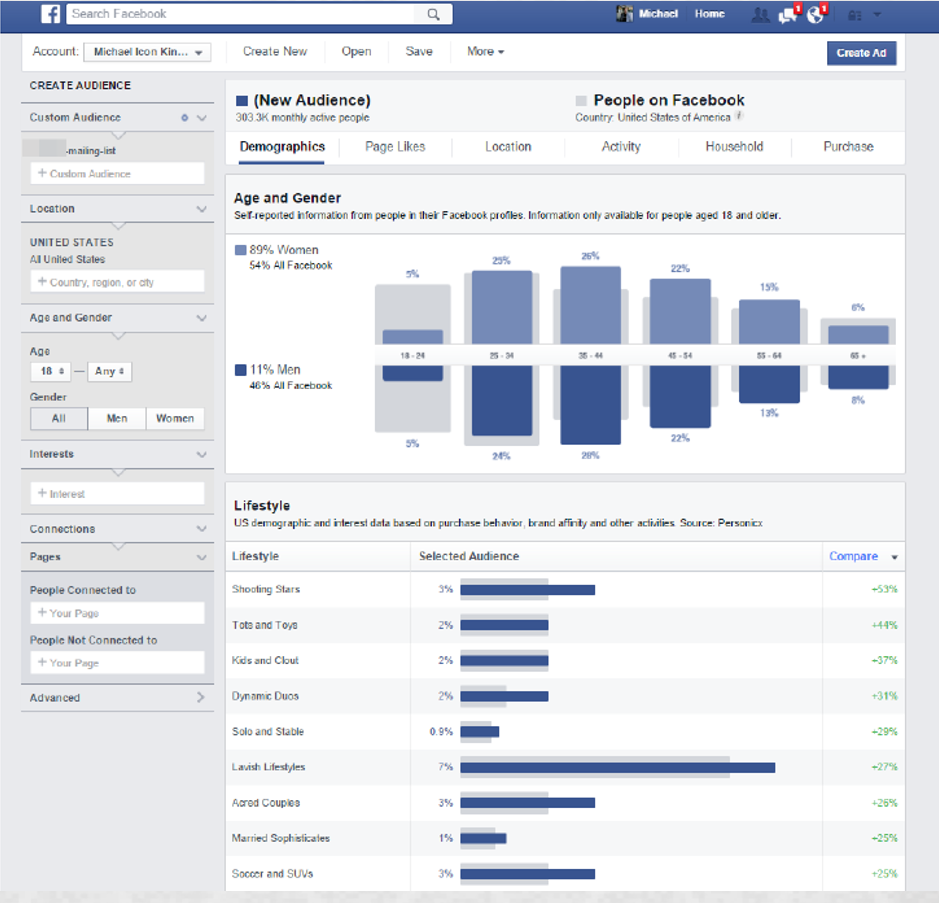
Once you know more about your customers, try to think of the words to search from their perspective. Use tools like Keyword Tool Dominator to build a keyword list.
Second, map the keywords to the buying circle.
When developing keywords, consider the buyer’s journey. Take the example of running shoes, when someone just starts the journey, i.e., when he/she is in the awareness phase, queries might be broad, such as “running shoes for women.”
As the person moves through the journey, he/she may become aware of some brands and different options. Therefore, the queries become more specific, like “Asics vs. New Balance running shoes” or “long distance women’s running shoes.”
Finally, the customer would enter the purchase phrase when he/she is at the end of the journey and knows exactly what to buy. The query would then be as specific as something like “Asics women’s GT-1000 4 running shoes midnight.”
To attract and convert customers from all stages, Janet suggests that marketers have a combination of keywords from all stages of the buying cycle.
And…do not miss the opportunity to map your keywords to content!
Besides the discussion above, marketers should also align keywords planning to content strategy. When you write a blog post about something, for instance, about shoes that are suitable for hiking, be sure to include the relevant keyword because the readers may search it.
Subscribe to:
Posts (Atom)