Monday, April 17, 2017
Snap vs. IG Stories
There has been a huge amount of coverage lately on the negative impact that the launch of Instagram Stories has had on Snapchat. Some sources claim that Snapchat's growth has slowed over 80% since the launch of this new product. This shouldn't be surprising given how prevalent Instagram already is in so many of our lives. Opening one less app is just the easier, almost obvious thing to do. But this raises a larger question about the viability of any new competitors in a world dominated by Facebook, Amazon, and Google. It's hard, after all, to imagine a service with a bigger social network than Facebook, or a site that is easier to shop than Amazon, or a better email service/search engine than Google -- not to mention the funds to either acquire or copy any legitimate competitor. The verdict is still out, but it seems likely that many potentially online startups in the coming years will go the way of jet.com and be bought out by the "big dogs".


Sunday, April 16, 2017
Smartphone and Vending machine
Smartphone and Vending machine
Kirin
Beverage, the largest beverage company in Japan, and LINE, a SNS company, launched
a new service called "Tappiness" in Jpanan on April 13. "Tappiness" is a coined word
meaning “tap the smartphone on a vending machine” and “happiness”.
We
can get a point by tapping our smartphone on a vending machine and buying a
beverage. 15 points can be exchanged for a free drink online ticket. This
ticket can be granted to someone using “present” function in LINE. We can also
use this ticket as currency in “LINE pay”, a settlement service of LINE. It is
expected that the service will be added to 20,000 vending machines in one year.
This
service is derived from "LINE Beacon", a function that we can receive
data from beacon (Bluetooth® transmitter for short range communication)
installed at a store and receive product coupon/ information. "Tappiness"
utilizes this function and link customer and vending machine.
For
Kirin Beverage, LINE has made it possible to reach a wide range of people and to
reduce the cost of application development. For LINE, this will promote IoT (Internet
of Things). Moreover,
both companies can obtain huge amount of customer data. Every machine in our life could be a device to collect commercial data.
Programmatic Platform Is Solving Brand Safety In Automated Advertising
Link:
Google's Ad Rivals Leap at Chance to Seize Dollars After YouTube Controversy
In late March, brand safety became a major issue when dozens of big-name marketers, including AT&T and Johnson & Johnson, started freezing YouTube budgets because their ads on the video platform were sometimes running next to user-generated clips that promoted ISIS, racism or other extreme subjects. While brand safety concerns on YouTube in recent weeks have given automated ad buying a black eye, MediaMath announced a measure to make its clients feel better protected.
"MediaMath views its new service as responding to a market shift. The YouTube crisis wasn't just a backlash against Google, it was a protest against the pitfalls of automated advertising in general -- the systems and services that let marketers accurately target consumers but also sprinkle ads everywhere across the web. MediaMath said its new service will limit that sprinkling, sending ads to websites and online videos that it constantly monitors for quality."
Saturday, April 15, 2017
Hire Staq, they will manage your digital ad revenue sources for you
Do you have too many digital ads and don't know which one actually creates revenue for you? Do you receive 4 billion cells worth of data daily and don't have the time to look into them? There is a firm that does this sorting for you. Staq (http://www.staq.com) will aggregate data from the tech companies your company partners for digital advertisement. You might ask why is it so complicated to add the data into one. It's because many of your partners use different servers, networks, DSPs, SSPs, DMPs, CRM, analytics tools and other types of platforms. In addition, Staq can tell you which ad creates revenue for you and how much. Staq can even report data from social networks such as Facebook.
Before using this service, make sure you ask yourself, do we really need this service? If your company has various brands, many different websites, work with numerous marketers and ads, then this can be a good way to hone your company's target ad programs. In this case also, you might want to rethink how much data is optimal for your use before hiring Staq.
Friday, April 14, 2017
5 Things That Have Always Worked For Digital Marketers, Until Now
This is the 10th and the last blog of the course,
thought I’d end it on an interesting article I read on Entrepreneur. The author
listed 5 things that have always worked for digital marketers, but no longer work.
5. Twitter – the author claims Twitter might be more the
problem than the medium itself. Boring tweets, low engagement with followers
and over-selling (or only selling) products can all lead to poor Twitter
returns.
I have always questioned the value Twitter adds, so I have
to agree with the author on this.
4. SEO Technical Tricks – The author claims that SEO tricks
such as adding keywords, links and content with no images, no longer work after
Google updated their algorithm as part of Panda and Penguin updates.
Given that we spent 2 class sessions on SEO, and I took lot
of notes on this topic during the class J,
I am not willing to accept this without further research and testing to
validate if this is true. Also curious to know what the professor thinks about
this?
3. Coupon Sites – the author claims that coupon sites no longer
work; he used Groupon as an example and claims that Groupon sales do not
incentivize new customers and can lead to profitability issues for the business
in the long run.
I think the author is correct about Groupon, at least when
it comes to small and medium businesses. I recently interviewed over 50 retailers
and consumers as part of customer discovery for a project and almost all small
business owners said they do not like to promote on Groupon because the more
Groupons they sell the more money they lose. Consumers don’t like to use Groupon because of
the restrictions and the bad experience they had when trying to use the
coupons.
Having said that, I don’t agree that all coupons don’t work
anymore and I think this issue is Groupon specific.
2. Fake Instagram followers – the author claims that digital
marketing companies were taken for a ride by a personality who they believe has
a niche following that they can capitalize on, but in fact were fake accounts. A
couple of years ago, Instagram cleaned house and did a mass purge of all their
fake accounts.
Ok, I have to admit – I did not know that there were massive
numbers of fake accounts on Instagram; but it doesn’t sound impossible. It is
certainly possible, so I am going to just accept the author’s view on this. Also,
such a cleanup would only benefit digital marketers.
1. Batch and blast email campaigns – the author claims that
blast email campaigns and boilerplate templates no longer work, especially with
millennials.
We spent a class session on email in which we learnt that
email is still the preferred method of digital marketing and that is where
small and medium businesses are spending the most. I also think we talked about
using boilerplate templates. I am not a millennial (as much as I wish I were),
but based on my own experience, I think email marketing still works. I delete a
lot of marketing emails, but I do look at emails from certain brands and
companies.
Also, I think the author is missing the point on email
templates – the templates do not have to be static, they can be dynamic and be
customized for the target user.
We are at the end of the course and while I cannot claim
that I have become a digital marketer, but based on the knowledge I gained in the
course, I can say with confidence that I know a lot more now than I did before.
Harnessing The Power Of Influencer Marketing
As we work on our group project, we have to always be conscious
of the budget available to us. We are working on coming up with digital
marketing strategy for a fairly new start up with very little budget, which
means we have to be very judicious about where an how we spend the money and always
look for ways to get the most out of each dollar we spend. A good marketing
strategy that is relatively inexpensive is to leverage influencer's. After
jogging my memory to recollect the lessons professor Kagan taught us on
influencer marketing, I started doing more research on it.
Why does influencer marketing work? It works because we
humans love a good secret; it is wired in our DNA. Which is why “Hey, have you
heard about this?” gets our attention and we eagerly bend forward and listen,
hoping to learn something juicy. We trust our friends in a way we don’t trust
companies. Less than 30% of audience is influenced by traditional advertising, but
when a buddy talks, 90%of us take their words at face value.
Social media influencers tend to have loyal and impressively
large followers and connections. When they speak, those followers hear their
words like you and I would hear the words of a trusted colleague. What happens
when influencers bring brands into their active dialogues? Suddenly, the brand
has tangibility and recognition, and that translates into economic
possibilities you can take to the bank.
Rapid growth of social media has removed the middleman and
media is no longer controlled by few companies. Every day, content is being
commoditized by individuals who are content creators themselves. The appeal of
influencer marketing is the built-in audience and the short time it takes to
get the word out
Anybody looking for better ROI? The cost of a 30-second
television ad is around $400,000. By comparison, influencer marketing campaigns
cost a fraction of the cost for a TV ad.
While influencers may be working for your brand their
audiences see them as authentic, fresh, real and passionate. Create a genuine
relationship with an influencer, and anything the influencer says or does on
behalf of your brand will come off as genuine
Cheap, passionate, genuine message, quick turnaround, direct
access to built-in audience – need I say more about the power of influencer marketing!
How to gain links naturally?
Using content to attract link
1. Identify link building targets, see what content will most resonate with the publisher of the target sites, and then tweet the content plan accordingly.
2. Keyword research also helps identify content related to your target market, and it can play a role in identifying topics that may help attract links.
3. Use content that helps to establish your site as a leading expert on its topic matter, when you produce really high-quality stuff, it builds trust with the user community and increases your chances of getting links.
4. Minimizing the commercial nature of the content pages, do not put ads in the content.
5. Do not disguise the relationship between the content and the commercial part of your site. If you are a commercial site and you hide it altogether, you run the risk of being viewed as deceitful.
Marketing content for link acquisition
1. Content syndication: publishers may choose to create content for placement on another site, for the purpose of providing content to another site in return for a link to its site.
2. Social media: use the network effect to help your content spread virally or to develop relationships with critical influencers.
3. Spreading content via blogs: starting a blog for the purpose of obtaining links is a process that can take a long time, and the best place to get links is from other blogs. This is best done by targeting relationships with major bloggers and earning their trust and respect. And there are a few key things to remember when building the relationship.
l Be patient
l The publisher should target a portion of its content at the interests of the major bloggers
l Other lesser-known bloggers will begin to see links on the major blogs and begin to follow suit
Short Email
Short
Email
We receive tons of emails for marketing/promotion every day. Some of them are too long to read especially for people who are not necessarily highly interested in that theme. On the other hand, in our work situation, we are often told “Be concise”/ “Clarify the point”. I found that Focus Pointe Global literally practices this in their email marketing.
Focus Pointe Global is a company that
provides valuable information to companies that need to conduct marketing
research. The screenshot below is a real sample of their email, which encourages
participation in their online survey. The essential information is summarized
in the first four lines using a few words. This type of research company sends
a large volume of email, but Focus Pointe Global considers the recipient. Basically,
all necessary information to judge whether to participate in the survey can be
read in 5 seconds.
As everyone becomes busier and busier,
shortness also becomes more and more important.

Wednesday, April 12, 2017
The Limits of Single Channel Programmatic Advertising
https://www.emarketer.com/Article/Study-Marketers-Renew-Interest-Cross-Channel-Attribution/1015595
I've always wondered what the limits were for the advertising swing to single channel programmatic ad buying. Although no one seemed to give it much thought, there had to be a point where the emphasis would swing back the other way to a point that utilized several channels. It makes sense that this would occur as companies are able to gather more and more data and ultimately implement tactics such as dynamic offers and UGC.
With everything moving online, offline advertising has gotten little attention but that also seems to be coming back around. There are certain human habits that aren't prone to change as quickly as the digital revolution, which is why we are seeing this shift. For instance, many people still like to go into stores and be able to touch what they will ultimately purchase. That is unlikely to change in the near future despite the ease of purchasing online. The emphasis on cross channel marketing makes sense as it addresses both our human tendencies and the fast pace of innovation.
Influencer Marketing: An Opportunity Slipping Through Our Fingers
Article Link:
Influencer Marketing: An Opportunity Slipping Through Our Fingers
Influencer marketing is on the rise in the recent years, and it seems to be the next trend to disrupt social marketing. However, while we see more and more money are spent on influencer marketing, consumers are becoming more critical about that and it’s become such a mess that the Federal Trade Commission is now involved.
The author's opinion is that we shouldn’t discount influencer marketing yet just because it’s not working in its current state. He believes that it actually has the potential to fundamentally change the way brands communicate with consumers.
The essence of influencer marketing is being authentic and trustworthy. People trust word-of-mouth, and they follow influencers because they want to get authentic information, they want to hear from people they trust and relate to more than an overpaid influencer. As marketers, we should not waste the advantages that influencer marketing offers and just spend money hiring influencers based on the number of followers to post meaningless ads without real engagement or feelings. To fully leverage the power of influencer marketing, it's better to find influencers who have a moderate following, get them to share information they feel passionate about and promote that content to people who have overlapping interests with the influencer. It's more about finding the niche representatives to talk to your target audience. This will allow brands to engage with people on an authentic level.
Tuesday, April 11, 2017
Do social paid ads work?
The effectiveness of social paid ads remains a mystery.
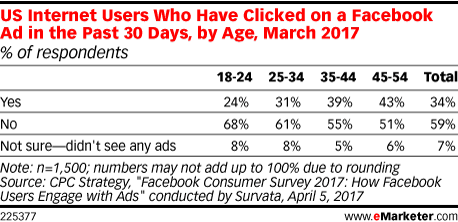
A recent research by eMarketer revealed that customers weren’t interested in buying staff while they were on a social platform, and millennials were least likely to click on an ad on social media.


However, while many users were not clicking on an ad on social media, there were still 34% of the respondents saying they did. In some cases, users are not sure what they are clicking on is an ad or a normal post.
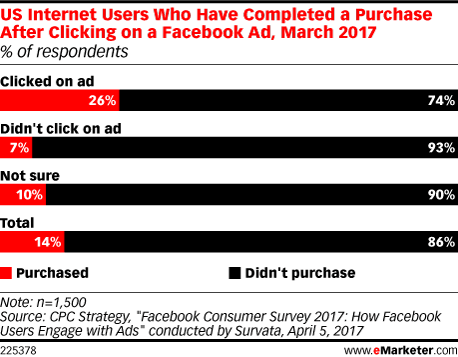
Moreover, according to the research, those who did click on an ad were about 3.5 more times likely to buy a product than those who didn't. Personally, this shows how hyper-targeting the social paid ads are.
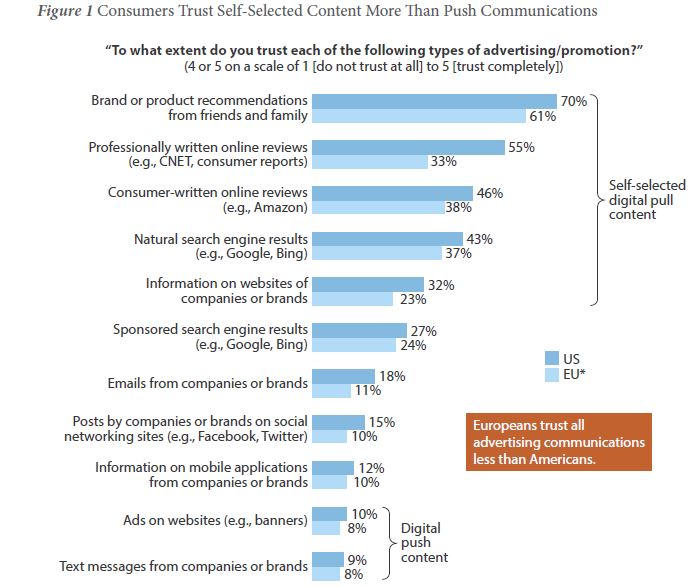
In conclusion, people dislike ads on social media, especially millennials. However, this doesn’t mean brands should pause their social ads completely – it means they need to adjust their strategy to make the efforts on social media more effective. For example, make the ads so native that customers don't know what they are looking at are ads. In addition, combine social advertising with influencer marketing--let the trusted influencers have real conversations about brands and products.
Monday, April 10, 2017
Disrupting Traditional Cable Packages
https://www.nytimes.com/aponline/2017/04/05/technology/ap-us-tec-google-youtube-tv-debuts.html
Fed up with an ever-ballooning TWC bill, I "cut the cord" a few months ago. I think I would have been a little more reluctant to do so if I didn't have hope that the new a la carte programming options weren't making serious headway. The article above discusses the current rollout of YouTube TV and highlights a few of the shortcomings. In my opinion the only shortcoming that could derail this shift would be if they aren't able to sign up enough networks to the platform. The other kinks will work themselves out as they get feedback from the market. I have yet to sign up for Youtube TV but probably will in the next few months. If I do so, my total internet (still with TWC) and cable expense will be 50% of what it was before. Unless TWC, Verizon et al. can offer programming in the same price range, I believe people will continue to cancel their subscriptions.
In terms of marketing, this then suggests that Google will acquire new types of data from new and existing customers (different from the data derived from search) and can then use this for targeted marketing both on the Youtube platform and beyond. Over the course of the semester my posts have been a rollercoaster of predicting Google's ultimate demise or singing their praises for continued domination but this post is going to be more the latter. If YouTube is going to allow me to share an account with five people, effectively cutting the already small price by 5x, I can only say one thing, "Google, take my money".
Saturday, April 08, 2017
Optimizing for Image Search
Optimizing for image search can be a very smart strategy since a significant amount of traffic can come from image search, and the number of people competing for that traffic is much lower than the general web search.
There are several different ways that image search optimization can help to improve traffic and conversion for your site.
1: subtle reputation management
Providing a generous number of images of your products, services, and facility assisting consumers during the search gives your company the transparency, saying that you have nothing to hide from the public, which increases the consumer confidence as well as the chance that you will be selected to do business with.
2: shopping via image search result
Consumers are growing searching for products via image search engine, which allows them to find what they desire without digging deep. If your products have a presence in the image search engine, you have an improved chance of being found by people. Otherwise, the chance is zero.
3: increase your chances of showing up more frequently in the universal search
Optimizing image search improves your chance of showing up in the universal search result, an additional position for customers to find you.
4: empower others to promote your business
If you hold the legal copyright to your images, you can allow others to take and reuse the images in return for promoting your business.
Image optimization tips:
Unlike regular web pages, which are often filled with text content, image search is much more difficult for it provides few clues about the content in the image. Though techniques, such as optical character recognition (OCR) to read text content within the images or facial recognition software to determine whether the image is a face, body, or something else, they are still not that effective. For that reason, success in image search optimization depends on using all the signals available to you to increase the search engine’s confidence in the content of an image.
You can do a number of things to further optimize your website. Here are some of the most important ways.
1: give emphasis to the texts immediately preceding or following the image. These texts are what the users and the search engine mostly associate with the picture.
2: make sure the image filename, img, and arc contain your keywords.
3: utilize the alt attribute.
For instance: <img=”Abe Lincoln” src=http://example.com/abe-Lincoln.jpg/>

4: avoid query strings for img src just as we do for web page URL. Removing excessive parameters can reduce the possibility that spider may refuse to crawl your site.
5: use good quality images/good contrast images which are easy to read and more likely to invite a click.
6: do not save images as graphic files with embedded thumbnails, turn this feature off in picture editing software. The search engine may copy your image, reduce them in size, and save them in a compressed format, and deliver a thumbnail of it in the results.
7: do not store the image in the banner, footer, and navigator, the search engine will ignore them as irrelevant elements.
8: have a proper copyright license of the pictures used on your site. Don’t get sued
9: if you are using images that also are shown in other websites, change the file size, aspect ratio of the image or add watermark to tell the search engine that your images are original so that the images won’t be thrown out if the SERPs hit a duplicate filter.
10: make sure your robot.txt files allow the crawlers to access your image files and display them in the search results pages.
11: encourage people to use your images and give credit, which will invite more promotional activities.
Friday, April 07, 2017
Google's cost of offensive ad placement? $1 billion
In recent years, as advertisers are increasingly investing
in online ads, Google and Facebook have stumbled upon a big problem: How do
they ensure that these ads don’t appear next to offensive content?
For advertisers, this can be a big PR issue and for Google,
the cost of poor placements on YouTube is significant; it’s estimated that this issue will
cost Google $1 billion in sales this year. Advertisers are looking for
solutions and are putting more and more pressure on Google. While options for
filtering inappropriate content exist, Google has not yet enabled third parties to do
so. That said, if ad placement continues to be a sticking point for
advertisers, as is likely, it is hard to imagine that Google will be willing to
continue to take a top-line hit.
Thursday, April 06, 2017
YouTube Partner Program Change
It appears that Google has changed policy for YouTube, in light of advertisers ads appearing alongside extremist content on YouTube's ad network.
Previously, YouTube's Partner Program allowed any user to upload content and monetize their videos. As of today (4/6/2017), Google announced a change to this policy. Channels that have had fewer than 10,000 total views can no longer run ads on their videos. Per YouTube itself, they are using this threshold because it allows them enough information to determine the validity of the channel.
When a channel reaches 10,000 lifetime views, they will review the channel against their policies. Such policies include:
Then, if the channel is agreeable to the policies, YouTube will bring the channel into the YouTube Partner Program and start serving ads. Per YouTube, this policy was created to ensure that ad revenue only flows to "creators who play by the rules."
Surely, this is in response to the long list of companies who complained about their ads being displayed with videos of hateful or extremist content.

Previously, YouTube's Partner Program allowed any user to upload content and monetize their videos. As of today (4/6/2017), Google announced a change to this policy. Channels that have had fewer than 10,000 total views can no longer run ads on their videos. Per YouTube itself, they are using this threshold because it allows them enough information to determine the validity of the channel.
When a channel reaches 10,000 lifetime views, they will review the channel against their policies. Such policies include:
- Respect the YouTube Community
- No nudity or sexual content
- No violent or graphic content
- No hateful content
- No harmful or dangerous content
- No violation of copyrighted material
- No threats
- No spam or scams
Then, if the channel is agreeable to the policies, YouTube will bring the channel into the YouTube Partner Program and start serving ads. Per YouTube, this policy was created to ensure that ad revenue only flows to "creators who play by the rules."
Surely, this is in response to the long list of companies who complained about their ads being displayed with videos of hateful or extremist content.

Using Emotion to Create Facebook Ad
Emotions can go a long
way to create a click-worthy ad online. Emotions have always been used to sell
goods and service. We see it all the time in the ads shown in the TV or printed
in the newspaper/magazines. Emotion help businesses generate sales volume.
Given there's so much to see and click in the Internet, the question is how
should we compose an ad in the Facebook to make that ad effective so that
online viewers click that ad. The idea is to use the same playbook used by the
general ad creators, some of whose secrets are listed below:
(1) `Spark the Sense of
Belonging
People are hardwired to
search for understanding and support from their peers. A sense of belonging to
a large community improves our motivation, health and happiness. If we could
frame our ad offer as an invitation to an exclusive club of awesome members,
people will be interested in joining the community and respond to the ad.
(2) Use Power of Guilt
People feel guilty about
different things, and if we hit their right nerve, we will win their attention.
Ads highlighting the good and the bad components of dog food (Blue Brand)
(BlueBuffalo.com) is one such ad - whereby, the users of non-Blue dog food is
made to feel guilty by showing that the dog food they are feeding has bad stuff
in it. Consumers who feel guilty tend to respond well. Gym memberships soar
after a long holiday period around Jan-Feb every year. Your ad should use
strong words that spark negative feelings, and then must provide a quick fix to
overcome that guilt.
(3) Make People Feel
Important
Feeling of being
significant is a basic human need. Many wars have been fought and is continued
to being fought to this day over this feeling. We all want to feel important
and valued by others. To create an ad that makes the viewers feel important,
its important to create a personalized ad that talks directly to the reader
using words such as “you” to address the reader. By creating a highly personalized
value offer, Spotify will ignite curiosity while also making the person feel
important in its ad “You know there’s a
playlist with your name on it, right?”
(4) Surprise Your
Viewers/Readers
Consumers such as I use
a lot of emotion to evaluate a brand / product / service. Surprise is a good
emotion to catch audience’s attention which can then lead to them exploring your
proposal. Usually, it’s a good idea to use good surprises to make people feel
special and important. This could take a form of “coupon” or some other pleasant
surprise to make the reader click on your ad and go to the next level. Some
companies give out Starbucks coupon to fill a survey used to assess target
audience’s need via survey.
(5) Create a Sense of
Urgency
If I get too much time
to decide, then I tend to postpone the conclusion and sometimes I also forget
the ad. I have seen ads with limited time offer and have often responded on
them due to fear of losing an awesome offer. I am sure I am not the only person
who feels this way. For such ads, it’s important to define clear dates and offer
a great discount.
(6) Help People Feel
Proud
Emotions have a strong
effect on our immediate actions. LEGO’s Facebook ad makes mothers feel proud of
their kids reminding of their children’s capacity to create amazing things. The
ad uses emotion of hope to draw parents to the offer. Many ads (e.g. Dollar
Shave Club) use the words “smarter choice” to make the people feel great about
their purchase as if they have contributed to a greater cause.
(7) Generate Negative Feelings
By generating a negative
feeling and then offering a solution to cheer us up is a good way to market our
stuff. Small doses of mild negativity can help strengthen customer’s positive
impression of a product or service. The negativity should be followed by some
pleasant surprise may actually help company retain customers.
(8) Make People Happy
Emotional articles,
especially those that generate strong emotions of happiness and surprise (positive
ads), are more often shared than others. Brightly colored ad that includes
images with smiling people / pets etc. are used to generate emotions that make
us click the ad, share with others, or bookmark in our browser.
(9) Make People Curious
Curiosity is the
discrepancy between what we currently know and what we would like to know. For
example, in Hubspot, “How well do you rank for SEO”? The technique involves
asking people a fascinating question or telling them a cool story and then
leaving the best part untold. Another example: SurveryMonkey does it by asking
its readers “Want a GoPro?”
(10) Show the Excitement
Excitement makes people
become more impulsive and make people act quicker. People think and behave very
differently when excited. Selling to such people becomes easier, and most
likely these people tend to purchase if given an option.
(11) Offer Hope for
Better Future
We see such ads – that uses
hope to suggest they are making smarter choice to improve their lives. Such ads
usually help people to take an action on the ad. People notice ads with bright colors,
lots of exclamation marks and energetic tone of voice.
(12) Master the Art of
FOMO (Fear of Missing Out)
Many people experience FOMO
when they aren’t able to attend an event when their friends are going. People
are afraid of being left out without and amazing experience. Sometimes we see
ad saying “X number of businesses are using our tool to …” indicating that the
reader that there’s a fascinating community they are not part of. Such ads make
us feel that we are missing out on something.
Wednesday, April 05, 2017
Pepsi's Ad that United the Internet - but not positive for the brand
This article from WIRED highlights the new Pepsi ad featuring Kendal Jenner and the idea that Pepsi unites us all behind a cause. The ad received 1.6MM views in 48 hours with 5x more down-votes than up-votes on YouTube.
This ad shows two things - Pepsi completely missed the mark on what they were trying to get across in the ad. While it has had a ton of views, the power of the internet and fast spreading information has caused, almost unanimously, all viewers to dislike Pepsi.
As a result, Pepsi has seen a lot more negative impact from this ad and has since pulled the ad. However, the internet has taken this mistake one step further that Pepsi can't just 'pull'. Memes have been made of a Pepsi being inserted into rough protests and continues to highlight to poor taste of the original ad.
In the future - Pepsi should consider testing the ads and making sure the feedback from the internet doesn't have this exponentially poor reflection on the brand.
“Pepsi was trying to project a global message of unity, peace and understanding. Clearly, we missed the mark and apologize,” Pepsi said in a statement. “We did not intend to make light of any serious issue.”
https://www.wired.com/2017/04/pepsi-ad-internet-response/
Subscribe to:
Posts (Atom)