Friday, September 22, 2023

Crunching the Cookie: Navigating Pixels and Privacy in Digital Marketing

 Prompt: Can you write a blog post answering the following questions?

How do cookies help with digital marketing? How are they similar and different to pixels? How can advertisers leverage their affordances to amplify a brand's identity and performance? Lastly, how have tracking mechanisms evolved due to privacy regulations across the world with consideration for GDPR, CCPA, and stipulations on cookie/pixel lifespans?


Crunching the Cookie: Navigating Pixels and Privacy in Digital Marketing

The realm of digital marketing has seen the proliferation of tools designed to understand, engage, and re-engage audiences. At the forefront of this revolution are cookies and pixels. However, as their use has expanded, so have concerns about user privacy, prompting a rethink in their application.

The Role of Cookies in Digital Marketing
Cookies are tiny text files saved on a user's device when they visit a website. They serve several key roles in digital marketing:
  1. 1. Personalized Experiences: By remembering user preferences, cookies allow brands to tailor website experiences, presenting users with relevant content or products.
  1. 2. Analyzing User Journeys: Cookies provide insights into user behavior, tracking their paths and activities on a site.
  1. 3. Retargeting: With cookies, advertisers can remind users of products they've viewed but haven't purchased, displaying ads on different platforms they visit afterward.
Cookies and Pixels: A Comparison

While both cookies and pixels are data collection tools, they have distinct functionalities:

1. Storage vs. Tracking: Cookies store user data on their devices, such as login details or cart items. Pixels, on the other hand, are small 1x1 images embedded in websites or emails that send data back to a server when viewed.

2. Data Range: Cookies can hold a broad range of data over an extended period. Pixels are event-driven, capturing specific interactions, like opening an email or landing on a webpage.

3. Lifespan: While cookies have a set expiration, pixels operate based on user interactions and don't have a typical "shelf life."

However, their mutual objective is to offer insights into user behavior, crucial for refining marketing strategies.

Maximizing Brand Impact with Cookies and Pixels
By leveraging the data from these tools, advertisers can:
  1. 1. Drive Personalized Campaigns: Using behavioral insights to design resonant marketing messages.
  1. 2. Enhance ROI: Accurately track conversions to understand campaign efficacy.
  1. 3. Boost Engagement: Utilize retargeting strategies to keep audiences engaged, increasing the likelihood of conversions.Privacy Paradigms and Their Influence
With the omnipresence of tracking mechanisms came the global call for stronger user privacy:

GDPR (Europe): A monumental piece of legislation, GDPR demands clear consent from users for data collection and offers them rights to their data, impacting cookie usage and permissions.

CCPA (California, USA): Much like GDPR, CCPA grants consumers rights regarding their personal data, influencing how businesses handle data collection.

Cookie/Pixel Lifespan Stipulations: Both GDPR and CCPA have brought to light the importance of defining how long cookies and pixels can hold or relay information, prompting businesses to be more transparent about their data practices.

Homework #1: Finding Reliable Metrics in the Dynamic World of Digital Marketing

 Article (see below for prompt and thoughts):

Introduction

In the ever-evolving landscape of digital marketing, the search for meaningful metrics can be as challenging as solving a complex puzzle. As businesses navigate the fast-paced and unpredictable realm of online marketing, they must decide how to acquire and then interpret the “right” data for their goals.


Challenge 1. The Illusion of Vanity Metrics

It can be tempting to focus on some of the most visible metrics, such as page likes or follower counts – but what can they actually do for your business? Though they may offer a superficial boost to our egos or reports to leadership, they provide little substance. Millions of likes don’t matter if they fail to convert into actual customers.


Challenge 2: Navigating Multichannel Complexity

Digital marketing has birthed a multichannel ecosystem where businesses often have to keep organic and/or paid presences on multiple platforms. From social media to email campaigns, keeping track of metrics across numerous channels can feel like herding cats. Each platform has its own distinct reporting systems and unique terminology, resulting in an overwhelming and time-consuming summarizing process where important trends or takeaways can be lost among the details.


Challenge 3: Decoding the Attribution Puzzle

Imagine this scenario: a customer sees an advertisement on YouTube, later gets a banner ad on their laptop, and ultimately makes a purchase in-store. So… How can you accurately attribute that sale to the appropriate channel? Would they still have come in the store without seeing the banner ad? Would they have registered the banner ad as interesting without the context of the YouTube video? Where should the business focus their budget to recreate that success?


Challenge 4: The Overwhelming Data Deluge

With so many analytics tools, dashboards, and reports available, businesses risk becoming inundated with a sea of data. Instead of gaining clarity, the surplus of data often leads to analysis paralysis, rendering the data’s role in decision-making almost arbitrary.


Some potential solutions:

1. Defining Success Clearly: It is crucial to establish clear business objectives and select metrics that align with these goals. Avoid becoming fixated on vanity metrics and instead focus on metrics that drive tangible value, such as conversions and customer lifetime value.

2. Consolidation and Streamlining: Simplify tracking efforts by utilizing marketing automation and analytics platforms that consolidate all data into a single location. Create comprehensive reporting dashboards that offer a unified view across multiple channels.

3. Embracing Data Literacy: Invest in educating your team on data analysis, enabling them to comprehend metrics and effectively interpret them rather than going by their gut. This will empower your team to make informed decisions based on reliable data.

4. Testing and Refinement: Experiment with various metrics and measurement techniques to determine what works best for your business. Remember, there is no one-size-fits-all solution in the realm of digital marketing. Not every strategy is going to succeed for every business, but that’s part of the process.


By embracing a data-driven mindset, adopting the right tools, and maintaining a flexible approach, marketers can successfully navigate the ever-changing world of digital. So, equip yourselves with your analytical mindset, arm yourselves with knowledge, and prepare to conquer the unpredictable world of digital metrics...


What data-related challenges have you encountered in your work, and how are you addressing them? Comment below!

------------------

Prompt on GoCharlie:

Write an article of 300-400 words about the challenges of nailing down reliable and meaningful metrics in the fast-moving world of digital marketing. Make sure to include examples of these challenges. There should be recommendations, but it shouldn't be too prescriptive. The tone should be helpful, clear, and a little snarky.

I then added, because I wasn’t quite happy with my starting point, the following:

Rewrite this to be a little less folksy and casual. The intended audience is midlevel marketing professionals.

------------------

Notes about using GenAI:

Part of my experience was frustration with the GoCharlie UI – after using ChatGPT and being able to navigate forward and backwards in my “conversation” with the platform, it was frustrating to deal with GoCharlie’s erasure of previous work and versions. I’m surprised at how, in my limited use of AI for short-form content generation, I’ve already come to expect and rely on that “conversational” format of ChatGPT and Bard.

This was infinitely easier than crafting my own article from scratch, and takes far less time, creativity, and energy. For something like this, where we’re not exactly reinventing the content wheel and it’s more about producing something useful and engaging, it makes total sense to me that we would use AI. The metaphorical activation energy required to craft a first draft is the hardest part of any content creation for me, while I find editing far easier and more seamless. It’s almost as if I asked a direct report or intern to bang out a quick draft for me, g and now I can use what I know and like to build off of it. I’m torn, of course, because there is still something that feels kind of empty about this kind of content – putting aside the vast ethical considerations to just speak of the experience – but it reads like you put 20 content bloggers in a room and blended all of their drafts into something bland and usable. If you’re just pumping out content marketing for a blog, this makes total sense.

For something more personal or meaningful, I would feel weird about it – though that might be a bias because I know it’s generated. If someone handed this to me and said an intern wrote it, I might not think twice.

I do use AI and ChatGPT sometimes in my day job to help me generate social copy, and it can cut down on time when I start from there – but just like here, I’m certainly not happy with the result pre-edit and depending on my ability to prompt correctly, I could waste a lot of time tweaking the prompt to get something usable.

And even when the starting draft is solid, as it was here with only a few iterations, there’s still that alien tinge to the word choice and structure. In this particular case, ideas were too frequently repeated and word choice was weirdly flowery. I definitely had to edit this as closely as any other draft.


[Manav Gupta]: Homework # 1 Using Generative AI to Create Compelling Content

Prompt to chatgpt:  Please write a 300–400-word blog post on the topic of conversational marketing. Focus on explaining briefly what conversational marketing means. Then focus on pros and cons. Then focus on giving some guidelines on situations when to use conversational marketing and when to not. Finally, a brief summary to wrap it up.

Blog:

Conversational Marketing:

Conversational marketing is revolutionizing the way businesses interact with their customers in the digital age. It's all about real-time, one-on-one connections facilitated by tools like chatbots, live chat, and messaging apps. In this blog post, we'll explore the pros and cons of conversational marketing and offer guidelines on when to use it effectively.

Pros:

1. Engagement Boost: Conversational marketing excels at capturing and maintaining the attention of website visitors. Instant messaging allows businesses to engage with potential customers right when they express interest.

2. Lead Qualification: Chatbots can collect valuable customer information and qualify leads in real-time. This streamlines the sales process and helps businesses identify high-potential prospects.

3.Higher Conversions: Quick responses to customer inquiries lead to higher conversion rates. When customers have their questions answered promptly, they're more likely to take the desired action, such as making a purchase or requesting more information.

Cons:

1. Lack of Human Touch: While chatbots can be highly efficient, they may lack the human touch and empathy that some customers prefer, especially for complex issues or emotional support.

2. Initial Setup: Implementing conversational marketing tools requires an initial investment of time and resources for setup, integration, and training.

3. Data Privacy Concerns: Collecting and using customer data for personalization can raise privacy concerns. It's essential to handle data responsibly and transparently.

When to Use Conversational Marketing?

1. High-Traffic Websites: Conversational marketing is ideal for websites with significant traffic, as it allows businesses to engage with many visitors efficiently.

2. Lead Generation: Use conversational marketing to qualify and nurture leads. Chatbots can gather information and guide prospects through the sales funnel.

3. E-commerce: For online stores, conversational marketing can assist with product recommendations, answer customer questions, and reduce cart abandonment rates.

When Not to Use Conversational Marketing:

1. Low-Traffic Websites: If your website receives minimal traffic, dedicating resources to conversational marketing may not be cost-effective.

2. High-Touch Services: Businesses offering highly personalized or complex services may find that human-to-human interactions are more appropriate and effective.

Summary:

Conversational marketing is a powerful tool for businesses looking to engage customers, qualify leads, and boost conversions. However, it's essential to consider the specific needs of your business and your customers. When used strategically and responsibly, conversational marketing can be a valuable addition to your digital marketing toolkit, enhancing the customer experience and driving growth.

Lastly, visit Six successful conversational marketing examples | IBM Watson Advertising | IBM for some great examples of conversational marketing.

[Benjamin Tsujiura] ChaptGPT Generated Digital Marketing Blog


The Prompt:

“Please write a blog post between 300-400 words that provides a step by step roadmap for a small clothing retailer on how to gain more followers on instagram. Please provide a short introductory paragraph followed by a list of steps. The tone of voice should be that of a millenial female blogger who is in the know when it comes to pop culture references.”


The Post:

Title: Level Up Your Insta Game: A Small Brand’s Guide to Gaining More Followers

Hey there, fashionistas! Instagram isn't just a platform for sharing your latest #OOTD, it's a powerful tool for growing your brand. If you're ready to slay the social media game, here's a step-by-step roadmap that will consistently grow your following.

1. **Optimize Your Profile:** Your Instagram bio is your virtual storefront. Make it pop with a clear and catchy username, a clear profile picture, and a bio that tells people what your brand is all about. Use emojis for extra flair!

2. **Content is Queen:** Create stunning, high-quality content that showcases your brand. Consistency is key, so post regularly, but don't sacrifice quality for quantity.

3. **Hashtag Magic:** Research trending and relevant hashtags in your niche. Incorporate them into your posts to increase discoverability. Pro tip: use a mix of popular and niche-specific hashtags for maximum impact.

4. **Engage, Engage, Engage:**Engage with your followers, respond to comments, like and comment on other users' posts who are in your target audience. Building genuine connections is how you keep the Insta love flowing.

5. **Stories and Reels:** Don't sleep on Instagram Stories and Reels! These features are 🔥 for boosting engagement. Share behind-the-scenes content, fashion tips, and fun snippets of your day-to-day all while leveraging trending audio and Reels templates.

6. **Collaborate Like a Boss:** Partner up with influencers or other small businesses in your niche. Collaborations can expose your brand to a whole new audience or strengthen a shared audience.


7. **Timing is Everything:** Post when your target audience is most active. Instagram Insights can help you find the perfect posting times.

8. **Instagram Ads:** Consider investing in Instagram ads. They can be highly targeted, ensuring your content reaches the right people.

9. **User-Generated Content:** Encourage your customers to post photos wearing or using your products and tag your brand. Repost their content with credit to build trust and loyalty.

10. **Stay Trendy:** Keep an eye on current fashion trends and pop culture references. Incorporate them into your content when relevant to stay fresh and relatable.

11. **Analytics and Adjustments:** Use Instagram Insights to track what's working and what's not. Adjust your strategy based on your audience's preferences.

12. **Engage Authentically:** Authenticity is the key to building a loyal following. Be yourself, share your brand's story, and let your personality shine through.

13. **Stay Consistent:** Rome wasn't built in a day, and neither is a massive Instagram following. Stay patient, stay consistent, and keep adapting to the ever-evolving social media landscape.


So, there you have it, a road map that'll have you gaining followers like a Kardashian. Remember, it's not just about the numbers; it's about building a community of like-minded enthusiasts who love what you do. Happy 'gramming, and may your follower count forever be on the rise! 💁📸 #InstaSuccess


The Reflection:

I really like using generative AI for kicking off a brainstorm. This is especially useful when it is a subject I have knowledge in, but lack the true expertise to structure a sound POV completely from scratch. In the context of this prompt, I wanted to experiment with tone of voice and writer personality. I ended up removing and changing a lot of word choices that felt forced (too trendy) in order to authenticate the post more-so in my point of view. However, for the most part, I was impressed with what it returned with respect to personality. It would be my preference that it exaggerated tone of voice like it did as I find it is much easier to ‘pull it back’ then to amplify it on my own.

[Joseph Kemp] The Small But Promising Expected Growth of the US Advertising Industry

 September 22, 2023

The US advertising industry is currently witnessing a promising surge in growth, driven by a confluence of factors that are transforming the landscape. The projections mostly predict close to a 5% increase in investments, which is slightly lower than the previous few years but is considered a return to normal for the significant spikes witnessed during the pandemic.

Analyst Brian Wieser sheds light on several pivotal trends catalyzing this growth, according to a recent article in AdWeek. One key takeaway from his forecast is the resurgence of traditional advertising formats like television and out-of-home (OOH) advertising. These mediums are experiencing a revival as advertisers recognize their enduring effectiveness.

Additionally, Wieser underscores the increasing prominence of data-driven advertising and programmatic buying, which are enhancing the industry's efficiency and precision. The forecast anticipates that these innovations will continue to propel growth in the US ad industry as advertisers seek to optimize their returns.

According to advertising spending data by Statista, the US consistently ranks among the world's largest advertising markets, highlighting its robust expansion. The report attributes this growth to the escalating investments in digital advertising, especially in social media and search advertising.

Moreover, Statista's insights indicate that the continued integration of e-commerce and advertising is playing a pivotal role in the industry's expansion. With consumers increasingly favoring online shopping, advertisers are strategically allocating resources to digital advertising to engage their target audiences.

The exponential growth of digital advertising within the US ad industry is also a key factor, according to Marketing Dive. With consumers dedicating more of their time to online activities, advertisers are redirecting their budgets toward digital channels like social media, video and display advertising. The article also emphasizes the surging investments in influencer marketing and mobile advertising, illustrating the industry's adaptability to shifting consumer preferences.

The trends show that the US advertising industry is on a remarkable upward trajectory, leveraging a blend of traditional and digital advertising strategies, data-driven insights, and innovative technologies. The above examples underscore how the industry is not only embracing change but also proactively evolving to meet the demands of a dynamic consumer landscape. Moving forward, the key to sustained growth will hinge on advertisers' ability to harness emerging trends and wield the power of data-driven advertising in an increasingly digital world. 

[Emily Crandall] Homework #1: Using Generative AI to Create Compelling Content

 Prompt:

Can you please help me write a blog post that is 300 - 400 words on the topic of clienteling (which is efficiently using customer information to create personalized communications and purchasing experiences for customers) in the retail luxury goods business? I would like to use the first article (WWW, What to Watch: Clienteling Is the New Black for Europe’s Luxury Giants) i gave you and specifically these two paragraphs below to set the scene of how important it is


Vitry said the most advanced brands employ a one-stock model and create omnichannel client journeys; empower sales associates with sophisticated clienteling apps, and motivate them with new renumeration models.


Step number one for brands to excel at clienteling is having the right company culture. Vitry noted that “technology has never been a driver for luxury” and that “creation has been at the center of luxury historically, not clients.”


Then I would like to use the second article i gave you (WWD, Sotheby’s, Bucherer Open Multichannel Luxury ‘Salon’ in Zurich) to illustrate that a store that has never opened one before did so with a focused omnichannel interactive approach


And then, I would like to use the third article to show how Farfetch Platform Solutions is using their “LUXURY NEW RETAIL: THE NOW & THE FUTURE” to further drive this and bring in the Brown’s example


Final:

Elevating Luxury Retail: The Power of Digital Clienteling


In the world of luxury retail, digital clienteling—efficiently using customer information to create personalized communications and purchasing experiences—has emerged as a transformative strategy. When economic uncertainties loom, clienteling has offered a way to navigate uncertainty while still providing customers with an unmatched personalized shopping experience.


The Importance of Clienteling


Digital clienteling has transformed the way luxury brands approach customer engagement. Founding partner of Paris-based luxury consultancy MAD, Delphine Vitry, highlighted that the most advanced brands “create omnichannel client journeys; empower sales associates with sophisticated clienteling apps, and motivate them with new remuneration models.” Fostering a culture of personalized service and customer-centricity is crucial and able to come to life via new digital techniques.


A Store Reimagined: Sotheby’s and Bucherer in Zurich


To illustrate, let's examine Sotheby's, which partnered with Swiss retailer Bucherer to open its first store in Zurich. Sotheby’s and Bucherer's salon is more than just a store; it's an entirely new approach to luxury retail. The store leverages technology to create a connected journey, enabling customers to purchase items directly in-store, participate in auctions, and engage with Sotheby's specialists.  This move exemplifies how luxury brands are embracing omnichannel strategies and focusing on providing an immersive and interactive customer experience.


The Future of Luxury Retail: FARFETCH Platform Solutions


Looking ahead, FARFETCH Platform Solutions leads the charge with their visionary approach called "Luxury New Retail." This concept envisions a world where technology seamlessly blends the online and offline shopping experiences, creating a truly personalized journey for customers.


One prime example of Luxury New Retail is the Browns flagship boutique, which has redefined the luxury shopping experience. The Browns app serves as a gateway to the connected experience, offering customers the ability to explore the full catalog, virtually try on products, book appointments, and more. Sales associates are equipped with dedicated apps that enable them to connect with customers, access inventory information, and facilitate seamless transactions.


In conclusion, digital clienteling has emerged as a pivotal strategy for luxury brands in today's ever-evolving retail landscape. As seen in the collaboration between Sotheby's and Bucherer and the Luxury New Retail concept, the future of luxury retail is all about creating digitally seamless, personalized, and immersive shopping experiences that bridge the gap between the digital and physical worlds. It's a testament to the transformative power of digital technology and customer-centricity in the world of luxury retail.


Citations:

https://wwd.com/business-news/business-features/clienteling-luxury-goods-dior-vuitton-hermes-1235445528/


https://wwd.com/business-news/retail/sothebys-bucherer-open-multi-channel-luxury-concept-store-zurich-1235801124/?cx_testId=1&cx_testVariant=cx_1&cx_artPos=2#cxrecs_s


https://www.farfetchplatformsolutions.com/insights/luxury-new-retail-browns


Notes:

To get the relevant information that I wanted ChatGPT to include in my blog post, I had to copy and paste the text from the articles I was referencing. ChatGPT does not work with links to articles, and it is not updated past 2021. Once I added the text, ChatGPT gave me a summary in blog post form, but it did not incorporate any other outside information. It would have done this if I had simply asked it to give me a blog post on digital clientling in the luxury retail space.


ChatGPT also did not shorten the summary to 400 words, so I had to do that manually. I have found that ChatGPT can often feel very "fluffy" and requires some editing and adjustment to my own voice, as well as updating the content to fit more into the assignment details. I have used ChatGPT and Bard for other written tasks, and the consensus is that additional work needs to be done on the user side by providing context and "training" the AI to generate exactly what you are looking for.


As someone who works in marketing, I cannot imagine having this complete any of the strategies that I need to put together. Aside from this not being up to date (specific to ChatGPT), the work it would take to train it would not be worth it. Where I think it is most useful is in a general business sense and could certainly help with copywriting, idea generation, and synthesis of text.

Wednesday, April 12, 2023

Will Meta finally make VR "happen"?


Chat GPT prompt: Please write a 250 word response to why the price cut for the meta quest 2 will not entice more consumers to purchase the product. Refer to the article on the following website: https://www.cnet.com/tech/computing/meta-cuts-prices-on-quest-2-quest-pro-vr-headsets/


The recent price cut on the Meta Quest 2 and Quest Pro VR headsets may not necessarily lead to a significant increase in consumer adoption. Although lower prices generally lead to increased demand, there are several factors at play that could limit the impact of this price cut.

Firstly, the Meta Quest 2 is already a popular device, with a strong and established user base. Those who were already interested in purchasing the headset have likely already done so, leaving little room for growth in the existing market. Additionally, the market for VR headsets remains relatively niche, with many potential consumers yet to be convinced of the value proposition of such a device.

Secondly, the ongoing COVID-19 pandemic has caused economic uncertainty and financial difficulties for many households. Despite the price cut, the Meta Quest 2 is still a relatively expensive item, with a starting price of $299. This may deter consumers who are more cautious with their spending during uncertain times, even if the price cut is a significant one.

Finally, the Meta Quest 2 and Quest Pro are primarily gaming devices, and not everyone is interested in gaming. While VR has potential for other applications, such as education and training, these use cases are not yet widely adopted or marketed.

In conclusion, while the price cut for the Meta Quest 2 and Quest Pro VR headsets is a positive move by Meta, it may not be enough to significantly increase consumer adoption. Other factors, such as market saturation, economic uncertainty, and limited use cases, may continue to limit demand for these devices.


Source: https://www.cnet.com/tech/computing/meta-cuts-prices-on-quest-2-quest-pro-vr-headsets/

Friday, March 10, 2023

US News Rankings vs. Digital Marketing

 The Article


I found this article that talks about how schools are dropping out of the US News school rankings system that we all know and love. I personally like to check out the school rankings and see where we are this year, or help shape my opinion of other schools based on some publication's opinion that I otherwise have no use for in the least. I love Columbia University, I will always support my people that have gone through the business school gauntlet. However, it is pretty easy to see that Columbia has enjoyed being at the top of the US News school rankings for far too long based on the user-friendliness of its website. I remember as a virtual student my first term looking at the website and wondering what it would be like once I was there in person for classes. I took the virtual tour and check out the pictures of campus on the website and that was about it. In true Columbia fashion, the website is a labyrinth of random pages that lead to someplace you never wanted to end up. I wonder if Columbia outspent its competition on digital marketing how that would affect its rankings in the US News publication. Regardless, Columbia should be investing seriously in the potential student experience on their website and probably would do well to overhaul most of their crazy systems in place like giving students two email addresses, one of which goes away forever. I digress. The main takeaway here is that digital marketing has the potential to compete with the old ways of doing things like the US News school rankings and allow for a shakeup on top of the leaderboard, if universities and colleges fail to invest in a targeted digital presence.  

The Rise of Retail Digital Marketing: Instacart as a Case Study

 https://digiday.com/sponsored/retailers-have-become-premium-suppliers-of-ad-inventory/

A trend in digital advertising is the power of the retailer.  Instacart is an example of a company that has reaped the benefits of this trend.  In January 2022, Instacart set forth a strategy to grow via ad revenue (https://www.adexchanger.com/online-advertising/heres-how-instacart-plans-to-become-a-major-ad-platform/).  An article on AdExchanger explains how the grocery industry is one with thin margins, but a focus on ads would allow for Instacart to grow without needing to grow in terms of staffing.  In late February 2023, the Instacart was showing growth as a result of this initiative.  Per the Wall Street Journal, the company recently announced a 50% increase in revenue for 4Q’22 compared to 4Q’21.  (https://www.wsj.com/articles/instacart-sees-revenue-profit-boost-ahead-of-public-listing-1d7891d).  While the company “has struggled to increase order volume at the same pace it did during the height of the Covid-19 pandemic,” they have found success in advertising. 

Per Digiday, spend in retail “is expected to account for 19.3% of digital advertisers’ allotments in 2023.”  Given that platforms have first hand access to consumers’ data, this trend makes sense.  Per Digiday, “retailers’ rich first-party data procured from audiences’ sources has allowed them to become premium suppliers of ad inventory in a relatively short time.”  This is the very reason why Amazon’s ad business is growing. 

It is interesting to watch the transformation of companies such as Wal-Mart.  This business was a traditional brick and mortar operation.  Over time, they expanded to an online platform as well.  Today, they too have an online advertising revenue stream.  While Google will likely remain the winner in digital for years to come, it will be interesting to see how other companies grow profits in the digital ad arena. 

Tuesday, March 07, 2023

The Future of Virtual Influencers

*** I USED CHATGPT TO WRITE THIS!***

The prompt I put in can be found at the end. I wanted to do some research on virtual influencers (or “vinfluencers”) because our last class was the first time I’d ever heard of them (even though I work in influencer marketing…), so I wanted to learn more. 


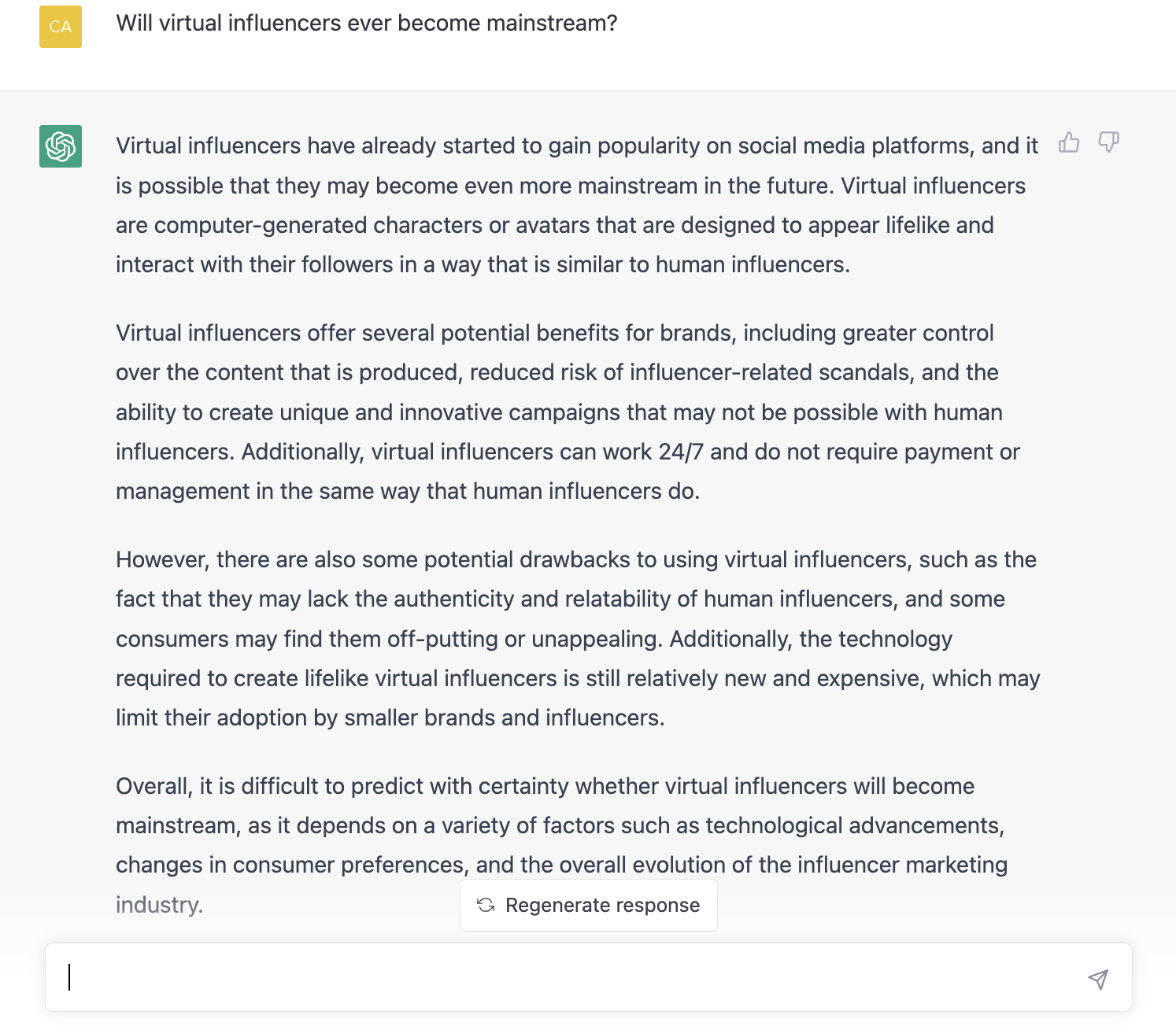
Virtual influencers have already started to gain popularity on social media platforms, and it is possible that they may become even more mainstream in the future. Virtual influencers are computer-generated characters or avatars that are designed to appear lifelike and interact with their followers in a way that is similar to human influencers.

Virtual influencers offer several potential benefits for brands, including greater control over the content that is produced, reduced risk of influencer-related scandals, and the ability to create unique and innovative campaigns that may not be possible with human influencers. Additionally, virtual influencers can work 24/7 and do not require payment or management in the same way that human influencers do.

However, there are also some potential drawbacks to using virtual influencers, such as the fact that they may lack the authenticity and relatability of human influencers, and some consumers may find them off-putting or unappealing. Additionally, the technology required to create lifelike virtual influencers is still relatively new and expensive, which may limit their adoption by smaller brands and influencers.

Overall, it is difficult to predict with certainty whether virtual influencers will become mainstream, as it depends on a variety of factors such as technological advancements, changes in consumer preferences, and the overall evolution of the influencer marketing industry.


I agree with all of the pros and cons that ChatGPT mentioned, but I would probably add the role that virtual influencers will play in web3 and the metaverse. I believe that is where their adoption will be the most widespread, and then it will eventually trickle down into our real universe. I also think the technology will need to evolve in order for them to really catch on within mainstream marketing because right now they look…unsettling. On the other hand, however, I think any brands willing to make a big bet on virtual influencers might eventually benefit from the “first mover advantage,” allowing it to become a dominant player in the largely untapped space for years to come. 


I am also curious about how programmers/developers will handle aging with vinfluencers—for example, Lil Micquela was 19 when she first created her Instagram account in 2016, and her Instagram bio still says that she is 19 seven years later. I think this could be a rare opportunity for brands since this is something humans cannot do. I think it would be interesting for brands to use a vinfluencer who doesn’t age in order to acquire audiences from every generation rather than have him/her “grow up with” the people they attract. I am very eager to see how brands will handle this in the future!


Source: https://www.instagram.com/lilmiquela/


In my first prompt I actually referred to them as “vinfluencers” like I heard in class, and ChatGPT thought they were wine influencers! See below:


Monday, March 06, 2023

CHATGBT compared Go Charlie ! What a world of difference ! Romancing The AI What Can Artificial Intelligence Do For Digital Marketing?

I recently asked CHATGBT the following prompt "Please write a humorous 350-word blogpost on that AI is predicted to have on digital marketing". To be honest the response was a bit lackluster. Vs. Go Charlie which required a Blog Title: Digital Marketing and the Impact of AI , Tone: humor, boston, cutting edge, SEOs, and a target audience: entry-level marketers. To be honest, CHATGBT may be the first mover but some of these second-generation tools will be the true leader in AI automation. 

Chat GBT -->


Hello there! As an AI language model, I'm very excited to talk to you about the impact of AI on digital marketing. AI is revolutionizing many industries, and digital marketing is no exception. But let's take a moment to step back and appreciate the absurdity of this situation - machines are taking over the world, but at least they're making our ads more relevant!

First, let's talk about personalization. AI can analyze data on customer behavior and preferences to create hyper-personalized ads. Gone are the days of generic ads that don't resonate with anyone. Now, we have ads that are so specific, they feel like they were made just for you. It's almost as if the AI knows you better than you know yourself! But don't worry, I'm sure there's nothing creepy about that.

Next, let's talk about chatbots. AI-powered chatbots are becoming increasingly common in customer service. They can answer common questions, provide recommendations, and even complete transactions. This means that humans are no longer necessary for these tasks. So, if you're a customer service representative, you might want to start looking for a new job. Unless, of course, you want to become friends with a chatbot.

Finally, let's talk about predictive analytics. AI can analyze vast amounts of data to predict future trends and behavior. This can be incredibly helpful in digital marketing, as it allows businesses to anticipate the needs and wants of their customers. But let's not forget that AI isn't perfect. Just because a machine predicts that a certain trend will be popular, doesn't mean it will actually be popular. So, if your business suddenly starts selling a bunch of products that nobody wants, you can blame the AI.


In conclusion, AI is having a huge impact on digital marketing, and it's both exciting and a little bit scary. On the one hand, it's amazing that machines can analyze data and make predictions that were once impossible. On the other hand, it's a little unsettling to think about a world where machines are making all the decisions. But hey, as long as the machines keep making us laugh with their weird and wonderful ads, I think we'll be okay.

GO Charlie --> Romancing The AI What Can Artificial Intelligence Do For Digital Marketing?

Digital marketing is a rapidly growing field that is constantly evolving. With the help of AI, marketers can automate tasks and improve the overall quality of their campaigns. Below, we will take a look at how AI can be used in digital marketing to boost reach and engagement.


When it comes to reaching potential customers, AI can be used to automate customer segmentation. This means that you can automatically target different groups of people with different ads and content. By identifying which groups are most likely to convert, you can better target your campaigns and ensure that your messages are reaching the people who need them most.


Similarly, AI can be used to optimize websites for better performance. By using machine learning algorithms, marketers can identify which pages are performing poorly and make necessary changes to improve traffic flow. This allows you to provide a better user experience while also boosting ROI.


Beyond improving website optimization, AI has the potential to enhance data analysis from multiple sources. For example, you could use AI to identify which social media platforms are being used most frequently by your target audience and tailor your posts accordingly. This would allow you to provide more engaging content that would keep users coming back for more (and hopefully convert more leads into customers).


Last but not least, one of the biggest benefits of using AI in digital marketing is its ability to personalize ads at scale. By using machine learning algorithms, marketers can identify customer trends and preferences – even those customers who have never interacted with your company before! This allows you to provide superior customer experiences by anticipating their needs rather than hoping they'll stumble across your content organically.


Overall, embracing the AI revolution is essential for better reach and engagement with your customers online. By using technologies such as Generative AI, marketers can streamline their processes while also providing more relevant content that appeals directly to consumers' interests.


Sunday, March 05, 2023

Email remains the best channel for business leads

 Email marketing remains one of the most effective channels for generating business leads. According to research, email marketing has an average return on investment (ROI) of 42:1, meaning that for every $1 spent on email marketing, businesses can expect an average return of $42.

Emails allow businesses to communicate with their target audience in a personalized and targeted way, which can result in higher engagement rates and more conversions. Additionally, email marketing offers a wide range of tools and techniques that can help businesses track and analyze their campaigns, including open rates, click-through rates, and conversion rates.

However, while email marketing can be highly effective, it's important to note that it's just one of many channels available to businesses for generating leads. Depending on the industry, target audience, and specific goals of a business, other channels like social media advertising, content marketing, or search engine optimization may be equally effective or even more effective than email marketing. Ultimately, the best approach will depend on a variety of factors, and businesses should consider a range of channels and tactics when developing their lead generation strategy.


Chat GPT or real?

Saturday, February 11, 2023

Superbowl Ads

https://digiday.com/marketing/what-a-7m-super-bowl-ad-buy-can-purchase-in-digital-media-in-2023/amp/

This is an interesting article that shows the digital equivalent to a $7 million superbowl ad.  Further research shows that the total viewing audience for superbowl is estimated at 208M P2+ individuals (https://www.nfl.com/news/super-bowl-lvi-total-viewing-audience-estimated-at-over-208-million).   

In comparison in digital impressions, for $7M, the stats in the article are

 Netflix – 127.2M impressions

Instagram Reels – 2.3B impressions

TikTok – 1.64B impressions

Twitter – 2.3B impressions (+$250 ad credit)

YouTube – 2.21B impressions

Newsletters – 280M impressions

 From an impression standpoint, it is shocking to see how $7M differs from digital to linear, 2.3B impressions on IG is an over one thousand percent increase of the 208M for linear.

 Looking at the ad through the digital lens, digital marketing has its own toolset for the ad:

 SEO: Content marketers can use the ad creative as a tool for SEO – there can also be “behind the scenes footage” posted to the web

 SEM: From a paid perspective, there can be a SEM spend to help generate traffic around the commercial (e.g., if a celebrity is in a commercial for a brand, that brand can build an ad using the celebrity as a key word)

 There is also utility for Superbowl ads in social, both in paid and organic.  Video clips can be posted to social platforms, and the clips can also be supported with a media buy. 

 It is also worth noting, Superbowl has merits outside of pure impressions; for many marketers there is earned media involved when doing a spot for the Superbowl.  There is typically a press release around the campaign, and the commercials are available to press outlets.


Friday, February 10, 2023

Bing Taking a Bite out of Google’s Pie

 With the introduction of ChatGBT into the Bing search engine, is this now the race to the bottom in terms of pricing just like what Amazon Web Services (AWS) did for compute and storage servers? 

This is the first major innovation in years to the search market. Microsoft is hoping its investment into ChatGBT as the critical knife point that would enable Bing to take a bite out of Google’s dominance as the world’s search engine. Microsoft’s CEO “Nadella said he was willing to accept any “demonetisation” of the search business” in order to lessen Google’s slice of the pie. In response, Google has had a blunder filled week with the error prone first impression of Bard, Google’s response to ChatGBT. Yet, Bing’s new search result layout is eerily similar to Google’s. This leaves the reader to wonder, is the real battle a preference over a product or will the AI enabled search truly be a lasting innovation or is it just another fad? I personally believe that this may be a fad in search but the larger impact on automating jobs like cold email or drafting emails will forever change. With the major impact of AI is still unknown, I look forward to the disruption that will be taking place in the near future. 


Source: https://www.ft.com/content/2d48d982-80b2-49f3-8a83-f5afef98e8eb?desktop=true&segmentId=7c8f09b9-9b61-4fbb-9430-9208a9e233c8#myft:notification:daily-email:content


Thursday, February 09, 2023

Podcast Advertising is Becoming a Pretty Big Deal

Podcast Marketing Stats for Businesses

I am not sure this is exactly digital marketing, but I think there is something to this whole podcast marketing deal. I listen to a total of two podcasts, and I only listen to one of them regularly. I can however, recite most of the ads on both of them by heart. It's a lot like influencer social media marketing for your ears I guess and after reading the article, I realized that I have paid a lot more attention to the ads from my podcasts than from pretty much anywhere else I see or hear ads. Magic Spoon, Vuori joggers, Helix Mattresses, Alamo Drafthouse, Bob's Steak and Chophouse, Eatzi's Market & Bakery, I can recite all of their ads and the only place I hear them are on my two podcasts. I'm not saying this is the future of advertising, but I remember them for some reason and I couldn't tell you the last commercial I saw or the last ad I clicked on intentionally. I bring this to this forum to raise the question, what role should podcast advertising play in a CMO's plan to drive sales? 

Whether you buy it or not about podcasts, this little article was a bit of content provided by a digital marketing agency as an ad in the hopes that you will consider using them to help you fill out your content strategy etc. This article/ad was included in a daily newsletter that was sent to me by another digital marketing agency in the hopes that I will want to use them because they send me daily content. Pretty slick. 

Monday, February 06, 2023

Will TikTok Replace Google as Gen Z’s Go-To Search Engine?

Will TikTok Replace Google as Gen Z’s Go-To Search Engine? By Paige Carlotti


ChatGPT isn’t the only thing threatening Google’s dominance in the search market. Not only did TikTok become the most visited web domain in the world as of 2021, but according to one Google exec, 40% of Gen Z consumers report turning to TikTok and Instagram for search before Google. The trend is so pervasive that TikTok even made a video about it (but posted it on YouTube, which I found interesting and slightly ironic). In other words, social is the new search engine.

I think this trend (or perhaps it is a permanent shift) further underscores the generation’s suspicion of corporations and the value of personalized recommendations. While some people may be tempted to say it’s because the generation is “lazy” or “doesn’t want to read,” I simply think they would rather hear from a person talking about their experience using a new product as opposed to the company telling them how great it is, and take pleasure in putting a face to the person who is explaining how to baste the perfect Thanksgiving turkey. Whether the platform is actually conducive to this change in behavior or not, I believe that if social search has the potential to be profitable, TikTok will shift its strategy in order to capture that value. I am eager to see how this could potentially prove the power of following the consumer!


Sources: 

https://www.wired.com/story/tiktok-search-google/

https://www.youtube.com/watch?v=SaE1z4dZ4As

https://mashable.com/article/tiktok-search-engine-ad-google


Sunday, February 05, 2023

QR codes to potentially flood the Super Bowl 2023 commercials


There is lots of talk about how all brands could be leveraging QR codes in their ads this year for the Super Bowl.  Coinbase did this particularly well in last year’s Super Bowl – so well that it nearly crashed the app it got so much traffic.

This is a clever tactic to drive customers right to a brand’s site.  Once they are there, the brand knows exactly from what entry point they entered the site, and they can then start collecting data about them.  Ideally they could ask for their email, and once collected start 1:1 communications with them and introduce them to the brand and start their journey through the marketing funnel.

It seems that once brands caught on to the success that Coinbase, and other brands had with this method, many other brands jumped on the bandwagon as well.  I’ll be curious to see how many QR codes are shown in ads this year.  In an ever increasingly digital world, the Super Bowl continues to be a major event to collect millions of eyes.  This is an extremely clever way of digitizing that reach and providing a call to action to do more than collect impressions, but to potentially collect and convert customers as well.