Wednesday, December 03, 2014

Five popular online business models


If you are looking to generate an income online then it is very important to understand what type of online business model you would like to create for yourself.
While there are many types of businesses that can be created I will share five popular online business models people use create an income online.

Blog

Blogs are websites designed for social interaction.
Typically a blog is a way of communicating with an audience (usually, but not always readers) about any and everything from technology, cooking recipes, and daily activities, to bodybuilding and the latest news.
Information can be shared on a blog using text, video, and audio.
These type of websites can also use social widgets such as Facebook, Twitter, and YouTube to share and spread their content.
Blogs usually allow individuals to comment, share ideas, and communicate with the creator of the site or that sites team directly through comments and email.
They also allow individuals to communicate and share ideas with one another and opinions with one another.
In online business blogs are usually created to build an audience and educate them in a way that helps them improve a certain aspect of their lives.
Over time products and services can be offered to help the readers and community of the blog move closer to a goal that the community is striving for.
Blogs have the ability to generate income through software products, affiliate links, ebooks, educational material and other forms.

Membership site

Membership sites can be a great way to build an income because monthly and/or annual payments can be made to generate an income on a continuous basis.
This can be very appealing as a business model because you aren’t selling a one time product but creating a continuous revenue stream which requires far fewer people to maintain a good source of income.
Membership sites are usually paid monthly subscriptions that allow the person purchasing the membership to become part of a community, gain valuable information on a topic that they consider important, learn valuable skills through multimedia such as video, text, and images, and gain exclusive offers and promotions.

Niche site

A niche site is a website designed to target a very specific market.
Most niche sites focus on a specific product/service created to satisfy that markets particular needs.
These sites are usually low maintenance and don’t require as much updating as other business models.
Niche sites tend to gain most of their traffic through ranking well in search engines for specific keyword terms, and use short copy to communicate the importance of their product to try to convert their prospects into buyers and email subscribers.
Keyword research is a must for those looking to create high traffic niche sites that generate income.
Niche sites can also generate a decent income from placing within the top 3 positions on search engines such as google and using Adsense and advertising to collect revenue through ppc advertising.
Some niche site builders use this model as a set it and forget it online business model since it doesn’t require continuous content generation or marketing to generate a continuous income as other business models do.

Review site

Review sites are websites that post reviews about products and/or services to allow visitors to make better buying decisions for whatever they are trying to purchase.
These sites offer detailed information about each product/service and list of pros and cons of each to help the buyer figure out which product/service works best for him or her.
What makes these sites so appealing is that most people looking at review sites are ready to make a purchase and are looking for the best product for their situation.
A lot less work is involved in converting prospects into buyers.
Review sites are often monetized through affiliate links and paid or ppc advertising.
Most of the work on the site is creating product reviews and using SEO to improve ranking in search engines.
You can also use other forms of marketing to get the word out for your review site if you are so inclined.

E-commerce site

E-commerce sites focus on buying and selling products through an electronic medium.
Some good examples of e-commerce sites are Ebay, Amazon, and Macy’s.
These type of sites can produce large amounts of income, but tend to require the most work to build and maintain.
Storage (fulfilment services), shipping and delivering, product refunds and a whole list of other responsibilities fall under running an e-commerce site.
Communication with buyers and sellers is vital, and gaining traffic and converting prospects into buyers also plays a primary role in e-commerce.
Unless you have a dedicated staff you may find yourself spending a lot of your time running and maintaining this type of online business model.
e-commerce can be a great business model if you understand how e-commerce works and are able to shift responsibilities to other staff members to alleviate your time consumption, but if you aren’t familiar with e-commerce you can always get your feet wet by practicing and getting familiar with websites such as Ebay, and Amazon.

By 


3 Non-Promotional Marketing Campaign Ideas to Boost Engagement

Do you want to run a marketing campaign but you're tired of running a promotion?
There are a variety of ways you can run marketing campaigns that garner engagement and reach your audience without having to give something away.
The best outlet for these campaigns is social media.
Did you know that 8 out of 10 small businesses use social media for their business to drive growth? (Tweet this stat)
When a business combines their social media presence with their marketing goals, great things can happen.
Sometimes coming up with those ideas can be hard, which is why I've put together three examples of non-promotional marketing campaigns that businesses can use to drive traffic, build leads and convert followers into sales.

#1. Offer A Valuable Resource 

In the last three years, we've turned our resources, such as downloadable PDFs, info graphics, eBooks and guides into one of our top sources of revenue.
Resources give your business a chance to position yourself as a leader in your industry and educate your existing and potential clients.
There are a lot of materials that can build a great resource, such as statistics, best practices, white papers, case studies, employee highlights, etc.
I recently came across a great example of a valuable resource offering from SBLI a life insurance company.
They chose to use a marketing campaign to display a Life Insurance Quick Guide.
Life insurance can be confusing so they've broken down the information into four main points that they feel people need to know.
They then used a campaign to display those points in a visual and easy to follow fashion.
Quick Guide to Life Insurance

#2. Get Feedback About New Products/Ideas

Business owners all have one thing in common: They want to provide products that their clients want!
The easiest way to know if a new idea or product is right for your clientele is to get their feedback on it.
Asking your followers for their feedback on a potential product makes them feel like they are part of your decision-making and shows that you care about their opinion.
Plus, it'll save you the headache of knowing whether your next big idea will sell or not.
ZipCar recently used a marketing campaign to get some feedback about a brand new Android App they've built.
They published the campaign on their website in order to leverage their existing website visitors.
Zip Car

#3. Promote An Upcoming Event or Offer

Every business has exciting things to look forward to!
Whether it's an upcoming event, webinar, online tutorial, company tour or offer, chances are you're offering something interesting to your potential and existing clients.
Using a campaign to promote these types of scenarios is a great way to streamline your audience to see exactly what you want them to see.
In the example below, Facebook ad expert Jon Loomer, is using a campaign to promote an upcoming webinar he's hosting.
By choosing to place this on its own campaign versus his website he can assure that people who are interested in his webinar don't get distracted by anything else on his website.
Just think of a sales funnel. You put a note on social media that you're offering a webinar, you run ads against that webinar, and continually promote it to your audience. If they want to learn more they are sent to your campaign rather than to a website where they could easily be distracted by other offerings or content.
Jon Loomer Power Editor

The great thing about non-promotional campaigns is you're still able to collect emails and other information that you can use to market to your audience beyond the life of your campaign.
The next time you're wanting to spruce up your marketing efforts, don't get caught up in trying to think of a promotion to run. Use these ideas to leverage all of your marketing efforts.

Small businesses are about to get screwed

Beginning in mid-January 2015, Facebook is warning companies with fan pages that the social network will intensify its efforts to filter out unpaid promotional material in user news feeds that businesses have posted as status updates. This will hurt small businesses and entrepreneurs who currently use Facebook as a tool for free advertising. If these companies don’t pay to promote their posts, then hardly anyone will see the posts. In a recent WSJ article, one entrepreneur Chrisy Bossie estimates that nearly half of her $100K in annual sales comes from free Facebook posts. Well, that’s about to change.

Over 80% of small companies using social media to promote their businesses cited Facebook as their top marketing tool – followed by LinkedIn and Twitter. The top three reasons owners listed for creating a Facebook page were:
  1. Customer acquisition
  2. Building a network of followers
  3. Increasing brand awareness

These stats come from a recent survey of 2,292 small businesses by Webs, a digital services division of Vistaprint.

Facebook’s VP of Small Business, Dan Levy, says that Facebook’s paid-advertising options have become more effective recently. He believes that small businesses should view Facebook as a tool to “help them grow their businesses, not a niche social solution to getting more reach or to make a post go viral.” He says he has “a lot of empathy” for businesses who “are feeling this evolution” in the reduction of organic reach. However, he says that there are many other reasons why small businesses benefit from being on Facebook – given that last month there were over 1 billion (yes, billion) visits to Facebook pages.

Back in the old days, businesses used to own their audience through email or other in-house marketing channels, or through other traditional advertising channels like newspapers and TV. However, the moves of Facebook and the like are attempting a third model: renting an audience. This is where businesses can build a community but never actually own an audience on their platform.

I don’t think many small businesses will be happy about this, but what choice do they really have? They either need to pay to stay in the game, or figure out something else.


Does the future of going to the movies mean getting hit with fake bullets and drenched by rain?

With a significant amount of movies being leaked before release, and other former movie-goers choosing to forgo the pricy tickets and wait until the movie is released on Netflix, attendance at movie theaters has been on a constant decline. Profits at both AMC and Regal have fallen over 50% year to date, compared to the same period last year.   The largest decline has come from the younger viewers, with the 12-to-17 age bracket declining 13%, and the 18-to-24 demographic dropping 17%. This is especially concerning as movie theaters have long relied on younger viewership to continually turn up.

Some believe that younger audiences have a hard time focusing on just one screen for an extended period of time, and need more to capture their attention. To get ahead of the problem several theaters have been going to great lengths to recapture this audience that is demanding more exciting experiences.  Regal, for instance, launched 4DX this spring, equipped with seats that move to the motion of the action on the screen, and everything from compressed air blasts to simulate flying bullets, to water dripping from the ceiling to simulate the rain you’re seeing in front of you. Though Regal has thus far only tested this concept in Los Angeles, they have received such positive feedback that they are planning to roll this out to a great number of theaters across the US and abroad over the next few years.

Cinemark is another theater that is trying to upgrade the typical movie-going experience, but offering 270-degree viewing. While they have received positive feedback from this offering, they hold firm that they are not willing to change the experience too much more, stating, “we still think the reason people go to the movies is to see movies.” 

And while few theaters have actually picked up on the concept just quite yet, last year Disney experimented with an idea called “Second Screen”, where moviegoers were actually encouraged to bring iPads and play games that related to the scenes they were watching throughout the movie.

It will be interesting to see where the future of movie theaters goes, and just what types of experiences we’re in for in the future. 

Read more about the potential future of movie theaters.


Tuesday, December 02, 2014

Paypal's foray into bitcoin

Paypal recently announced that it is working towards enabling some of its major clients to be able to accept bitcoin from customers via Paypal. The benefit goes both ways for merchants and customers: merchants are able to accept an additional form of payment at no incremental work or cost (since the functionality lives on the Paypal platform) and customers can put more value (and faith!) into bitcoin and potentially other cryptocurrencies. While this is another win for bitcoin after a string of exciting announcements in the past year(s) (bitcoin's acceptance on overstock.com and newegg for example), it is still a hard to accept form of digital payment for many. The topic of bitcoins and retailers accepting bitcoins has been buzzworthy and in my opinion, a marketing ploy to get innovators and early adopters to try the currency out with credible players. However, it has not caught on as expected, likely due to the many security issues bitcoin exchanges have experienced in the past, with about 1 in 10 bitcoins having been lost. Despite all this, everything is moving to be mobile-driven, including payments. And with that shift means more consumers opening up to the idea of an everyday behavior of digitally-transferring money. Bitcoin can offer lower transactions costs and more flexibility, so its time to shine may come in the not-so-far-distant future. Just not today.


Source: Techcrunch

Monday, December 01, 2014

Black Friday and Cyber Monday Social Media Debrief

As one of the largest retail weekends wraps up with a culmination of Cyber Monday, here is a quick snap shot of the biggest brands on social media. On Black Friday, the brands most mentioned on Twitter and Facebook were Khol's, Apple, Samsung and Microsoft. On Cyber Monday, Amazon, Etsy, EA and Motorola came on top as the most mentioned brands. This year there was an even bigger push for sales as brands leveraged their social media presence to drive revenue and traction among consumers. In 2013, Black Friday discussions on social media were tracked at 996,306 whereas this year that number doubled to over 2,000,000. Moreover, data seem to suggest that women were more talkative about brands on Cyber Monday than on Black Friday, and were generally more social media oriented than their male counterparts on both days. Not surprisingly, the most engaged age bracket on social media were between 25-34; the least engaged on either day were aged 18-25 which could indicate that brands should consider alternative strategies targeting this specific age group. The bottom line is that both Black Friday and Cyber Monday are growing in popularity across social media channels and creates huge opportunities for companies big and small to push sales.

Source: http://www.forbes.com/sites/ianmorris/2014/12/01/apple-samsung-ea-and-microsoft-were-black-friday-and-cyber-monday-winners/

Black Friday Sales Break Record

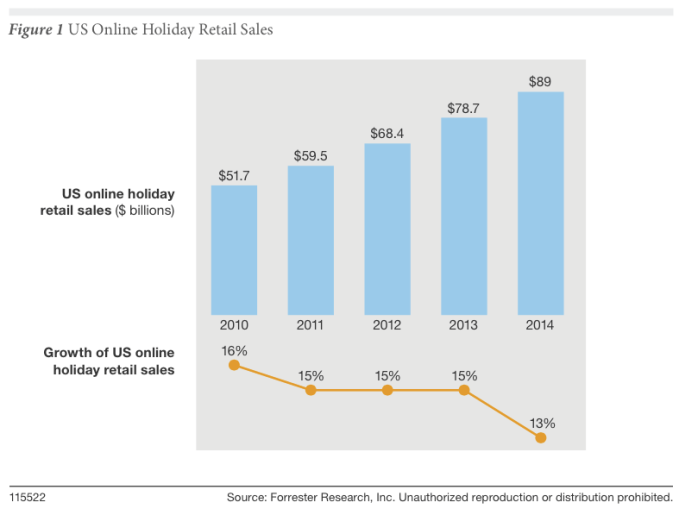
Happy Cyber Monday to you as online retailers hone in on another year of post-Thanksgiving holiday sales rush. Results don't disappoint as e-commerce retail hit record numbers, totaling $130 billiong between US and Europe. However, the NRF shows downward trend for brick and mortars, a cool -11%  or down to $50.9 billion year over year. Thanksgiving itself made more than $1 billion and Black Friday passed the $1.5 billion mark, both huge double digit growth stories (growth of 32% and 26% over 2013, respectively).

IBM saw huge mobile penetration, with 51.2% of all e-commerce in browsing, and 28.9% in sales contribution. Here is a trend on online sales trend over the past 5 years. It's interesting to observe that growth dipped after 3 years of flattening trend.

Screen Shot 2014-12-01 at 14.02.39

Some concern should be raised regarding actual Black Friday sales in the U.S., which were actually down -11% year over year. It seems that issues stemmed from Cyber Monday and shipping issues. Retailers should take note that a tight capacity management process and strategy are high imperative regarding package delivery network during the small window between Thanksgiving and Christmas.

Forrester has identified 3 key trends in U.S.:
 3.4 million new online buyers. Note that actual number of new buyers is actually shrinking annually, due to loyal online behavior that are used to lower prices.
– More wallet share online. Average online buyer will spend 10% more online in 2014 than last year, due to comfort and trust of online shopping during holidays.
Rise of mobile. ~213 million consumers are expected to have smartphones in 2014.iOS continues to dominate for browsing and buying. Screen size also matters. PC traffic still strong with sales making up ~3/4 of all online sales. Average order value of PC is higher than mobile, by about $16. ($112.81 on mobile devices.)Apple iOS users averaged $117.45 per order versus to $97.74 for Android users, and iOS sales accounted for 22.7% of total online sales, nearly four times that of Android at a mere 6% of all online sales. iOS traffic accounted for 35.4% of total online traffic, more than double that of Android at 15.4%.

So, with less new online buyers but more mobile activity, retailers shold take note of how to
- attract loyal customers without deeply discounting
- find ways to further draw a seamless PC to mobile to iPad experience (and make sure people are aware of these choices)
- pay attention to how US sales affect European markets aka re-evaluate the global holiday plan and strategy (very much tied to supply chain and delivery related issues)
- how to compete for a well-rounded annual figure that may not depend so heavily on one Black Friday as the week is now becoming diluted with sales all across the board

Source: http://techcrunch.com/2014/12/01/u-s-thanksgiving-black-friday-sales-break-1b-total-holiday-spend-online-will-be-89b/

The Sony Legacy

If you've been following the spread of data breaches at major corporations this year then you've had plenty to digest. Target, Home Depot, and now Sony have been victims of high profile data breaches. This is a serious concern for digital marketers. Keeping customer data is what enables us to be be better at what we do, it is the data that allows us to optimize message and delivery vehicle.

The more often that these security breaches occur the less customers are to be comfortable with us keeping their behavioral and or demographic data. The most recent breach is Sony's second in recent memory, following an embarrassing breach of Playstation user data. This most recent event is interesting in that there are signs it may have been committed by agents of a hostile State. The repercussions will last for some time as #GOP claims to have in their possession new Sony movies that have yet to be released. Is it possible digital marketers are at the center of the new future of state sponsored economic sabotage?

Twitter is taking a page out of Facebook and Google's playbook

According to Business Insider, Twitter will soon be changing its terms of service so that it can monitor the other apps that users have on their phones. There are major privacy and user experience issues that arise with this new policy. Ultimately, it comes down to a universal technology dilemma: How much control will we give technology to improve how it serves us?

Twitter contests that it can make better products and better understands the needs of its customer by being able to track what apps its users are also interacting with; however, Twitter won't have access to the actual content that user access in other apps. Twitter makes the case that other technology companies such as Facebook and Google already have much more access to user data; in fact, Facebook has started to replicate Google's search model where users remain within the Facebook app when they access outside content.

Obviously, Twitter believes it needs to keep up with these other tech behemoths to predict what is "the next big thing". While this can be a great development for small upstarts looking to be acquired, it also presents an unfair advantage given that Twitter and Facebook have the ability to quickly replicate services and products it deems to be threats.


Traditional News Going Social and Mobile

ABC and Disney announced today their new vision for social media making their news content more user friendly and allowing a traditional one-way communication system to be more if an interactive two-way communication street.

ABC news is launching a 1 minute "Summary" series that will appear every weekday on the sites Facebook page. The program will feature 3 or 4 topics often focused on a single photo that caught the news teams interest. It will also incorporate comments and story ideas suggested by viewers from the page. This among other initiatives show these top media companies increasing efforts to distribute their content more digitally as consumers viewing rates rise dramatically on tablets and smartphones and their efforts to reach more mobile viewers.

Like their parent company ABC, Disney will unveil a more mobile-friendly version of its ESPN.com site in April 2015. The company has shown social is an effective medium for quickly sharing show highlights through releasing its Disney Movies Anywhere could-based storage service to Andriod which bolstered its Watch ABC app.

Another example of social success for news content is the "World News Tonight" which is in second place behind NBS Nightly News, and Nielsen reported their posts with video on the program's Facebook page got 7 times as many viewers as non-videos posts.

Overall, I think it is very exciting such a traditional medium like news is taking such a progressive stand on taking a media that is typically projected at audiences, making it more of an interactive conversation.


Full Article:
http://adage.com/article/digital/abc-kicks-social-media-version-world-news-tonight/296024/

Big data to stay


While big data sounds like yesterday’s buzz word to most, this massive amount of analytics related to sales, consumer behavior and historical activity is something that is only getting bigger and more crucial for companies of all industries.

            Looking at the chart below, you can see that business executives of top companies worldwide are increasing their literacy and/or understanding of big data. You cannot be at the top of your firm without knowing how to dissect the myriads of data which has the potential of steering the company towards making the most profitable strategic decisions.

 
            This is an extremely advantageous trend for MBA graduates, who are trained to translate large excel files filled with quantitative and qualitative data into meaningful information.
 

Tumblr Expands Sponsored Capabilities

Tumblr has introduced “Tumblr Sponsored Apps,” a new mobile ad unit to attract more advertising dollars. The new ad unit will allow publishers to target the Tumblr community with creative sponsored posts that are designed to encourage users to download mobile apps from the iTunes App Store and Google Play through an “Install App” button.

The main difference between Facebook and Twitter’s mobile app install ads and “Tumblr Sponsored Apps” posts is that Tumblr’s posts are overlaid with an “Install [the app]” call to action. These posts will initially show up on mobile users’ dashboards, but will also be displayed as regular posts on Desktop without the “Install” message. Essentially desktop users can still organically see the sponsored posts associated with the ad and will be able to further reblog or share the content.

Max Sebela, creative strategy manager at Tumblr explained, “The core is that the native functionality allows marketers to talk to the community the same way any advertiser would be able to on Tumblr. Users don’t just download the app, but they can also share the content that is treated like other posts on Tumblr.”

The platform debuted “Tumblr Sponsored Apps” with three business partners: Gree, Big Fish, and TwoDots, all of which are gaming companies. In addition to the sponsored posts and mobile app ads, Tumblr will test a variety of ad formats in the “Tumblr Sponsored Apps” program to gauge its online community’s interest.

Tumblr says currently it has 400 million global monthly unique users, and 65% of its users access content through the mobile app. Its total mobile engagement has grown 84% year-over-year.


Sources: Tumblr, TechCrunch, ClickZ

Six Tips for Executing a Successful Augmented Reality Campaign

From 3-D playing cards and movie posters to virtual fitting rooms and vehicle test drives, augmented reality (AR) is emerging as a more accessible, innovative marketing tool.
Because more than half of shoppers use their smartphones to research purchases, AR offers new and improved ways for retailers to build relationships and engage with their customers—both inside and outside stores. In addition to creating a more engaging user experience, AR provides data that empowers brands to better understand what is resonating with consumers, and to tailor their marketing efforts accordingly.
Early examples of AR have proven successful for many brands, but barriers to widespread adoption among consumers are still present. So how does AR avoid fizzling out like so many marketing tech trends that came before it? (Sorry, QR code, but we're looking at you.)
Executing an innovative and successful AR marketing campaign doesn't have to be complicated. For retail marketers considering experimenting with AR, here are a few simple tips to keep in mind.
1. Make it relevant
For markets and brands considering making AR part of their strategy, it's critical to understand what types of AR content are relevant to their users.
Within a user's live environment, AR technology has the ability to deliver 2-D and 3-D imagery, video, and animation via a mobile device. For example:
  • Conde Nast Traveler added an AR feature to its iPhone app that helped travelers discover nearby attractions simply by scanning the area around them with their iPhone camera.

  • The ice cream gurus at Ben & Jerry's added an AR feature within the brand's "Scoop of Happiness" app that allowed users to learn more about their ice cream flavor of choice by simply scanning the lid.
By tapping into the insights that AR provides—based on where, when, and how their audience is engaging with their content—retail marketers can better understand what content resonates with the user, then tailor their messaging and marketing efforts.
2. Create engaging content
Multiple studies have shown that consumers are more likely to buy—or even pay more for—a product after they've touched it. The same has been said about consumers who are able to envision owning a product they've seen while shopping online.
AR makes it possible for consumers to visualize and engage with products like never before, but only if brands can identify and create the right types of content to grab consumers' attention. For example, if you're selling home decor, build an app that allows users to see how a piece of furniture would look in their home.
Engaging content not only gets consumers thinking about products but also leads to increased brand affinity. The more time consumers spend with a brand, the greater their attachment to that company becomes.
3. Understand where users are interacting with content
In 2011, Red Bull ran a subway ad campaign that relied heavily on QR codes. Not a bad idea in itself, at least until you consider that most subways don't offer phone connectivity, rendering the codes essentially inaccessible and useless.
If marketers are planning to integrate AR into their campaigns (and if AR wants to avoid the same fate as QR codes), it's important to understand where consumers are engaging with their content and plan accordingly.
4. Include a clear call to action
Brands don't want consumers to just browse; they want consumers to buy, track, and share. Users should therefore be able to see and do more with AR, and brands should give them a clear call to action to respond to. Just as with traditional marketing campaigns, smart retailers know that success comes from asking consumers to engage with the brand in a specific way. A clear call to action within your AR campaign will not only drive better results but also help gauge the success of the AR campaign.
5. Integrate with other marketing tools
Location-based tools, social networking, recommendations, and reviews are all great standalone tools, but when integrated with AR, they unlock a whole new level of engagement and activity-based re-engagement by making the user experience much more personalized.
When Olympus released its PEN E-PL1 portable camera in 2010, it simultaneously released an AR campaign that allowed users to virtually explore the camera's features, plus share their photos and videos online. Such a more robust campaign offered a way for the brand to engage consumers on a much deeper level.
6. See the bigger picture
User experience is only one part of the AR equation. Another is data, which proves extremely valuable to brands. With traditional retail marketing tactics, such as catalogs and mailers, it can be difficult to access deep-dive data that reflects what consumers are engaging with, what's capturing their attention, and what isn't working as well.
AR technology opens up new levels of data and feedback, allowing retailers to see which ads people are engaging with, how long they're looking at an ad, whether they have downloaded a coupon or shared something with a friend. Such information makes it easier for retailers and brands to identify trends, deliver more personalized content, and re-engage users.
Consumers love their smartphones, and they are looking for more ways to use them, while brands are searching for ways to unlock the potential of the smartphones their customers are already using.
AR provides a way to bridge the gap between the physical and digital experience, empowering brands to better engage with their customers and drive real business results in the process.

The State Of Digital Marketing In 2015

Planning ahead for 2015? Don't miss these key trends in digital marketing, as examined by columnist James Green.

“The digital marketing industry is experiencing a major transformation.” The main change driver is the abundance of new data being created every second. Marketers are learning how to decipher and implement the information they are receiving, which will drastically change the digital marketing landscape.

As consumers are also continuing to shift from online to mobile platforms, retailers need to continue to learn about how the behaviors differ because consumers expect a seamless experience.

1.     Big Data Will Become Bigger
a.     Companies now have so much access to data and they are learning how to process it all to improve the customer experience.
b.     Big data will continue to grow, forever!
2.     First and Third-Party Data will be a Hot Topic
a.     This will help retailers have a better picture of who their customers are and when they are ready to make a purchase.
3.     Automation will Continue to Increase
a.     “Eventually, all media buying will become automated”
b.     We are already starting to see a lot of this, with more and more real time ad buying
c.      The trend will continue and expand to other ad spaces, including TV
4.     Ad Fraud will still be a Concern
a.     Fraud represents 5-10% of all search clicks, which is huge!
b.     Display fraud is even more complex than search because of the large numbers of players and intermediaries
c.      Unfortunately, the perpetrators hide out in countries where this is not necessarily illegal so this is unlike to go away anytime soon
5.     The Need for Personalized Advertising will Grow
a.     As marketers are getting access to way more data, they will be more likely and able to target individuals as opposed to broad populations

b.     Data sources will be combined to create complete customer profiles


http://marketingland.com/state-digital-marketing-2015-109130

ABC Kicks Off Social-Media Version of 'World News Tonight

Walt Disney Co.'s ABC News division is producing a social-media version of its "World News Tonight" program to attract mobile viewers.
The 1-minute-long news summaries will appear every weekday, starting today, on the show's Facebook page. In what the company said was a first for a network anchor, "Facecast: The One Thing" will be hosted by David Muir, who took over the evening newscast from Diane Sawyer in September.
The Facebook program will feature three or four topics, often focused on a statistic or photo that caught the news team's interest, Mr. Muir said in a telephone interview. It will also incorporate comments and story ideas suggested by viewers, he said.
"The nightly news is not a one-way street anymore," Mr. Muir said. "I Tweet during commercial breaks."
Media companies are stepping up their efforts to distribute their content digitally as viewing rises on tablets and smartphones. Time Warner Inc.'s CNN last month elevated Alex Wellen, the head of its CNNgo app, to become the network's first chief product officer as part of a broader effort to reach more mobile viewers.
Disney will unveil a more mobile-friendly version of its ESPN.com site in April. The company recently extended its Disney Movies Anywhere cloud-based storage service to Android devices and bolstered its Watch ABC app with social-media features, such as the ability to quickly share highlights from shows.
"World News Tonight" is in second place in audience ratings behind Comcast Corp.'s "NBC Nightly News," with just under 8 million daily viewers this season through Nov. 23, according to Nielsen data. Posts with video on the program's Facebook page get seven times as many viewers as non-video posts, the network said.
"Producing an original, fully-separate newscast just for Facebook users, who can access it conveniently and share as quickly, is a natural extension of delivering news in a world where it is frequently consumed on the go throughout the day," Almin Karamehmedovic, executive producer of the show, said in an e-mailed statement.
It's also an opportunity to use extra footage, such as pictures from an August trip Mr. Muir made to Syrian refugee camps. There's just so much, Mr. Muir said, "that doesn't fit into a 22- minute newscast at night."

Vox Media raises $46.5M at a $300M valuation

Another web content business, Vox, raised $46.5M at a $300M valuation from General Atlantic, a blue-chip private equity firm. In the wake of other big prices paid for similar firms such as Buzzfeed or Reddit, the question becomes why? Content businesses don’t scale and are dinosaurs of the past right?


Kind of, but not really. The digital media businesses that win in this competitive market are not only generators of compelling content, but they are high end technology firms at their core. Vox, for instance, has a sophisticated content management system that enables streamlined content creation and curation while maximizing user engagement. Buzzfeed has sophisticated algorithms that can predict pageviews with a high degree of accuracy, and it is constantly iterating which pieces are promoted and pushed to the top of the funnel. The result of the pageviews, of course, is ad revenue, which has some pretty attractive margins once the publisher reaches scale. So as you see money funneling into content businesses, realize that they aren’t the same content businesses of the past. They are highly sophisticated technology businesses that have become experts at utilizing their tech stacks to monetize the mountain of digital content better than anyone else.

The Future Of Marketing Combines Big Data With Human Intuition

When it comes to marketing as a job function, many marketers take pride in their "marketing guts" to make decisions. The marketing gurus come with amazing innovative campaign, but most of the time those memorable marketing ideas could be one in thousands of ideas that were actually successful. We are now in the age of big data, and technology enable marketers to rely their decision on much more integrated data. Most of the time the two things wont go in the same direction, and marketers that refuse to look at the data may find their new campaign being ineffective and wasting company's budget.

All in all, we are not saying that marketers should stop being creative and rely on massive data. The marketing function should be human center. The data technologies are just a tool to making things easier to understand and cheaper to test out. Marketer can analyse large amount of data to see whether their hypothesis can work or not prior to rolling it out in the market. Fatemeh Khatibloo, a senior analyst at Forrester Research just published research on the help of data to marketing and technology management and its effect on firm's startegy, below are some of the interesting findings:

  • No industry is immune to the disruptive potential of the data explosion. We’ve all heard the stories about healthcare, media, and travel. But even one of the most traditional industries in the world — agriculture — is using data to transform itself. John Deere Company’s Farmsight is truly visionary: it turns farming into a high-tech, data savvy business that helps farmers balance intuition (qualitative) with data-driven (quantititative) insights.
  • Doing big data doesn’t come without a few risks. We’ve all seen the White House’s report onthe privacy risks of big data, and of course those risks are significant. But it doesn’t stop there. Business that start leveraging more data for better insight also need to prepare for the unknown financial liabilities of big data (the fines and lawsuits against companies that “misuse” data are just beginning). But beyond that, big data challenges us to ask, “just because we can, should we?” The question applies to everything from using customer data to predict sensitive health conditions to whether parole boards should be required to rely on statistical models to predict recidivism.
  • The old way of defining big data just doesn’t cut it anymore. We’ve spent the last half decade focused on three Vs (volume, velocity, variety) that attempted to describe what big data was, but didn’t tell us a thing about what it could do. It’s time for us to focus on the how and why of data. We think that means mastering context, changing your organizational culture, developing the right capabilities, and yes, acquiring the capacity to transform your data into insight.
  • Finally, tech managers can’t do this alone; business leaders need to step up. Do we expect you to become a technologist overnight? Of course not. But it’s imperative that marketers become willing stakeholders in the big data journey. You must help your technology peers understand your business challenges, and your vision for how you will be engaging your customers in the future, whether that’s 12 months or five years from now. You must be an advisor to the technology strategy process and, conversely, include BT in the buying process for outsourced marketing technology solutions. Your ability to bridge this yawning gap will transform your organization’s approach to big data.