Following is an interesting article comparing Pinterest and Snapchat. The 2 most probable candidates to become next facebook.
Online advertising is all about purchase intent, right? To quantify just how valuable the purchase intent of search is, it’s worth thinking about revenue per search. In 2006 Google’s revenue per 1000 searches was $45, in 2009 it was $35. (I’d like to put in a more recent datapoint, but my cursory Googling is coming up short.)
Keep in mind that Google search ads are non-interruptive units. By way of contrast, let’s talk about advertising on YouTube. These units either make you wait to watch the video, or takeover part of the video player while it is playing. Despite the fact these ads are designed to be more “engaging”, eCPMs for video are far lower vs search. Here are some approximations of revenue from top publishers on YouTube according to Peter Kafka:
[M]any big publishers say that after YouTube takes its 45 percent cut of the ads it sells, they frequently end up keeping about $2.50 for every 1,000 views their clips generate — that is, if their video generates a million views, they get $2,500. Other publishers say their split can be as high as $10 per 1,000.
I don’t want to spend more time comparing and contrasting eCPMs across different medium types, but the underlying point is this: some user experiences are inherently more monetizable via advertising than others. No matter how many fancy pieces of technology you throw in the mix to allow sophisticated segmentation, targeting, creative, etc, the context by which users are exposed to advertising sets the stage for the business.
Why compare Pinterest and Snapchat?
They are currently valued equally by the private market.
Advertising intent on Pinterest
I have always been optimistic about Pinterest as an advertising-supported company because of how users were using it from the very beginning. Pinterest is about organizing and planning things in your life. A big part of that organizing and planning has to do with products that you have bought or would like to buy. That seems like an ample amount of purchase intent which has always been a part of the core user experience. I imagine Pinterest could roll out Promoted Pins and most of the userbase wouldn’t notice.
Previous statements from strategic Pinterest investor Rakuten seem to agree with this analysis.
Advertising intent on Snapchat
This is a tough one. Brands pushing coupons with short timeouts to users? Geo-fenced push offers? How would a call-to-action work from a disappearing message? Would the ad unit stick around inside of the Snapchat UI? The smartest ad unit would probably take advantage of the fact users are trained that stuff disappears so they would need to act fast before it goes away.
Even if we assume some sort of amazing killer ad unit is released, are users in a state of mind to want to consume advertising? It appears that Snapchat is a new communications medium, which seems very fundamental and valuable. However, in other communication mediums such as phone calls, email, or SMS, interruptive messages from advertisers are historically not appreciated by consumers.
So why would the private market value them equally?
Snapchat has far more user base than Pinterest. The difference in the number of users somehow offsets Pinterest's superior business model.
Showing posts with label Kwonho Shin. Show all posts
Showing posts with label Kwonho Shin. Show all posts
Tuesday, December 08, 2015


Tuesday, December 01, 2015
Two-Thirds of Consumer Goods Companies Need to Do More to Harness Digital Technology for Marketing, Says New Study by Forbes Insights and Wipro
I found an article highlighting on the importance of the digital marketing. Even the most traditional products requires cutting edge technologies to attract more customers.
A new study by Forbes Insights, in association with Wipro Limited, confirms that if companies are not taking advantage of digital technologies to improve marketing efforts, they are falling behind their competitors. According to the study, 65% of executives say their companies need to do more to harness digital technology to improve marketing effectiveness. In addition, 61% say their companies need to do more in terms of harnessing marketing data to improve effectiveness in complementary areas such as product development and logistics.
These are among the major findings of “The Race Is On: Keeping Pace with Consumer Goods Leaders in Digital Marketing and Technology,” a new study from Forbes Insights and Wipro. The study surveyed 125 C-level executives from large, global consumer goods companies, in the United States, Europe and Asia Pacific. Forbes Insights also conducted one-on-one interviews to provide context for the findings.
“This study shows that many companies still have a long way to go to realize the full potential of digital marketing,” says Bruce Rogers, Chief Insights Officer and head of the CMO Practice for Forbes Media. “A trailblazing group of transformative companies is leading the way and achieving closer alignment between marketing and other departments. Others need to forge ahead or risk falling behind.”
Hiral Chandrana, VP & Global Business Head, Consumer Goods, Wipro Limited said, “Executives today face a bewildering array of digital marketing technologies. It not only requires integrated website, mobile and social media strategies alongside well-conceived and executed data privacy and security strategies but also concepts such as omni-channel and analytics which add to the complexity. But at the same time, the collective capabilities of these technologies to grow and optimize sales and marketing are too important to be ignored.”
He added, “The rapid shift to digital is providing businesses, across consumer industries, with more opportunities than ever before, to connect and engage with their customers. How well businesses are able to implement digital technology has a direct impact on business results and will keep them ahead of their competitors.”
Other key findings:
• Forty-two percent of executives believe their current approach to digital marketing is too fragmented—rising to 47% among companies with greater than $17 billion in sales. The larger the organization, the more products and divisions, the greater the likelihood there will be fragmentation.
• Silos contribute to the challenge: Digital marketing is often organized as a separate function (37%), while e-commerce often operates as a separate business unit (39%).
• Half of executives, 50%, report that in one or more instances, their digital marketing has failed to integrate with essential back-end processes.
• Nonetheless, 20% of companies describe themselves as transformative. These are the leaders, companies that have already embraced a broad array of digital strategies: social, mobile, web and analytic tools and technologies transforming not only sales and marketing but also the overall business.
• Forty-three percent of executives believe their IT departments are so busy they are unable to help with digital marketing technology needs.
• Fifty-nine percent indicate that their companies are amenable to adopting a greater degree of technology outsourcing—specifically, a model where a third-party, full-service technology provider is able to assist with a greater degree of both front-end marketing and back-end operational processes.
Tuesday, November 17, 2015
12 Social media marketing trends for small business
#1: Social Media Critical for Small Business
First, 96% of survey participants use social media marketing, and 92% of those agree or strongly agree with the phrase, “Social media marketing is important for my business.” Keep in mind that participants self-selected from a pool of over 300,000, and therefore are probably more interested in social media marketing than people who did not respond.
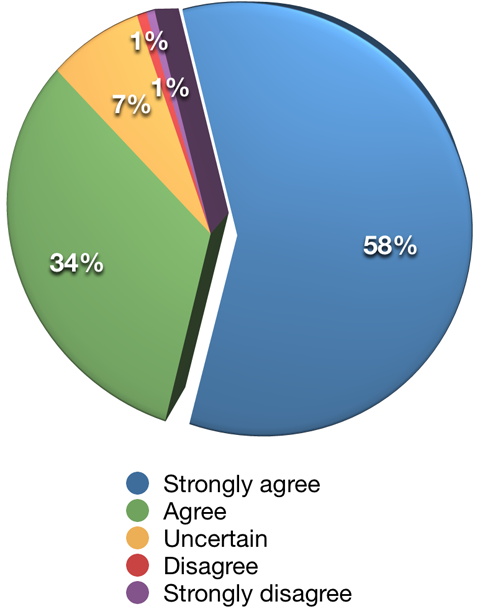
Nearly all survey participants use social media and view it as important for their business or company.
#2: Facebook Dominates Small Business Social Media Marketing
The majority of respondents carry out social media marketing on Facebook. The chart below shows that 93% use Facebook, ahead of Twitter at 79%. In the coming year, 62% of respondents plan to increase their use of Facebook for marketing purposes. Sixty-six percent will increase Twitter, YouTube and LinkedIn activity.
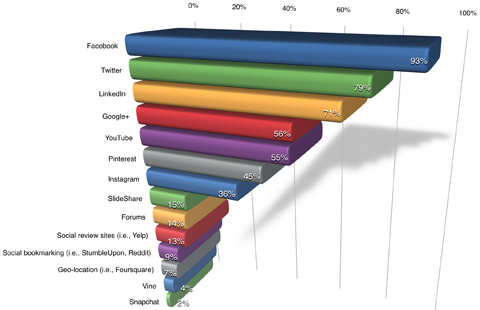
Ninety-three percent of survey respondents indicated using Facebook for social media marketing.
Twitter is gaining on Facebook, however, and with its new advertising opportunities, will be an interesting property to watch over the next year or so. It’s much the same story for Instagram and Pinterest, both of which doubled their traffic from 2014 to 2015.
YouTube is more commonly used by larger businesses. Specifically, 71% of businesses with 100+ employees use YouTube, compared to 38% of the self-employed.
#3: B2B Small Businesses Use Social Differently Than B2C
Breaking down Social Media Marketing Industry Report averages is useful. B2B respondents for this survey report that LinkedIn is their number-one choice for social networking.
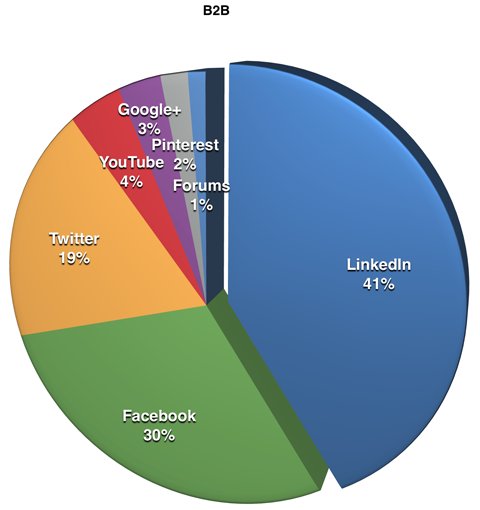
Those in the B2B space give LinkedIn the majority of their attention, but use Facebook and Twitter too, at respectable rates.
B2C companies, on the other hand, go to Facebook first and in larger numbers. This makes sense because B2B businesses are looking for the marketing people, facilities managers, buyers and others who rely on LinkedIn for industry connections and news. Facebook is comprised of nearly every consumer on the planet.
Seventy-one percent of B2B marketers want to learn more about LinkedIn this year. This said, just 18% of B2B marketers are using LinkedIn ads. These same marketers are using Facebook ads at a rate of 75%.
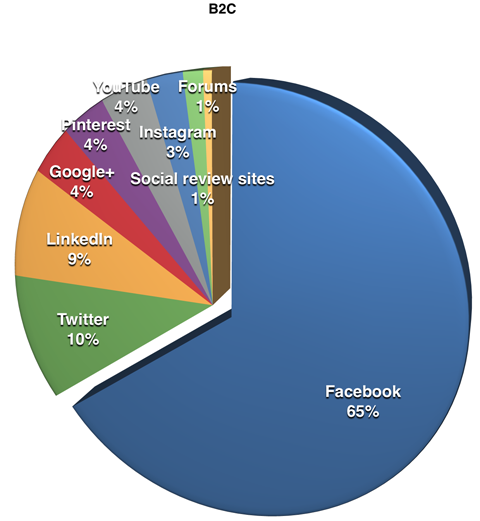
B2C companies can’t resist the huge potential consumer pool on Facebook.
#4: Most Small Business Marketers Don’t Know if Facebook Efforts Are Working
Despite the fact that 92% of small businesses agree that social media is important for their business AND that the majority use Facebook for their social media marketing, most also report that they don’t know whether their Facebook outreach is “working.”
“Working” may mean building brand awareness and relationships with customers. It could also mean bringing in more leads and sales. The bottom line is that the majority of small businesses either don’t know if Facebook achieves the goals they’ve set or it does NOT achieve those goals. It could also mean they have no goals or they haven’t bothered to measure their progress toward goals. Shockingly, despite the high numbers using Facebook, just one in three self-employed respondents characterize Facebook efforts as “effective.”
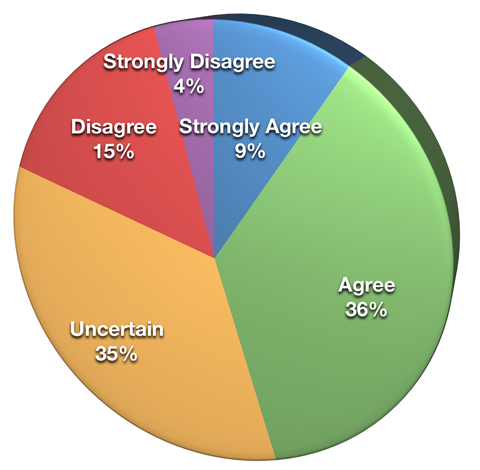
Thirty-five percent of marketers have no idea whether their Facebook efforts are effective.
Facebook’s domination of social media marketing despite the fact that most marketers are uncertain of its impact should concern small businesses. Without the benefit of a marketing team creating a strategy complete with goals and measurement, small businesses have a harder time evaluating marketing efforts. They may have simply embraced the notion pushed by marketing agencies and media that Facebook is THE place to be, an inexpensive way to market to a targeted audience. As a relatively new marketing platform with plenty of buzz, Facebook’s hype could be clouding its true potential for small business.
On the other hand, 44% of survey respondents have been using social media for two years or less. That short time frame makes the lack of clarity understandable. Most marketing efforts take a year or more to begin returning results. Small businesses may not be giving their social media efforts a chance.
#5: Small Businesses Plan to Expand Facebook Activities This Year
Tuesday, September 29, 2015
The Top 7 Online Marketing Trends That Will Dominate 2016
Forbes posted the top 7 online marketing trends that will dominate 2016. This is a very insightful and informative in understanding current digital marketing landscape.
1. Video ads will start dominating. Video ads are certainly nothing new, with social channels like YouTube dedicated to hosting billions of videos and advertising platforms like Facebook and Bing already offering advertisers video options. 2016 is set to be different because Google is finally getting on board with in-SERP video advertising. It’s a sign that users are becoming more accepting of video ads online, and as that trend continues, expect to see more types of video ads popping up in more unexpected places. With Google’s ownership of YouTube, the possibilities are virtually limitless.
2. App indexing will lead to an explosion of apps. Google has offered app indexing for a while, but as the ranking possibilities for apps become more complex, 2016 will be the year more business owners realize the online visibility advantages of a dedicated app. A mobile-optimized site works wonders for appealing to the mobile crowd, but soon, apps will begin to replace them. Apps can do everything that websites can, except in more intuitive, convenient, accessible ways. We’re still several years away from apps completely replacing websites as a medium, but 2016 will be a pivotal year in app adoption from business owner’s perspectives.
3. Mobile will completely dominate desktop. 2015 was a big year for mobile—not only did Google announce that mobile traffic finally overtook desktop traffic in 10 different countries, it was also the year they released the “Mobilegeddon” algorithm update to phase out sites not optimized for mobile. But apparently, you don’t have to have an optimized desktop site in addition to a mobile version—according to Google, a mobile-only site with no desktop counterpart is perfectly acceptable. This alone won’t be enough to drive down desktop traffic, but it’s clear what side of the fence Google’s on; they’re banking on desktop traffic fading away, meaning the smart money rests on mobile-focused online marketing.
4. Digital assistants will lead to a new kind of optimization. Search engine optimization (SEO) and pay-per-click (PPC) advertising are two highly popular strategies for getting your site seen by thousands of previously unknown visitors. But the rise of digital assistants is going to lead to a new kind of optimization. Digital assistants like Siri and Cortana do utilize traditional search engines, but only when necessary to find information. The key to optimizing in this new format is to make sure your business information is easily accessible to these assistants, rather than trying to funnel people to your site specifically.
5. Virtual reality will emerge. There are dozens of different virtual reality devices set to release in the next few years, some of which are dedicated for specific applications like video games, and others which are available for general use. Oculus Rift, arguably the most hyped VR device, is set to release in the first quarter of 2016. Oculus Rift and other VR devices will introduce an entire new medium of online advertising, with integration to popular social media platforms, video channels, and even forms of direct messaging. There’s always a chance VR could fizzle as a temporary fad, but there are billions of dollars of funding in limbo, ready to bet otherwise.
6. Wearable technology and the Internet of Things (IoT) will pave new ground. While not quite to the level of virtual reality, wearable “smart” devices should start gaining more traction into 2016. 2015 saw the unveiling of the Apple Watch, a first-generation smart watch, but more smart watches and similar wearable devices should start emerging next year. Such devices will change the landscape of local marketing, and will do more to blur the lines between “online” marketing and “real” marketing.
7. Advertising will become more expensive. Competition in the online marketing world has increased dramatically over the course of the past few years. 2016 will see it increase even more. As the basic laws of economics suggest, an increase in demand is often accompanied by an increase in price, so all those new online marketing competitors will drive the prices for online advertising even higher. Realistically, online ads are pretty cheap, but the increases in price may drive some smaller companies out of the landscape.
1. Video ads will start dominating. Video ads are certainly nothing new, with social channels like YouTube dedicated to hosting billions of videos and advertising platforms like Facebook and Bing already offering advertisers video options. 2016 is set to be different because Google is finally getting on board with in-SERP video advertising. It’s a sign that users are becoming more accepting of video ads online, and as that trend continues, expect to see more types of video ads popping up in more unexpected places. With Google’s ownership of YouTube, the possibilities are virtually limitless.
2. App indexing will lead to an explosion of apps. Google has offered app indexing for a while, but as the ranking possibilities for apps become more complex, 2016 will be the year more business owners realize the online visibility advantages of a dedicated app. A mobile-optimized site works wonders for appealing to the mobile crowd, but soon, apps will begin to replace them. Apps can do everything that websites can, except in more intuitive, convenient, accessible ways. We’re still several years away from apps completely replacing websites as a medium, but 2016 will be a pivotal year in app adoption from business owner’s perspectives.
3. Mobile will completely dominate desktop. 2015 was a big year for mobile—not only did Google announce that mobile traffic finally overtook desktop traffic in 10 different countries, it was also the year they released the “Mobilegeddon” algorithm update to phase out sites not optimized for mobile. But apparently, you don’t have to have an optimized desktop site in addition to a mobile version—according to Google, a mobile-only site with no desktop counterpart is perfectly acceptable. This alone won’t be enough to drive down desktop traffic, but it’s clear what side of the fence Google’s on; they’re banking on desktop traffic fading away, meaning the smart money rests on mobile-focused online marketing.
4. Digital assistants will lead to a new kind of optimization. Search engine optimization (SEO) and pay-per-click (PPC) advertising are two highly popular strategies for getting your site seen by thousands of previously unknown visitors. But the rise of digital assistants is going to lead to a new kind of optimization. Digital assistants like Siri and Cortana do utilize traditional search engines, but only when necessary to find information. The key to optimizing in this new format is to make sure your business information is easily accessible to these assistants, rather than trying to funnel people to your site specifically.
5. Virtual reality will emerge. There are dozens of different virtual reality devices set to release in the next few years, some of which are dedicated for specific applications like video games, and others which are available for general use. Oculus Rift, arguably the most hyped VR device, is set to release in the first quarter of 2016. Oculus Rift and other VR devices will introduce an entire new medium of online advertising, with integration to popular social media platforms, video channels, and even forms of direct messaging. There’s always a chance VR could fizzle as a temporary fad, but there are billions of dollars of funding in limbo, ready to bet otherwise.
6. Wearable technology and the Internet of Things (IoT) will pave new ground. While not quite to the level of virtual reality, wearable “smart” devices should start gaining more traction into 2016. 2015 saw the unveiling of the Apple Watch, a first-generation smart watch, but more smart watches and similar wearable devices should start emerging next year. Such devices will change the landscape of local marketing, and will do more to blur the lines between “online” marketing and “real” marketing.
7. Advertising will become more expensive. Competition in the online marketing world has increased dramatically over the course of the past few years. 2016 will see it increase even more. As the basic laws of economics suggest, an increase in demand is often accompanied by an increase in price, so all those new online marketing competitors will drive the prices for online advertising even higher. Realistically, online ads are pretty cheap, but the increases in price may drive some smaller companies out of the landscape.
Tuesday, September 15, 2015
New Business Model for Food Delivery Applications
Last year Goldman Sachs' PIA invested USD35 mil. to a start-up called Baedal Minjok(BM) in South Korea. BM is a food delivery application which offers similar services as Seamless. However, it made a significant shift in its business model this summer.
BM announced that it will abolish commissions imposed on every order handled through its platform in order to focus on expanding the number of users.
BM currently charges shop owners a commission of around 5.5 percent to 9 percent of the price per order made through its direct-payment system. (This is very similar to what Seamless does) The existing commissions accounted for around 30 percent of its combined revenue the rest being advertisement fees from shop owners.
Customers complained that the quality of foods they get through BM's platform was significantly lower than they usually get because restaurant owners had to bear the fees charged from BM.
Instead, the company said it will tap into other businesses by capitalizing on the wide scope of those using the app, which boasts 5 million orders monthly from around 3 million smartphone users.
This might be the first of the series of strategic shifts of food delivery application providers I think.
BM announced that it will abolish commissions imposed on every order handled through its platform in order to focus on expanding the number of users.
BM currently charges shop owners a commission of around 5.5 percent to 9 percent of the price per order made through its direct-payment system. (This is very similar to what Seamless does) The existing commissions accounted for around 30 percent of its combined revenue the rest being advertisement fees from shop owners.
Customers complained that the quality of foods they get through BM's platform was significantly lower than they usually get because restaurant owners had to bear the fees charged from BM.
Instead, the company said it will tap into other businesses by capitalizing on the wide scope of those using the app, which boasts 5 million orders monthly from around 3 million smartphone users.
This might be the first of the series of strategic shifts of food delivery application providers I think.
Subscribe to:
Posts (Atom)