Showing posts with label Digital Campaigning. Show all posts

Saturday, March 05, 2016

SEO Runs Both Ways: The Negative Side of Search

By Blaire Townshend

The benefits of Search Engine Optimization have been touted far and wide, and rightly so. When SEO is implemented effectively, these benefits can be profound. Increased customer impressions, brand exposure, improved click through rates - the list goes on. Needless to say, search should be an important consideration for the digital strategists of all politicians currently campaigning in the presidential race. However, what happens when such exposure is actively used against you?

The most obvious example at the moment is the much-discussed term "Drumpf" - associated with Republican hopeful Donald Trump - which has become a sensation online to such an extent that the term "Donald Drumpf" now precedes that of "Donald Trump" in a Google search. Though this is not a phrase supported or endorsed by that candidate, it has overtaken his presence on Google through sheer popularity. This development epitomizes the democratic underpinnings of Google's algorithms, reminding us that SEO is based on visitor-generated interest.

Now, consider the impact of phrases and associations actively cultivated or endorsed by people with specific agendas. In a way, "Drumpf" stems from such an agenda - talk show host John Oliver brought the phrase to prominence in an effort to mock Donald Trump, encouraging his viewers to utilize it as well. Oliver's actions in fact mirror those of another host, five years ago - in 2011 Stephen Colbert actively encouraged viewers to click on links that brought up content linking Republican candidate Rick Santorum to inappropriate sexual material. Colbert was not even the instigator of this effort. It was columnist Dan Savage who originally "tie[d] Santorum's name with an...unpleasant sexual definition...and then 'Google bomb[ed]' the Republican until the new term became the top search result for 'Rick Santorum'" (Detrow 2.25.16).

Regardless of the origin of such efforts, it is fascinating to see the ability of one or two people to so drastically affect the search horizons of another. Each of these three (Oliver, Colbert, and Savage) knowingly use or used knowledge of how search engine optimization works to sabotage the search results of politicians - deploying the democratic forces of the internet citizenry against those campaigners they wished to impede. Understanding that Google uses click through rates, choice of search terms, and site visits as indicators of demand (and therefore value) thus becomes a powerful political tool, capable of manipulating the system to achieve political ends. In an already chaotic political arena, such machinations make the game increasingly complex.


Detrow, Scott. "How Do You Solve A Google Problem Like Rick Santorum's?" New Hampshire Public Radio. 25 Feb. 2016. Web. 5 Mar. 2016. 


Sunday, February 08, 2015

Digital Marketing for State Elections

In 2012 US Presidential elections, although there were traditional marketing strategies including television, radio, print etc., the digital marketing turned out to be the key differentiator.  While the email marketing was very useful for Obama especially in the swing state of Ohio, Facebook and Twitter following for both the candidates was also a useful metric.

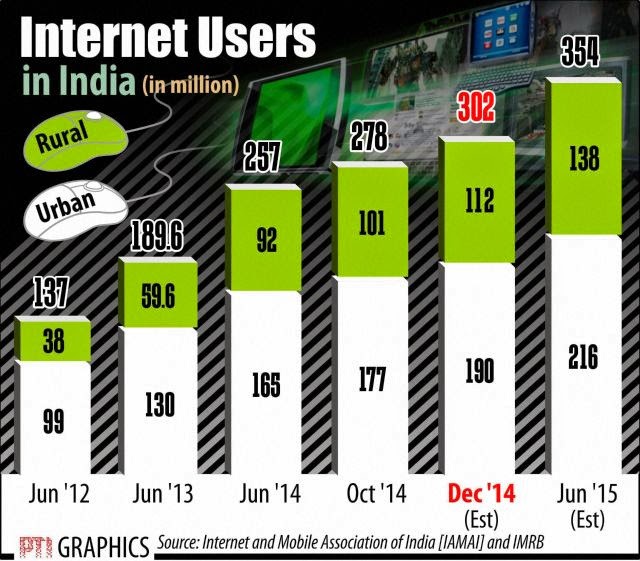
In 2014, India went for elections. This was the first election in India where a significant investment was made in digital marketing. Primary modes were social media and mobile phones. There are more than 200 million Internet users and nearly 170 million social network users in India. Most of them are young and mobile urban dwellers. This rise in internet usage compelled the political parties to start social media campaigns, not just for promotions, but to create conversations by using social media marketing and mobile in elections. According to Internet and Mobile Association of India (IAMAI) and IMRB report, about 119 million users access the Internet on mobile devices in urban India, while rural mobile Internet user base stood at 40 million in October this year. This is further estimated to touch 128 million (urban) and 45 million (rural) by December-end, it said.
The following chart indicates the stats of Internet users in India:


 Similarly, the number of Social Network users in India is also growing at a rapid rate as shown in the following chart:


 Source: Statista.com
 
With such a tremendous growth in social network users, politicians in India are bound to not only hold public rallies but also ensure to have those speeches captured on YouTube and have their significant presence on Facebook as well as Twitter pages.
But, still about 70% of Indian population has not used Internet while most of them do have mobile phones. Most of this population resides in the rural areas. Amongst those who have smart phones, the political parties are ensuring to campaign using mobile apps and various communication apps such as WhatsApp.
For those without smartphones, campaigning through SMS has been very popular. Another interesting mode has been “missed call” initiative propagated by AAP (Aam Aadmi Party), a new political party in India. This initiative meant that anyone could register as a party member or a volunteer by simply calling a designated number and hang up after one ring. AAP collected $1.8 million for the Delhi State Assembly campaign using mobile phones and social media and formed state government in Delhi.
This Saturday (February 7, 2015) Delhi will vote again for its state assembly. Although this is being keenly watched contest, my observation has been that the role of Digital
Marketing has increased tremendously as compared to last year. The reason is the following key stats of Delhi Population:
  • There are more than 12 million internet users in Delhi which is second highest in India after Mumbai.
  • About 7.2 million youngsters are going to vote in this election. 90% of these youngsters make frequent use of digital media to stay updated.
  • Delhi has more than 42.5 million mobile connections while its population is 25 million which clearly indicates that mobile is the most popular communication medium.

Obviously, none of the political parties have left any stone unturned especially when it comes to investing in Digital campaigning through mobile, internet and social media.
I am sure this trend is growing across the world with a significant increase of spending in digital campaigning. Digital marketing has now found a special place with the governments of different countries as it helps them to not only get elected but also communicate with the mass.

Sources / References:
http://www.pelsoftlabs.in/elections-promotions/
http://digitalmarketingtadka.com/mobilemarketing/twin-strategy-of-social-media-mobile-in-elections-2014/
http://www.thehindu.com/sci-tech/technology/internet/india-set-to-become-secondlargest-internet-market-by-decemberend-report/article6614417.ece