Showing posts with label Neeraj Nair. Show all posts

Sunday, April 19, 2015

Location Based Marketing is evolving


Location based marketing has evolved in last couple of years. The primary reason is now most of the digital marketing is becoming synonymous to mobile marketing.  The web traffic on mobile phones is going to overtake that of desktop computers sometime this year. The use of social media is now dominated on mobile phones. Various location based apps are primarily applicable only for mobile phones such as Foursquare.
Location based marketing is already been applied in many businesses especially few grocery stores such as SafeWay, Macys, Duane Reade have iBeacons. The primary ways location based marketing helps include:

Mobile Coupons: Mobile Coupons still continue to be one of the most popular uses for location-based marketing. Instead of clipping coupons from the newspaper, customers often have coupons targeted to them based on what store they enter or even where they are in the store. According to eMarketer, in 2014, approximately one in four mobile users were predicted to use a mobile coupon, and that number is growing each year.
Direction to promotions and discounts: Similar to offering coupons, location-based marketing helps in highlighting a current promotion or discount. For example, when a customer using the Donky app walks into the produce department, he or she might receive a message advertising a sale on oranges. Knowing about the promotion, often that customer might stroll over to the oranges and pick some up which he or she might not have done before. Thus, it helps to personalize the customer's experience, resulting in boost of sales for the store due to the targeted ads that location-based marketing provided.
Increased store app downloads and engagement: A grocery store may be one step ahead of many of its competitors if it has its own app. For example, Wegmans' mobile app uses a tool that is similar to but not exactly the same as location-based marketing. The app has a built-in shopping list function that helps customers find the items they need by organizing them by the aisle of the store that the products are located on. If customers have good reason to download and use a store’s app, the more likely they are to download and engage with a brand.

The last aspect is especially of importance.  Mobile location advertising technology firm xAd last week introduced Blueprints as a solution aimed at giving media buyers an assurance that their messages resulted in a store visit or sale. Blueprint is a new technology that automates the creation of the most accurate place data for location-based mobile marketing. According to xAd, Blueprint’s technology derives place data based on physical boundaries of business locations as opposed to the traditional navigational system data that captures the area around a street address. This is particularly important considering businesses are actually set back from the street.
Marketers relying on attribution models based on actual store visits that is usually based on proximity data from navigational systems can lead to misdirected or under-allocated spend because those data sources aren’t specific enough. Update: Google clarified to Marketing Land that it has a large operations team that draws the geometry of stores based on Google Earth and Street View data and that the company surveys stores and does Wi-Fi scans to accurately collect data on where store visits come from.

With Blueprints, xAd says it already has perimeters marked for more than 12 million business locations in the US. Blueprints uses a visual mapping algorithm that automates 70 percent of the place creation and updates to keep up with the over 130,000 new address listings and changes processed by the U.S. Postal Service each day. Blueprints also automatically processed in-store polygons for roughly 4,000 malls worldwide, including 1,900 in the US and 200 in the UK.
XAd claims more than 10 billion ad requests come through its platform daily. It includes companies such as Denny’s, Outback Steakhouse and Toyota Scion among its customers that use the platform to deliver location-based messaging to consumers. I am sure this new innovation of Blueprint would certainly be one of the major thrusts in the location based marketing this year.

References:
http://www.prweb.com/releases/2015/04/prweb12638835.htm
http://www.streetinsider.com/Press+Releases/xAd+shares+the+future+of+location+marketing+with+the+release+of+Blueprints%E2%84%A2/10440683.html

Wednesday, April 01, 2015

Takeaways from Facebook’s F8 Developer Conference


Mark Zuckerberg presented at Facebook’s third f8 Developers Conference in San Franciso last week. It was one of the major conferences of this year which may act as a stepping stone for the evolution of Facebook. Some of the key highlights of the event were focus on mobile user experience and enhancing user privacy.
My Top 5 key takeaways from Digital Marketing perspective would be

1. Bridge between Mobile Operating Systems
 
At F8, Zuckerberg seemed to address to the marketers how Facebook would be helping to reduce siloes in the marketing channels by augmenting its suite of developer tools. Facebook aims to do this by helping mobile apps run cross-platform operating systems (e.g. Google's Android, Apple's iOS, Microsoft's Windows etc.).

Currently, it is tough to imagine the Mobile operating systems working nicely with each other. Thus, Facebook wants to be the glue that would help stick them together. I think this would be a smart move by Facebook as brand marketers will need to rely on Facebook even more, especially for understanding customer experience and gaining that elusive personalized view of a customer.
2. Focus on Mobile and Mobile Apps"Like" Button

Facebook announced that it would release new mobile "Like" button where users could Like and share directly from a company's mobile app. This would also include a "send to mobile" feature to drive app downloads from Facebook and the mobile web as well as a new message dialogue for developers. Additionally, considering that 86% of time spent on internet is on Mobile devices and not on browsers (as per the chart below), Zuckerberg envisions Facebook on virtually every mobile app by indicating successful apps are bound to have a social media community.


3. Facebook Messenger opened to Third Party Apps
This is a major announcement from Facebook where it would revamp (find different word) its Messenger service, allowing users send content like GIFs, photos, videos,and more from third-party apps within the Facebook Messenger app.
The move would mean that app developers could now build Facebook Messenger support into their apps, making them directly accessible within the Facebook Messenger app.  The objective of allowing other social networks and services to directly post to it is supposed to make conversations even better and more seamless.
This is the major next step after allowing US-based users to send money to and from each other via Messenger. Zuckerberg also revealed plans to launch an associated service called Businesses on Messenger but the corresponding details are yet to be revealed.
Using the mobile app, people would be able to hold conversations with companies they interact with including the ones they buy goods from providing a seamless conversation through app instead of email.

4. User Privacy
One of the biggest announcements at the conference was the introduction of anonymous login. As privacy concerns continue to grow among consumers, Facebook is pushing to instill further trust with its users and give consumers more control. The anonymous login will allow users to log in anonymously to third-party apps so that they can try out an app before providing their personal data. This would help a person to test out an app or service that requires a Facebook login without the fear of the rogue Facebook posts. Facebook also announced advanced permissions and the ability for users to be more selective with the information that is shared with apps through a Facebook login.

5. Integrated Ads
Today mobile comprises for over 60% of Facebook's revenue. Around 90% of this is from advertising, but Facebook wants ads with good creative content that are targeted so well, that they do not upset users. Zuckerberg used F8 as a platform to help marketers and the developer communities understand that they would make more money only if they are respectful and value the users. At the moment, Facebook's average revenue per user is $2.44 in Europe. Interestingly it's $5.85 in the US but only $0.70 in the rest of the world.
There is a huge opportunity for Facebook to make considerably more money than they already do but according to me, the takeaway from F8 is to build a strong community first and subsequently plan how to monetize it properly later.


References:
http://www.netimperative.com/2015/03/facebook-opens-messenger-to-third-party-apps/

http://www.exacttarget.com/blog/facebooks-f8-conference-announcements-focus-on-privacy-and-mobile/

Sunday, March 22, 2015

Google – Content based Search?

Google is undoubtedly the dominant player in the search engine industry. In fact most of the companies that have adopted digital marketing have ensured to adapt to the Search Engine Optimization (SEO) techniques. Recently, Google released a white paper that indicated changing the criteria it uses to rank websites to include Google’s assessment of the accuracy of the content. This has shaken few search-engine-optimization experts speculating the changes for future.

Google's paper titled “Knowledge-Based Trust: Estimating the Trustworthiness of Web Sources,” discusses ranking websites based on the trustworthiness and factual accuracy of web sources. This new system would rely on Google’s own Knowledge Vault and a number of other metrics to gauge the accuracy of the information on a page. This would mean that if one's website contains known inaccuracies, or if it simply doesn’t contain much of the relevant content, the ranking on Google would be adversely affected for that website.
I think this in accordance with the focus on content based digital marketing. In the last two years, content marketing has gained tremendous focus and it is one of the most important areas in the digital marketing this year. Some of the following stats corroborate this finding:
- 57% of marketers report content marketing is their top marketing priority for 2013.

- 60% of marketers use content marketing on a weekly basis.

- 82% of prospects say content targeted to their industry is more valuable.

- 9 in 10 organizations market with content.

As a company owner involved in digital marketing, the better the company's website ranks, the more traffic it is likely to get and the greater is the lead generation and conversions.
A Knowledge-Based Trust (KBT) signal would be a significant departure from current practice, which uses traditional linking strategies to boost a website’s “authority.” Instead of rewarding or punishing a website based on the number and quality of links it has to other websites and portals, the search engine actually would assess the content of each Web page using the complex methodology discussed in the paper. This methodology is quite complex and Google has commented that these theories are still in research and development stage and not expected to roll out any time soon. Thus, I would strongly suggest companies to not stop any of the current SEO strategies.

Google is well known for aggregating all the content published on the Internet and respond with an output on demand. The fresher the content, the more helpful it is for Google likes it as websites, blogs, and paid media strategies all require fresh content to be effective. Even social media citations are starting to populate the search results- the most recent example being Twitter releasing its API allowing its tweets to be easily displayed through Google search.
The key to a successful content marketing strategy is to provide free, no-obligation information or advice that accurately answers questions and solves problems. It is also important that the content is aggregated from all sources and is also promoted on as many platforms as possible. To summarize, even if Google is yet to release its content based search model, marketers are already spending significant resources on content based digital marketing. In essence, content based marketing is a necessity today.

 Source / Reference:
http://kapost.com/content-marketing-facts/
http://thegazette.com/subject/news/digital-marketing-google-x2014-search-engine-for-truth-20150321
http://www.brightedge.com/blog/knowledge-based-trust-a-new-google-ranking-factor/

Sunday, March 08, 2015

Apple Watch and Digital Marketing

I am writing this blog less than 24 hours from one of the most awaited moments of this year in Technology, the launch of Apple Watch on March 9. There have been so many rounds of discussions speculating about the Apple Watch.
I read couple of articles related to Apple Watch and its launch.

http://www.wired.com/2015/03/apple-march-9-event-what-to-expect/

http://www.telegraph.co.uk/technology/apple/watch/11454514/Apple-Watch-latest-rumours-and-facts.html


But what really is an Apple Watch? Apple’s CEO Tim Cook calls it the most personal product the company had ever made. It would be a smartwatch with a rectangular sapphire-coated display which can be paired with an iPhone through WiFi or Bluetooth. Apple’s products have always created revolution in the world of technology and its close competitors especially Google would be more than eager to learn about it and also ensure they have a better answer.

As a student of Digital Marketing, I am keen to understand how Apple Watch would impact the Digital Marketing world. To answer that, I did some research to find how major technology innovations or launches have always made a significant impact in the world of Digital Marketing. Right from the launch of Google as search engine to the launch of I-phone and I-Pad, marketers had to adapt to the new technologies. Certainly, Apple Watch could be one of those major innovations for which the smart marketers should start preparing immediately.

One of the speculations is that the relevance and usefulness of ads would be even more important. In other words, it would be easier for a user to ignore an ad that is not relevant to him or her. This would mean that advertisers need to increase the number of methods and devices at their disposal through which to reach consumers making the relevance and usefulness of their ads much more important.

Another speculation is that location based marketing could be even more relevant. App developers could create some programmatic alerts that sense when an Apple Watch user is in close proximity. Accordingly, a store or restaurant can virtually “tap” the nearby user on the wrist to get their attention, and that person could be offered a promotional coupon valid for few minutes. It would promote the real-time location based advertising and also lead to some technological innovations on that front too. The digital content would need to be tailored to this new delivery method with short, simple messages and photos.

Last but not the least, it is also speculated that the smart watch would have the ability to continuously monitor a user’s heart-beat. There have been numerous studies correlating human behavior with the heart beats. This would be a completely new parameter that marketers never had information about and would further help marketers better understand consumer engagement with individual ads.

Still lots of questions related to Apple Watch are yet to be answered. I am eagerly waiting for the launch tomorrow to find those answers.

  
Reference:
http://www.launchdigitalmarketing.com/mobile/three-ways-the-apple-watch-will-change-digital-marketing/

Sunday, March 01, 2015

Future of Google+


I read the Forbes and business insider articles:

http://www.forbes.com/sites/miguelhelft/2015/02/26/exclusive-sundar-pichais-plan-to-keep-google-almighty/2/


This seems to be a major announcement from Sundar Pichai, Senior Vice President of Android, Chrome and Apps, mentioning Google+ could be broken down into different components.  Primarily, he meant that Google Photos and Hangouts would be separated from Google+.  At the same time, he also assured that none of the Google products are disappearing or closing down. This is especially interesting since from a social media perspective, Google+ could not make any significant impact as Facebook made. In fact, currently Google+ is not even in the top 5 in the list of leading social networks based on the number of active users. While Facebook currently leads with about 1.366 billion active users, Google+ is far behind at number 7 with 343 million active users. Please refer to the following link:


To understand the future of Google+, it is necessary to briefly discuss the history. I think most would have already forgotten Orkut by now. Orkut was a social networking website owned and operated by Google. The service was designed to help users meet new and old friends and maintain existing relationships, a social media platform. It started in 2004 and soon had many users world-wide especially in Brazil and India until 2008. Facebook also launched later in 2004 and ensured it was the most popular in the US and most of the Europe. Soon, Orkut could not match the advanced features and the tremendous growth of Facebook. At the end of April 2010, Orkut had 19.7 million unique visitors compared to Facebook, with 18 million visitors worldwide. Facebook grabbed the number one position for the first time in July 2010 with 20.9 million visitors, up 179%, a year ago. Since then, Orkut could never catch-up and had to be closed for ever last year in September 2014.

In addition to Facebook’s growth and its ease of use especially with mobile devices, I think another major reason for Orkut’s demise was Google was focusing on Google+ instead of enhancing and saving Orkut. Google+ was born in 2011. Google+ seemed to integrate in a better way as compared to Orkut on mobile devices but still has not caught up with Facebook yet. I think the key advantage is that Google+ provides a way to ensure users signed in to different Google services could have a common identity across all products. For example, if one is logged into his or her Google+ account in Chrome browser, he or she will be automatically logged into Gmail, Google Drive, and the Google's other services. This integrated user experience is critical for Google to ensure it has the accurate customer behavior. This is perhaps one of the reasons why Google+ is still very useful for Google even though it is not having a deep market penetration with active users as compared to the leaders such as Facebook. With that in mind, I think Google+ would soon be re-branded as an integrated platform for Google as compared to a Social Media network.

Reference:
http://knowtechie.com/google-plus-227/


Sunday, February 22, 2015

Latest trends in Digital Marketing


I read the article
 http://www.smartinsights.com/managing-digital-marketing/marketing-innovation/digital-marketing-trends-2015/

I agree with most of the part of the survey results conducted by smartinsights.com.

Survey results:


Content is certainly the king. Thus, it is intuitive that most of the marketers consider the importance of relevant, personalized, integrated content.  The excerpt from Venchito Tampon, Content Marketer and Link Building Specialist of Digital Philippines clearly indicates the importance of educating customers with the appropriate content: “Digital marketing in 2015 will definitely focus on caring customers/clients with all the available resources the brand could provide in its website. Content will make it easy for new and existing customers to locate and use the best products and services they intend to look for in various channels (search, social, paid advertising, etc.) Educating the target audience will now become the top selling point of many brands from whatever industry they are in.”

While Big Data may be the second most important trend as per the above survey, for me it is the number one. Let us take examples of the technology giants, Google and Apple. Google is already considered one of the leaders in data analytics.  Its acquisition of data driven performance platform in Marketing, Adometry (http://www.adometry.com/), has certainly proved the importance of marketing analytics. Apple’s recent acquisition of Semetric would bring Big Data to Music. Enterprise-level access to data on how listeners consume music, through both legal and illegal channels, with the help of Semetric could even catalyze the ascension of Big Data into consumer-centric markets. Data on this scale could likely revolutionize and change the way music is monetized, and could even shift value from the art and artists to the numbers. This acquisition would ensure Apple remains leader in the music industry.
Again, the above two giants are also coming up with some breakthrough devices which are yet to be completely revealed to the public:


The world seems to be eagerly waiting for the above two devices. While Apple seems to have indicated launching Apple Watch in the first half of this year, Google has not declared the world wide launch date of Google Glass yet. In fact, it declared that it is still in progress (opposing the thought that it may be dead) which certainly raises curiosity amongst everyone.


These devices would certainly make it easy to collect even more data across different data points and understand customer behavior. While I am also waiting for the launch and the revelation of additional details of the above two devices, my advice to the digital marketers would be to focus on the actual data that these smart devices collect and also sift and mine through the data to connect the dots. The key is to understand new methods of data collection points which may have not been possible till date.

Mobile has already taken over most of the other devices. Thus, mobile analytics would be even a bigger factor in this year for digital marketers. Additionally, the traditional email marketing, which has been prevalent for years now is still continue to stay. The only difference would be that most of these email promotions would be tailored for mobile devices and PDAs.

Finally, I would conclude by stating that most of the laggards who are yet to adopt digital marketing will change this year and start adopting. Mel Carson, founder of Delightful Communications states: “Businesses will finally wake up to the fact that social media and mobile marketing are no longer new phenomena and should be integrated right from the start of any marketing campaign or inbound initiative. The future of digital lies in companies being social and mobile by design!”

Source / Reference:

http://www.dmnews.com/apples-semetric-acquisition-brings-big-data-to-music/article/393721/ 


Saturday, February 14, 2015

Internet for All


When we talk about the world going digital and every one having internet access, we often either forget or may ignore the fact that still only about 40% of world’s population has access to Internet. It is estimated that as of now about 3 billion people in the world have internet access.
The internet access has been a major concern especially in developing and under developed countries across the globe. While this may sound like a challenge especially for governments of different countries to ensure everyone in their countries have access to the internet, this is also a huge untapped opportunity to grow for all those companies who rely on Internet. All the internet, mobile and digital marketing companies are making efforts in different ways to ensure larger part of world population has internet access. Internet giant Google seems to be one step ahead with their Project Loon.
Project Loon is an internet project from Google that utilizes high-altitude balloons to offer affordable internet access around the globe to around 5 billion people without any access. These balloons have the capability to travel approximately 12 miles above the earth’s surface, in the stratosphere.  Loon uses software algorithms to determine where the balloon needs to go depending on the direction of the wind. It started as a pilot project about two years back when 30 balloons were launched from New Zealand's South Island that beamed internet to a small group of users.
To learn more about Project Loon and how it works, visit the following YouTube Link

 In November 2014, Google announced that it has made tremendous improvements with this project especially with the auto fill equipment that would allow the balloons to last up to 10 times longer in the stratosphere than they did in 2013. The overall capability to launch has also increased up to 20 balloons per day.
According to a recent Times of India report, Google is in talks with the Indian Government to introduce its Project Loon to rural and remote areas of the country. Still more than half of the Indian population lives in rural areas and most of them living in villages do not have access to Internet. India has third largest number of internet users in the world only behind China and the USA. The internet user growth in India has been tremendous in the last year and it is set to surpass the United States before June 2015. Indian government elected in May 2014 has increased the budget for digitization across the country. With the rapid Internet growth in India, this Project Loon seems to be all set to be successful at least in India. According to the VP of business innovation at Google X, the plan is to launch a commercial version by 2016 covering all the parts of the world. Google X is already in touch with the governments and telecom operators of various countries including India.

I am eagerly waiting for the commercial launch of Project Loon sometime next year as it seems to be having a huge potential. It would also get sufficient support from all governments considering it is relatively inexpensive and environment friendly too.
 Sources / References:
http://www.internetlivestats.com/internet-users/
http://timesofindia.indiatimes.com/tech/tech-news/Google-to-bring-its-internet-energy-projects-to-India/articleshow/46226175.cms
http://finance.yahoo.com/news/google-talks-launch-project-loon-031603196.html


Sunday, February 08, 2015

Digital Marketing for State Elections

In 2012 US Presidential elections, although there were traditional marketing strategies including television, radio, print etc., the digital marketing turned out to be the key differentiator.  While the email marketing was very useful for Obama especially in the swing state of Ohio, Facebook and Twitter following for both the candidates was also a useful metric.

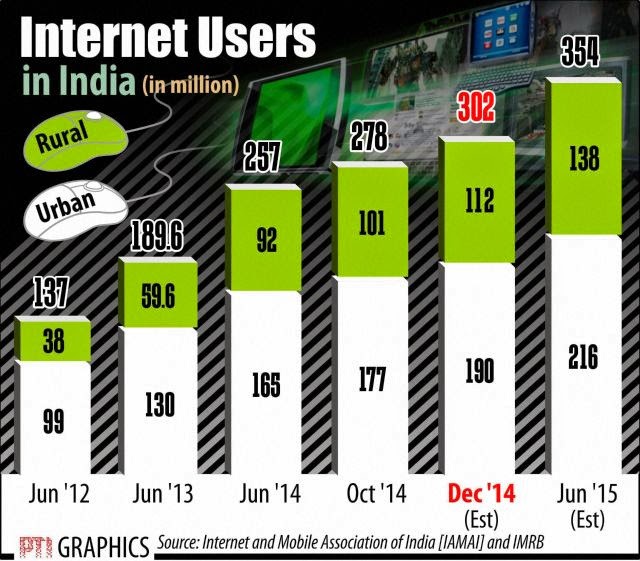
In 2014, India went for elections. This was the first election in India where a significant investment was made in digital marketing. Primary modes were social media and mobile phones. There are more than 200 million Internet users and nearly 170 million social network users in India. Most of them are young and mobile urban dwellers. This rise in internet usage compelled the political parties to start social media campaigns, not just for promotions, but to create conversations by using social media marketing and mobile in elections. According to Internet and Mobile Association of India (IAMAI) and IMRB report, about 119 million users access the Internet on mobile devices in urban India, while rural mobile Internet user base stood at 40 million in October this year. This is further estimated to touch 128 million (urban) and 45 million (rural) by December-end, it said.
The following chart indicates the stats of Internet users in India:


 Similarly, the number of Social Network users in India is also growing at a rapid rate as shown in the following chart:


 Source: Statista.com
 
With such a tremendous growth in social network users, politicians in India are bound to not only hold public rallies but also ensure to have those speeches captured on YouTube and have their significant presence on Facebook as well as Twitter pages.
But, still about 70% of Indian population has not used Internet while most of them do have mobile phones. Most of this population resides in the rural areas. Amongst those who have smart phones, the political parties are ensuring to campaign using mobile apps and various communication apps such as WhatsApp.
For those without smartphones, campaigning through SMS has been very popular. Another interesting mode has been “missed call” initiative propagated by AAP (Aam Aadmi Party), a new political party in India. This initiative meant that anyone could register as a party member or a volunteer by simply calling a designated number and hang up after one ring. AAP collected $1.8 million for the Delhi State Assembly campaign using mobile phones and social media and formed state government in Delhi.
This Saturday (February 7, 2015) Delhi will vote again for its state assembly. Although this is being keenly watched contest, my observation has been that the role of Digital
Marketing has increased tremendously as compared to last year. The reason is the following key stats of Delhi Population:
  • There are more than 12 million internet users in Delhi which is second highest in India after Mumbai.
  • About 7.2 million youngsters are going to vote in this election. 90% of these youngsters make frequent use of digital media to stay updated.
  • Delhi has more than 42.5 million mobile connections while its population is 25 million which clearly indicates that mobile is the most popular communication medium.

Obviously, none of the political parties have left any stone unturned especially when it comes to investing in Digital campaigning through mobile, internet and social media.
I am sure this trend is growing across the world with a significant increase of spending in digital campaigning. Digital marketing has now found a special place with the governments of different countries as it helps them to not only get elected but also communicate with the mass.

Sources / References:
http://www.pelsoftlabs.in/elections-promotions/
http://digitalmarketingtadka.com/mobilemarketing/twin-strategy-of-social-media-mobile-in-elections-2014/
http://www.thehindu.com/sci-tech/technology/internet/india-set-to-become-secondlargest-internet-market-by-decemberend-report/article6614417.ece
 

Sunday, February 01, 2015

Omni-Channel Marketing

There are more devices connected to the internet today than the world population. In fact, the recent GSMA report confirmed the number of mobile connections had passed the 7 billion mark by April 2014 and expected to go beyond 7.5 billion by the end of 2014.

The rapid growth in the digital media and marketing has ensured that marketers are faced with more choices than ever on how to reach customers. While the traditional retail, print, radio and TV advertising techniques are still prevalent, we often hear people using multiple devices and methods even for a single transaction. This has been possible due to the prevalence of digital marketing. Today, from cell-phone to tablets to desktops to social media to an in-store visit, we are entering an Omni-channel world, where consumers seek an Omni-channel experience. This certainly adds challenge to the marketer who would no longer focus on just one channel of marketing but ensure that his or her brand is always carried with the customer.
Here’s a chart from Telco 2.0 Research, illustrating the frequency of multi-device paths to purchase:
 
It is important to understand that Omni-channel marketing in its real essence ensures that the marketing is integrated and real-time across channels. In other words, customer disparate data sets would not exist at any instance across channels say between online and mobile content.  If such data sets existed, there are potentially two types of risks: One wasting marketing dollars by targeting those customers who are not interested in a product or service as indicated by one data set and the other which is even worse is not marketing to the consumers who are really interested in that product or service. Often the data across different channels is integrated by unique information identifying a particular customer say his or her email id or mobile phone which could be used across various channels.
Helps Targeted promotions
A significant advantage of Omni-channel marketing is that it is able to gather valuable information about customers by integrating and aggregating customer behavior across various channels such as internet, mobile, social media especially Facebook and Twitter etc. This helps the marketers to customize their promotions for different customers. It helps to provide a 360 degree view of the customer. Thus, Omni-channel would aid the Big-data initiative of the marketing analytics.
According to a report from MIT University, more than 80% of store shoppers check price online. This clearly shows the rapid evolution of Omni-channel. Customers are going from screen to mobile to store and from store to mobile and other channels. This process is continuous and reiterates an important point that customers today need to be engaged across different marketing channels.
Macy's has embraced Omni-channel marketing and the related short video briefly describes the concept.
 
2015 predictions
With the increasing prevalence of 4G technology, video advertising is predicted to be a growth area where mobile will become the platform of choice in 2015. Apple Watch is rumored to be launching in March 2015. Its function in Omni-channel marketing is presently not clear but analysts predict it could be a stepping stone.
By the end of 2015, it is predicted that the practice of dividing marketing by platform would be over and Omni-channel marketing would be the default standard.
Reference:


Sunday, January 25, 2015

Location-based Mobile Marketing Trends


Use of smart phones to shop and access information about different products and services is no longer a trend but a part of most of our lives. According to a survey conducted across a sample, one of the trends that clearly emerged was increasing number of smartphone users are keeping their mobile phones near to them nearly for the whole day. The day starts and ends for most of us with checking email, meetings etc. on our mobile phones.
According to Pew report, more than three quarters of smartphone users use location based services. Consumers are found to be very receptive to location based tracking which is widely adopted, irrespective of age, gender, ethnicity, education and income. Location-targeted campaign spending is dramatically growing as studies show that location-targeted campaign spending at the local level would account for $5.8B in mobile ad spending by 2016, up from $664M in 2012 while the whole location-targeted campaign market (national and local) would grow from $1.6B in 2012 to $9.9B in 2016.

Social Media is also increasingly adding the information with most of the posts, say photos or a simple textual post, with the location information from where it is being sent. This wealth of information is being especially used by retail giants to mine and provide a customized local ad or promotion specific to a person. This trend is also growing and expected to grow even further.
But, often the location based marketing has faced many challenges – the two key ones related to privacy and security of data. This has been perhaps one of the key reasons many people including teenagers do not select location tracking on their mobile phones. But the trend has changed dramatically especially in last two to three years with more people ready to share their location. This has been primarily possible due to the related practices evolving especially asking for consent to share the location information of the customer before actually sharing it. Equally important is the continuous enhancements in securing this customer data as it contains personal information based on the customer behavior.  Accurate Customer Behavior Information is something virtually every business entity today especially retail giants would like to acquire, mine and subsequently use to their advantages especially for targeted marketing.

The diagram below encapsulates the discussed trend of location based services being used on mobile phones.


References / Sources:
http://www.biakelsey.com/Company/Press-Releases/130122-New-BIA-Kelsey-Report-Emphasizes-Localization-Opportunity-for-National-Mobile-Ad-Campaigns.asp