Showing posts with label Digital Marketing for Elections. Show all posts

Friday, January 22, 2021

With Great Technology, Comes Great Reponsibility

Disclaimer: The intent of this article is to explore the use of digital marketing in campaigns. I hope you can appreciate the marketing strategies discussed regardless of your political views. 


By now, we all know that digital marketing is not just for brands trying to build awareness or sell products and services. Since 2008, politicians have incorporated digital marketing into their core campaign strategies. It's interesting to observe how these strategies have evolved over the last 12 years. An article from AdAge explores Biden's multi-faceted digital marketing campaign and its use of Gaming, Branded Content, Influencer Marketing, TikTok, and Facebook Page Partnerships.

Allison Stern, digital partnerships manager for the Biden campaign, acknowledges the need for Biden to compete with Trump on social media and discusses how finding the right partners online could deliver campaign messages authentically and at scale. 

"So much of marketing and communications is crafting the right message for the right audience. Our team focused less on the message, and more on the messenger. We worked to determine who or what is the right messenger to make this message most impactful with a very specific audience. We focused on using different voices, authentic to specific communities, and reaching people in their natural online habitat. Authenticity is easy to say as a buzzword, but the reality of execution is quite different. We achieved it and achieved it at scale."

"The Biden-Harris campaign was the first political campaign to embrace branded content at scale, including paid content partnerships with publishers like BuzzFeed, Teen Vogue, PopSugar, Pet Collective, Mitu and more. Biden entered the campaign at an extreme social media disadvantage to Trump and borrowing audiences from leading social publishers and influencers across the internet was a way to level the playing field."

I find the use of new marketing technologies in campaigns both exciting and scary. Greenfly, for example, is an app that provides images and suggested social text for users to share quickly and easily. 

"At the base of the broad scale influencer effort was Greenfly, an app managed by the campaign with a library of approved social assets, which influencers, surrogates, and everyday people (“brand ambassadors”) could easily upload to their social handles and share. 
...it does create a systematic way for Biden supporters (whether that be LeBron James or a campaign staffer) to share inspiring campaign art on Instagram with suggested social text in under 1 minute. If your social feed was flooded with Biden-Harris content it was not an accident, there was a sophisticated team with data, content, software, and relationships making this happen."

This reminds me of this summer when there was an abundance amazing artwork going viral during the Black Lives Matter movement. This kind of viral loop feels good to me because I believed in the message, but what happens when there are people creating content and messages for nefarious purposes? We've seen this before with Facebook ads during the 2016 election. Do you think that all new marketing technology companies will eventually evolve to have their own in house censorship teams? 

As they (some) say, "With great technology, comes great responsibility."*

Sunday, February 08, 2015

Digital Marketing for State Elections

In 2012 US Presidential elections, although there were traditional marketing strategies including television, radio, print etc., the digital marketing turned out to be the key differentiator.  While the email marketing was very useful for Obama especially in the swing state of Ohio, Facebook and Twitter following for both the candidates was also a useful metric.

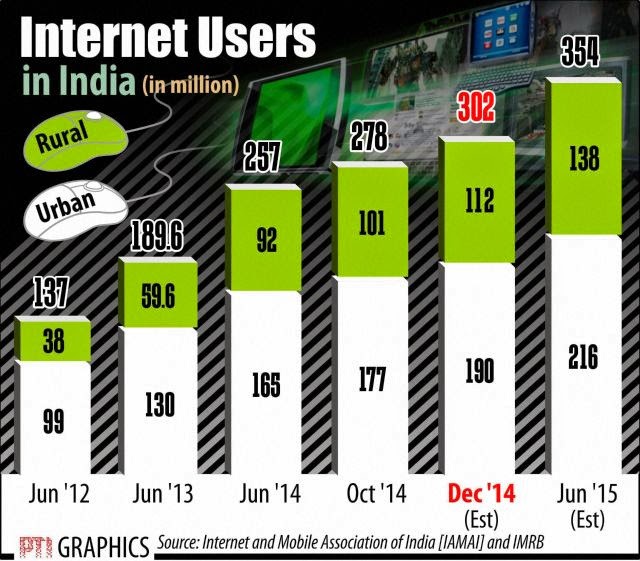
In 2014, India went for elections. This was the first election in India where a significant investment was made in digital marketing. Primary modes were social media and mobile phones. There are more than 200 million Internet users and nearly 170 million social network users in India. Most of them are young and mobile urban dwellers. This rise in internet usage compelled the political parties to start social media campaigns, not just for promotions, but to create conversations by using social media marketing and mobile in elections. According to Internet and Mobile Association of India (IAMAI) and IMRB report, about 119 million users access the Internet on mobile devices in urban India, while rural mobile Internet user base stood at 40 million in October this year. This is further estimated to touch 128 million (urban) and 45 million (rural) by December-end, it said.
The following chart indicates the stats of Internet users in India:


 Similarly, the number of Social Network users in India is also growing at a rapid rate as shown in the following chart:


 Source: Statista.com
 
With such a tremendous growth in social network users, politicians in India are bound to not only hold public rallies but also ensure to have those speeches captured on YouTube and have their significant presence on Facebook as well as Twitter pages.
But, still about 70% of Indian population has not used Internet while most of them do have mobile phones. Most of this population resides in the rural areas. Amongst those who have smart phones, the political parties are ensuring to campaign using mobile apps and various communication apps such as WhatsApp.
For those without smartphones, campaigning through SMS has been very popular. Another interesting mode has been “missed call” initiative propagated by AAP (Aam Aadmi Party), a new political party in India. This initiative meant that anyone could register as a party member or a volunteer by simply calling a designated number and hang up after one ring. AAP collected $1.8 million for the Delhi State Assembly campaign using mobile phones and social media and formed state government in Delhi.
This Saturday (February 7, 2015) Delhi will vote again for its state assembly. Although this is being keenly watched contest, my observation has been that the role of Digital
Marketing has increased tremendously as compared to last year. The reason is the following key stats of Delhi Population:
  • There are more than 12 million internet users in Delhi which is second highest in India after Mumbai.
  • About 7.2 million youngsters are going to vote in this election. 90% of these youngsters make frequent use of digital media to stay updated.
  • Delhi has more than 42.5 million mobile connections while its population is 25 million which clearly indicates that mobile is the most popular communication medium.

Obviously, none of the political parties have left any stone unturned especially when it comes to investing in Digital campaigning through mobile, internet and social media.
I am sure this trend is growing across the world with a significant increase of spending in digital campaigning. Digital marketing has now found a special place with the governments of different countries as it helps them to not only get elected but also communicate with the mass.

Sources / References:
http://www.pelsoftlabs.in/elections-promotions/
http://digitalmarketingtadka.com/mobilemarketing/twin-strategy-of-social-media-mobile-in-elections-2014/
http://www.thehindu.com/sci-tech/technology/internet/india-set-to-become-secondlargest-internet-market-by-decemberend-report/article6614417.ece