Jessica Hawthorne-Castro of Adweek argues that not only has the pandemic accelerated remote work and our adoption of delivery and home-based services, it has also accelerated digital marketing trends by up to a decade.
A blog for students of Professor Kagan's Digital Marketing Strategy course to comment and highlight class topics. From the various channels for marketing on the internet, to SaaS and e-commerce business models, anything related to the class is fair game.
Monday, November 08, 2021
Has the Pandemic Really Accelerated Digital Marketing Trends?
Wednesday, October 13, 2021
Digital Privacy and Who Pays for the Internet?
I missed this great piece on the tension between digital privacy and firms on Madison Avenue from Brian Chen of the New York Times when it was published late last month.
Chen summarizes the recent privacy changes implemented by FANG companies and the impact on the effectiveness of digital marketing for big and small businesses.
In April Apple implemented the ability to turn off tracking for particular apps on iOS devices. Google announced plans to block cookies to its Chrome web browser in June. And Facebook announced last month plans to target ads to users without knowing any user specific information.
These changes have come about through a willingness of governments to regulate big tech more, the most well-known example being Europe's GDPR legislation, and through shifting consumer preferences toward privacy.
However Chen rightly points out that this change impacts the effectiveness of digital marketing spend, providing the example of Georgia pastry shop Seven Sister Scones whose Facebook advertising became significantly less effective after Apple's iOS changes, resulting in a drop of monthly revenue from $40,000 to $16,000 in May.
Naturally the implications here are that if digital marketing becomes less effective, then naturally more spend is required to sustain the same conversions and revenue, and thus cost of acquisition increases. For businesses with tight margins, this may mean switching to more traditional forms of marketing in preference to digital, or if that is untenable, price increases. Indeed, Seven Sister Scones raised prices 25%.
In this respect, these privacy changes couldn't come at a worse time for the economy, as treasury bond yields begin to increase and inflation fears begin to take hold.
Advertising revenue sustains a great deal of the internet, so the question becomes - if digital marketing becomes too expensive, who pays for advertising-supported digital products and services?
Monday, February 04, 2019
Would you sell your iPhone usage data for $20 a month?
- Overview of Facebook's 'Research' app
- Overview of Google's 'Screenwise' app
- Facebook's defensive of its 'Research' app
Tuesday, March 10, 2015
Marketing on the Apple Watch: terrible idea?
Sunday, March 08, 2015
Implications of the Quantified Self
This parallel identity can be called the "quantified self"- the aggregation of all the actions we take online, collected into a measurable history from which a capable data scientist can construct an eerily accurate demographic and psychographic profile. This is fantastic news for marketers, and enables companies to more accurately target the right consumers with the right offers, at the right time (and increasingly, in the right place). We as consumers benefit from this as well- we receive less "spam" and irrelevant information, and receive better education and better deals on the things we actually care about. There's no doubting that the evolution of the quantified self has been good for business- but what about the effect on our personal lives?
The aforementioned trends started to remind me a lot of George Orwell's prescient novel 1984. As depicted in that novel, we now have "screens" that monitor us 24/7- our smartphones. While smartphones don't actively record us or every conversation that we have, they do collect an amount of personal data that would have shocked Orwell. Think for a minute about all of the data that Facebook is collecting on you- while Big Brother isn't watching you, Zuckerberg and his team certainly are.
The key distinction between 1984 and today is that an absolutist tyrannical government isn't forcing this upon us- we are all willingly signing up for this data collection when we sign the Terms of Use for every "free" app and service (as an aside- and not for the easily offended- South Park hilariously lampooned Apple's iTunes agreement in the "Human CentiPad" episode). Admit it- you never read those ridiculously long agreements- no one does. So who knows how your data is actually being used?
I believe that data today is (for the most part) being used purely for commercial, and not nefarious purposes. However, it will be an incredibly important issue for us to monitor as a society, as it appears that a small oligopoly of companies is collecting more and more data (think Facebook, Google, etc.). Also- behind the scenes, how are the NSA and other government agencies accessing our information? We don't know the answers to these questions, but they are questions that should impact how we conduct business, how we vote, and how we interact with technology.
Bringing the analogy full circle- Apple made a big splash early on with its 1984-inspired Super Bowl commercial. There's a certain element of irony that they now more closely resemble Big Brother than the hammer-throwing rebel that symbolized their brand in the commercial.
Sources:
http://pando.com/2015/03/06/as-the-quantified-self-industry-explodes-who-will-control-the-data-us-or-them/
http://www.cnn.com/2013/08/03/opinion/beale-1984-now/
Apple Watch and Digital Marketing
I read couple of articles related to Apple Watch and its launch.
http://www.wired.com/2015/03/apple-march-9-event-what-to-expect/
http://www.telegraph.co.uk/technology/apple/watch/11454514/Apple-Watch-latest-rumours-and-facts.html
But what really is an Apple Watch? Apple’s CEO Tim Cook calls it the most personal product the company had ever made. It would be a smartwatch with a rectangular sapphire-coated display which can be paired with an iPhone through WiFi or Bluetooth. Apple’s products have always created revolution in the world of technology and its close competitors especially Google would be more than eager to learn about it and also ensure they have a better answer.
As a student of Digital Marketing, I am keen to understand how Apple Watch would impact the Digital Marketing world. To answer that, I did some research to find how major technology innovations or launches have always made a significant impact in the world of Digital Marketing. Right from the launch of Google as search engine to the launch of I-phone and I-Pad, marketers had to adapt to the new technologies. Certainly, Apple Watch could be one of those major innovations for which the smart marketers should start preparing immediately.
One of the speculations is that the relevance and usefulness of ads would be even more important. In other words, it would be easier for a user to ignore an ad that is not relevant to him or her. This would mean that advertisers need to increase the number of methods and devices at their disposal through which to reach consumers making the relevance and usefulness of their ads much more important.
Another speculation is that location based marketing could be even more relevant. App developers could create some programmatic alerts that sense when an Apple Watch user is in close proximity. Accordingly, a store or restaurant can virtually “tap” the nearby user on the wrist to get their attention, and that person could be offered a promotional coupon valid for few minutes. It would promote the real-time location based advertising and also lead to some technological innovations on that front too. The digital content would need to be tailored to this new delivery method with short, simple messages and photos.
Last but not the least, it is also speculated that the smart watch would have the ability to continuously monitor a user’s heart-beat. There have been numerous studies correlating human behavior with the heart beats. This would be a completely new parameter that marketers never had information about and would further help marketers better understand consumer engagement with individual ads.
Still lots of questions related to Apple Watch are yet to be answered. I am eagerly waiting for the launch tomorrow to find those answers.
Friday, February 27, 2015
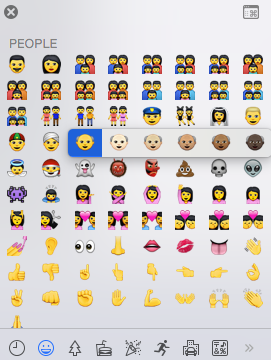
Three Marketing Lessons from Apple Emoji: Embracing Diversity or Simply Racist?
Users can now click and hold on the icon to change the skin tone on OS X 10.10.3 as well as iOS 8.3 beta 2. It is fun that we can now have Santa in different colors, and while general public celebrates the introduction of different type of family as advocating equal rights for LGBT families, Asian consumers are not too impressed with those 'ultra-yellow' emojis.A microbloggers wrote, "It looks like the yellow people have jaundice". The single post received thousands of likes on Chinese social media Weibo. Due to the long racist history of using "yellow" to describe Asians, many found the bright yellow tone uncomfortable or inaccurate. 'This can't be an Asian person', many said, and even more claimed that they are not inclined to use such emoji to describe themselves or their friends. (For more try weibo.com and search for a keyword combination of '苹果'-Apple,'表情' - Emoji, '黄'-yellow)
Regardless of the pathetic technical reasons that the yellow is simply brought by a standard set by UNICODE, what could we marketers learn from this unfortunate backfire when taking ethnical groups into account?
1. Don't think too highly of yourself.
It gets extremely complicated when marketing on a global scope - different cultures, different rituals, and different traps that you definitely hope to avoid. Your Asian friend might be okay with the super hilarious campaign to use in Taiwanese market - I personally very much enjoy the French comedy Qu'est-ce qu'on a fait au Bon Dieu? (Serial Bad Weddings) where a Chinese son-in-law is constantly laughed about trying too hard to please the in-laws, but the case would hardly be the same if the movie is to be broadcast over a Chinese national network. Take your time. Research your consumers. And be extremely generous when it comes to running tests on ethnical topics.
2. Monitor the social media your target actually use.
High conversion rate of Facebook Ads? Yes. Instagram great for luxury marketing? Yes. Your global consumers care about them? It depends. Line, Wechat, Kakao Talk, Weibo, and many other social platforms that I may have little knowledge of might be the center of world for your target consumers. If your new campaign has been retweeted thousands of times, try to get some sleep before you excitedly tell your colleagues several time zones away to work on it immediately. Those paying for your product might never own a Twitter account.
3. React. FAST.
No excuse to wait longer even if complaints are breaking out in another part of the earth. If negative comments appear, try to act as promptly as possible as if your boss is watching from your back. If the bright yellow color is a UNICODE default and not Apple's fault, let your consumers know. While I can find a detailed and convincing article explaining the yellowish color in English, I have yet to find any similar content in the Chinese world. And it has been FOUR DAYS since the initial controversy blurt out.
Monday, November 24, 2014
Apple improves its retargeting capabilities
Source: VentureBeat
Sunday, September 22, 2013
Burberry and Apple Collaboration for Fashion Week
Saturday, December 03, 2011
Microsoft Office Coming To iPad Next Year, Says Report
------------
Apple Could Have Three iPads For Sale Next YearMicrosoft may be bringing Office to the iPad next year, according to a report in The Daily.
The report cites unnamed sources, and says that Microsoft will also update its version of Office for the Mac next year.
On a business level, it might make sense -- the iPad is making inroads into enterprise, and having some sort of Office client available for it would let Microsoft earn at least some money from these Apple invaders. It would also help ensure that Office 365 -- the company's cloud-based business services -- would work on the iPad.
Microsoft might even do this at the risk of driving some enterprise customers to stick with iPads instead of adopting Windows 8 tablets. After all, Office and related back-end products has been driving Microsoft's growth for the last year, while Windows sales have been pretty stagnant. And Microsoft has built a version of Office for the Mac for more than a decade now.
But there are a couple possibly relevant facts that the report did not mention:
OneNote came out for iOS in January. OneNote, a note-taking app, is now considered one of the four core Office apps -- Excel, Word, and PowerPoint are the others. In January, Microsoft released a version of OneNote for the iPhone. It works on the iPad, but isn't optimized for it. Perhaps Microsoft is simply creating an iPad-specific version of OneNote. Or maybe that really was the first wedge.
Microsoft has NEVER released Office for the Mac in the same year (or before) Office for Windows. Microsoft is heads down building Office 15 for Windows. It's going to be a ton of work -- in particular, Microsoft will have to revamp it to work with the Windows 8 tablet interface, or risk having it relegated to traditional PCs only (and having one less reason for customers to choose Windows 8 tablets). The Mac version of Office almost always comes a year after the Windows version. It COULD be different this time, but that would require a diversion of resources to a minority platform (the Mac still has less than 5% market share for personal computers).
Microsoft didn't exactly deny the report, saying through a spokesperson:
"We already deliver Office on multiple platforms and devices and are committed to expanding in the future, but have nothing further to share today."
That little bit -- "committed to expanding in the future" -- is worth noting. There are only a few major platforms out there, and Office is already on three of them: Windows, Windows Phone, and the Mac. Or four if you include OneNote on iOS. So expanding to the iPad is not crazy.
http://www.businessinsider.com/microsoft-office-coming-to-ipad-next-year-says-report-2011-11?nr_email_referer=1&utm_source=Triggermail&utm_medium=email&utm_term=SAI%20Chart%20Of%20The%20Day&utm_campaign=SAI_COTD_112911
Monday, October 24, 2011
Can a tech company surpass big oil?
Sunday, August 07, 2011
Apple Gets Its Wings
Sunday, May 16, 2010
10 reasons to hate iPad or why no one should ever buy it...

It’s been said a lot recently about iPad and one common thing observed in all reviews is that people tend to split into those who realize all disadvantages of this gadget and those who simply overlook them trying to convince themselves that this device is well worth the money they wasted on it. Well, I’m a very rational person and simply knowing all disadvantages of iPad I can’t even think of buying it. So here is the list of what makes me skeptical about it:
1) No Multi-Tasking. Yeah, this one bothers me the most. 5-years old symbian-enabled Nokia phone can do it, so why the device that Steve Jobs calls a "magical and revolutionary " can not? Why can’t someone listen to music while browsing the web? Twitting while reading? What the heck? For a device that intended to be a substitution for laptops/netbooks and costs as much as the iPad does, the inability to multitask is unforgiving.
2) No Camera. Yeah, the same old Nokia has camera, 2 actually. I can’t say what is worse: not to have a front-facing camera for video-chats or not-having a back camera which should be natural for a such mobile device. Camera now is commodity. Very cheap commodity. And I see no reason not to include it. Even iPhone which I don’t like either has 2-3mp camera.
3) No USB. Since its inception in 2001 miniUSB became a standard for mobile devices. Then it was followed by microUSB. But Apple always has its own way. And usually this way is quite awkward (recall how long Apple was torturing its users with PowerPCs). Only Apple with its hunger for $ that could be earned on proprietary adapters (adapter for USB for god’s sake) could do it.
4) No Flash. End of last month Steve Jobs published very unusual letter that ended up with very thoughtful claim: “Flash is no longer necessary”. Yes, Steve, perhaps for you. But I’d still prefer to be able to browse many web-sites, play games and watch videos. Perhaps this guy believe in HTML5 – but Apple took no action in its development and it will be another 2-3 years before it takes off.
5) No VoIP. Sounds weird? But that’s true. As Dan Neary, Skype VP, stated this week: “I think the iPad is an exciting product but it is clearly not the same communications device in its current form that the iPhone is. So we’re looking forward to further advancements in the iPad and where that can go in the future.” Politically correctly, indeed. But the point is clear: I think he said the same earlier this year when Skype discontinued its Windows Mobile support.
6) Small storage. 16-64Gb – what is it? Are you kidding? My external hard drive is 1500Gb. My 500$ laptop is 320Gb. My tiny USB stick is 16Gb. It’s not a Nook, nor a Kindle that are supposed to store mainly books. This is a multimedia device and memory is crucial. And we all know that Apple never gives us a chance to increase memory in its devices.
7) Lack of widescreen. New iMac is 16:9. iPhone is 3:2. iPad is 4:3. The past is back. Welcome and enjoy almost forgotten old-TV experience.
8) No GPS on pure-WiFi versions. Many called iPad a giant iPhone. It’s not quite true. iPad is worse in all aspects except it’s bigger. And GPS is not exception: iPad for $699 doesn’t have it.
9) Poor reading experience. Unique combination of a heavy weight and the glare on the screen makes using iPad for a long periods “a battle for comfort”. Unlike with Kindle one can’t read well in direct sunlight with iPad. Moreover you can’t download books you bought from Apple bookstore for your iPad to your Mac or iPhone.
10) Price. I kept it for a last but it’s a very important aspect for many. $699 for 64GB for pure-WiFi and $829 for 64 GB for WiFi/3G model – come on, Lenovo’s IdeaPad S10-3t does it all for less than $500 and boasts much better specs than any generation of iPad is likely to have. Modern netbooks start from $250 and by $499, which is starting price for 16Gb iPad, you have a big choice of very good devices. Add to it quite expensive apps and it’s hard to believe in Job’s intention “to put this (device) in the hands of lots of people”.
You are not yet convinced with these 10? Then consider some “bonus”: no SD slot, no HDMI out, closed apps (i.e. you don’t have a choice for pre-installed programs like browser), use of microSIMs (the whole purpose of it was to fit into devices otherwise too small for a mini-SIM – and it’s not iPad for sure), poor reviews on keyboard experience and quality of WiFi receiver.
And yes, I do realize that some of these drawbacks were made by Apple intentionally as a part of their strategy of introducing more advanced models a year or so later after the first release. I think about it as a unique way of Apple to minimize its R&D costs – there are so many simple things missing in iPad that you can add them in the new models another 2-3 years. And while it may be a good strategy from marketing standpoint, it completely undermines my view of iPad as an innovative product.
So my suggestion: wait for HP Slate and MS Courier later this year just to see the differences yourselves or buy a good netbook from Acer or Lenovo already now.
Friday, February 19, 2010
CBS May Be Making Online TV Even Cheaper
In a move that could spell even lower value perception by consumers for online media content, Mashable reports that CBS's Les Moonves is hinting that the price point for television programs may be lowered to $0.99 saying, "There are certain shows that will be sold on Apple for 99 cents."Tuesday, January 26, 2010
Is the tablet really more imporatnt the the State of the Union
http://gawker.com/5456613/steve-jobs-is-walloping-the-president-with-his-magic-tablet
I think it actually makes sense. After all, we all know exactly what Obama is going to say: "Ladies and Gentlemen, the State of the Union is Strong." However, very few people know what exactly is this tablet - is it just a giant iPod touch or is it the device that'll kill all traditional media outlets. Perhaps more importantly, we pretty much know how much the healthcare reform bill is going to cost us. The price of the tablet is still unknown.
Jonathan Shulman