A blog for students of Professor Kagan's Digital Marketing Strategy course to comment and highlight class topics. From the various channels for marketing on the internet, to SaaS and e-commerce business models, anything related to the class is fair game.
Sunday, March 01, 2015
Future of Google+
Wednesday, October 22, 2014
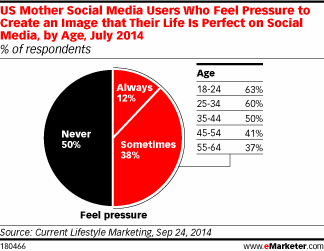
Can Moms Handle Social Media?
SOURCE: http://www.emarketer.com/Article/Do-Mothers-Need-Some-Time-Away-Social-Media/1011350/1
Wednesday, June 29, 2011
Here comes another social network: The Google plus
It has been a while Google is trying to come up with a next generation of social network tool however it has not worked for them. There is a hope that by launching this new gadget that has not only features from Facebook but also introducing many other cool features like user maps, video chat, Huddle, Sparks and Circles.
For a complete article visit Google official Blog
This article is also published on my personal blog at Digital Strategist.
Tuesday, June 09, 2009
On the Do’s and Don’ts of Social Networking for Arts Institutions
I recently came across an interesting article on the Do’s and Don’ts of social networking for Arts institutions on the Founder of Art Journal, Don McLennan’s, blog Diacritical entitled “10 Ways to Think About Social Networking And The Arts (the zen of "free" as a strategy. ” (Available from: http://www.artsjournal.com/diacritical/2009/05/power-in-numbers-there-ought.html)
In his post, McLennan begins by outlining some of the most compelling reasons for Arts institutions to adopt Social Networking tools such as Facebook, MySpace and Twitter such as the need to replace aging core art audiences with younger audiences and the need to build strong brand connections in an increasingly competitive arts landscape. After establishing the context, he then proposes a list of the 10 most important things for Arts institutions to remember when they are about to get involved with social networking. This list includes: avoiding an “Institutional voice” in communication; providing incentives to membership such as discounted or last minute tickets to shows/events, or special applications; and resisting the urge to use social media exclusively as a tool to sell tickets by supplementing your sites with interesting links, feedback from the institution, video, photographs, etc.
As someone interning this summer in the marketing department of a museum, I found this article interesting because it tied back the issues we have been reading/discussing in class to Arts industry. I was also excited to see an article on social networking featured in a widespread Arts Journal because it demonstrates that Arts institutions are starting to become savvier about their marketing campaigns. In my opinion, social networking is a very worthwhile tool that cash-strapped Arts institutions such as museums can leverage to promote their brands and connect to new audiences and that institutions that do not capitalize on this tool in the next couple of years will ultimately miss the boat.
Before signing off on this post, I wanted to just mention as an aside that McLennan just posted a really interesting post on the current Facebook Fanpage fueled battle between New York Magazine art critic Jerry Saltz and the staff at MoMA over the MoMA’s relative lack of artwork by female artists in its permanent collection entitled “When The Mob Turns Angry, What’s a Museum to Do?” (Available from: http://www.artsjournal.com/diacritical/2009/06/when-the-mob-turns-angry-whats.html ). This post really highlights how viral Facebook posts can really damage an institutions reputation if not handled properly.
Wednesday, May 13, 2009
You've been tagged
Wednesday, February 25, 2009
Social Media Detractors Continue to Sound Off
Much like Hulu claims to want to rot your brain into a cottage-cheese like mush, to be scooped out with a melon-baller and gobbled up (Hulu, an evil plot to destroy the world), social networking sites, according to Oxford University neuroscientist Susan Greenfield, may be contributing to the infantilization of the brain. She worries that “these technologies are infantilising the brain into the state of small children who are attracted by buzzing noises and bright lights, who have a small attention span and who live for the moment.”
Her argument is that if the young brain is exposed from the outset to a world of fast action and reaction, such rapid interchange might accustom the brain to operate over such timescales. When in the real world such responses are not immediately forthcoming, perhaps we will see such behaviors and call them attention deficit disorder.
Of course, without a scientific report to back up her claims, the video game and social networking communities are content to ignore the claims.
Monday, February 09, 2009
Facebook Has a Monetization Plan?
According to Telegraph, Facebook will soon allow multinational companies to selectively target its members in order to research the appeal of new products. Companies will be able to pose questions to specially selected members based on such intimate details as whether they are single or married and even whether they are gay or straight. The company's advertising department is marketing the new service to thousands of companies worldwide and it hopes the polls will go live this spring.
Like YouTube, Facebook has struggled to make money from advertising because of the unpredictable appropriateness of content adjacent to advertisements. Why does it matter whether or not Facebook has a strong and growing revenue source? Because until it does, everything they have worked so hard to build is at risk. If its business model is at risk, partners will be less and less likely to jump on board, compromising the site's network effect. Focusing on a primary revenue source will also signal to businesses building upon the Facebook platform which opportunities Facebook is not going to try to monetize, all of which adds up to opportunity for the developers.
Wednesday, January 28, 2009
Leveraging Old Media with New
This short article (non-subscribers) in the Wall Street Journal discusses a number of innovative means of creating stickiness and/or measurability being tested by several of this year's advertisers. New (to me) is a product in the Canadian market that allows consumers to use their digital cable remote to watch a longer version of an ad or bookmark that longer version for later viewing; the revenue model is decidedly new media: cost-per-click. A simpler tactic among several being used by Castrol is the purchase of keywords related to their ad to assure primacy in post-ad search. Doritos is likely going to take the prize for a second year with their viral ad contest:
“…offering $1million to anyone who can create a Super Bowl commercial for its Doritos tortilla chips that scores No. 1 in USA Today’s …ad competition.”
And, finally, what marketing opportunity would be complete without yet another brand attempting to create an online community, (this one is about Pedigree dog food under guise of pet adoption) which lets you download a barking dog ringtone for your iPhone....
My bets? Simplicity wins. Harnessing true consumer passion for your product wins. Forced community, maybe not so much.