Showing posts with label advertisement. Show all posts

Tuesday, December 08, 2015

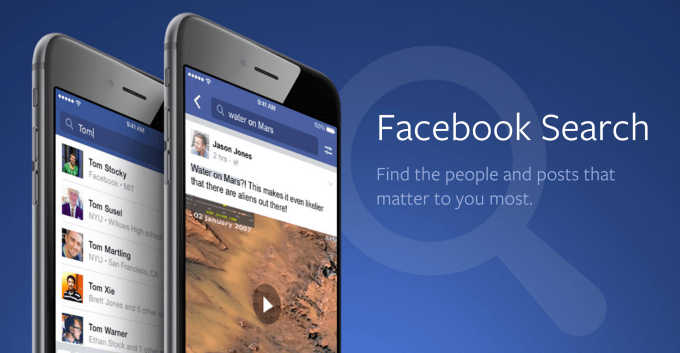
Is Social Search dead?

Source: Techcrunch

In 2013, Facebook launched what it called its third pillar, "Graph Search". Lead by a team of former Google employees, the company wanted to provide solutions and answers, not just links like Google. Mark Zuckerberg back then said:
What’s more interesting than any of these things (that Facebook currently does) is giving people power and tools to take any cut of the graph that they want.
People were amazed (some also were concerned) about how personalized and specific the search tool worked: You could ask queries like "friends in New York who like Harry Potter and Game of Thrones.” Many were convinced that this could mark the beginning of a serious attack on Google, as you could use the service for recruiting, product recommendations, travel, images, or even dating. The quality of the answers was supposed to be better as they had a "filter", a form of social approval and confirmation. Some even thought it was a feature to make people not leaving the site anymore, as now even search could be done there, but for many things better. Maybe all of that was a bit rash.

Graph Search did not take away significant traffic from Google, or Foursquare or Yelp. In fact, Graph Search was never completely rolled out to all users and its various search features are hidden in different places and subpages. Searching with Facebook again is so bad that Michael Morgenstern, a film maker from San Francisco build his own interface for searching with Facebook, searchisback.com.

As Google failed with its own social network Goggle+, social search still is unconquered territory. Even though Google uses insights about social connections and behavior for its search, Facebook's vast amount of data and user insights are much deeper and richer then that. We are social beings and many of our search requests could be improved by adding a social layer that works approving or just inspiring. Especially in commerce, news and entertainment, the opinion and recommendations of social connections can help prioritizing and filtering web content.
Maybe unbundling search and launching a powerful search app (with personalization features like Google Now) could be a way for Facebook to re-enter the game. I think search still is one of the most exciting spaces in the internet business. Alone because sponsored search is closer to transactions and its success is easier to measure, I think Facebook should keep on considering it a tremendous business opportunity.


Wednesday, November 18, 2015

Three Social Media Mistakes Walmart Is Making Right Now

Three Social Media Mistakes Walmart Is Making Right Now

Retailer giant Walmart has been known of its successful commerce- the ability to sell products. While retailer certainly should be aggressive to promote its products through advertisements, they often oversee many mistakes, and some of which are detrimental. In this article, one of Walmart’s major campaigns serves as a great example: Greenlight A Vet, a campaign to honor veterans for the rapidly approaching Veteran’s Day on Thanksgiving and Christmas. I assume that you have noticed Greenlight A Vet ads online, if not on TV. The ads ask Americans to leave a green light on I their homes and offices to show support for veterans. The company has even created a website and a YouTube Channel to promote the idea. The website specifically presented that Walmart is the ultimate sponsor and there is very little crossover between Walmart’s main digital properties and the campaign. As an outsider, I perceived the greenlight event completely divorced with Walmart itself. The advertisement involves significant mistakes.

First of all, the call to action is weak. Although the hope of supporting veterans is absolutely welcoming, but the campaign itself is slick, with just enough emotional touch to create a feel-good feeling and not much else. From my own perspective, I would ask myself, why would I blurb a light bulb for someone I do not know? I have much more stuff to finish and this is just a waste of time and energy, and most importantly, I get nothing from doing so. That is, Walmart merely just invited people to participate and light a bulb, what other meanings can this action delivers to the public? A more practical method of promoting support of veterans could be asking people to post a photo with a green light bulb and hashtag veteran or something similar to that notion. The point is to invite people to participate in the dialogue by asking them to submit their own stories and experiences. A mere promotion in social spaces is just not enough.

Second, commerce and community are not connected. How would you expect people to participate in your event when there is no direct link to buy a green light bulb? If Walmart wants to promote sales and commerce, not only should it provides the online access to purchase light bulbs, but also offers discount on the entire purchase if people share a photo of light green bulb. Ideas like this would definitely help promote the campaign.

Last but not least, a disjointed content strategy is a big mistake. Consumers are exposed to various colors of green light bulb, but are not reminded about what the bulbs are! That is, people have no idea what positions they are in, thus further confused by the link between Walmart and the event website. My recommendation is to put “Are you inspired by the video?” and the “Yes” button takes people to the shopping cart of the green light bulb. This way, it is more logical for consumers to understand what is happening and how to support the veterans in action.

In sum, the effort is noble, yet it requires sophistication and adjustment in order to be more effective. Every company makes mistakes, including a retail giant like Walmart.

Saturday, October 03, 2015

Rise of ad-blockers shows advertising does not understand mobile, say experts

“Apple's shiny new mobile system iOS 9 allows anyone using an iPhone to cut out ads, taking a bite out of the $31.9bn mobile ad market, not long ago touted as the savior of the publishing industry.” Not only did Apple change the color of their new product, it also changed their attitudes toward advertisements. Indeed, people are annoyed by ads, even including advertisers. According to a survey, 75% of online video ad viewers complained about seeing the same ads over and over, 62% were upset that there were so many ads, and nearly half thought the ads went on too long.


In my opinion, the purpose of the ads cutting system is to block frauds and enhance the mobile security for phone users. Nevertheless, a trade off for the reduced fraud-ads and virus-ridden badvertisement is the detrimental effects to publishers, especially small ones. While people may suffer less from the reduction of annoying ads that interrupt the streaming of the radio or videos, restricted advertising power will hurt the financing process of the ecosystem. As we have seen the effect power of the blocking system of iOS 9, $31.9bn has been eradicated from the media ad market. Among the blocked ads, I am certain there are quite a few are in fact legitimate and provide real great deals to people. By simply blocking ads without conducting quality examination and identity verification, ad-blockers will inhibit the growth of media market, suffocating many new media start-ups and small businesses. Then the problem will turn into a finance issue, rather than a negative advertisement effect. Therefore, I agree with Constantine Kamaras, chairman of the board of the Interactive Advertising Bureau (IAB), “The best path is a digital entente between users and companies that is based on quality standards and codes of conduct, but also on an understanding that all these services can only be financed, today at least, by advertising.”

Source: http://www.theguardian.com/technology/2015/oct/03/ad-blockers-advertising-mobile-apple

Friday, February 20, 2015

How to make a good advertisement


Nowadays people are unscapeble from advertisement. All kinds of companies try to grab customers’ attention by displaying their advertisements. 10 years ago, or even 5 years ago, advertisements on TVs dominated the ads market. As the internet becomes more and more popular, a large proportion of advertisements shift from TV to online platform, such as desktops, laptops and mobile phones. It seems advertisement industry has dramatically changed. However, one thing is still true that customers won’t remember most advertisements. Therefore, increasing the efficiency of advertisements is still an important goal for advertisements.

In order to discover how to create a more efficient advertisement, we need to understand how online advertisement works. This is a link https://www.youtube.com/watch?v=1C0n_9DOlwE introducing the flow of advertisement.

Online advertisements are divided into several segments. Three most important ones are search, display/banner and mobile, which respectively occupy 43%, 19% and 17% of the market share. Search advertisements are different from the rest because search advertisements are more passive. For example, an search advertisements only shows up when a researcher want to search this particular topic. However, Display/banner and mobile advertisements can actively target their consumers. Therefore, these two types of advertisements can have more strategies.

There are five ways to make display ads more efficient. First, tracking mouse movements can catch hesitation of consumers and provides evidence for subsequence research of consumers. Second, adding a map while consumers searching for locally available goods would make an ad very efficient in terms of turning searching to a purchasing behavior. Third, adding a calendar tool would be extremely useful for promoting film and TV launch dates. Forth, use dynamic creative data-drive display ads can pull relevant data about the user’s online behaviors. Fifth, social media is a great platform for users to share ads.


Having a more accurate targeting while advertising products makes both consumers’ and sellers’ life much happier.

Monday, May 25, 2009

end of the ad?

Jeff Jarvis of Buzzmachine writes often about the intersection between media, news, advertising, and the internet. His latest book is "What Would Google Do?", and in recent interviews he's posited something I find pretty interesting: the idea that advertising, as we know is, is pretty much over:
"Advertising is failure. If you have a great product or service customers sell for you and a great relationship with those customers, you don't need to advertise."
Now this, he admits, might be going a bit far - obviously, if you have a new product and no market awareness, you're going to have to do some advertising. But Jarvis suggests that the marketing relationship between company and consumer is changing, and changing fast. He suggests that the openness of the internet means that your product and your pricing are open for all to see - and in effect, your product becomes all the advertisement you need.

Instead, then, companies ought to consider spending their ad dollars on a more extended campaign to cultivate relationships with their consumers, for example - spending those ad dollars on online customer service, and calling that marketing.

In an interview on C-Span, Jarvis talked of the shifting roles of advertising and PR in a company's marketing strategy. Previously, advertising would make up the bulk of a marketing plan, and the public relations strategy would fill in the holes - essentially performing a stopgap measure. Jarvis envisions a new world where the flipside is true: advertising will end up filling in the gaps of a marketing plan that a strong PR plan can't address.

The reason why PR will be pushed to the forefront is that companies marketing online are now involving their customers to participate in their product to such a degree that these efforts amount to a long-term public relations campaign that has much less use for an advertisement. Continuous input and interaction with customers - with customers even contributing self-made testimonials or messages reinforcing the company's product - is an ideal that bypasses the need to create ad hype, and to the consumer, may feel far more genuine.

The Vest advertising blog points to several examples of this move from advertising to a more sustained, long-term "PR campaign" in which companies have created sites intended to foster very high degrees of consumer participation. The most interesting is The Potty Project from Huggies, where several real families and their babies represent different potty training "styles." These families are blogging, submitting video diaries, and using the site as a platform to discuss the difficult and confusing process of toilet-training a young child.

This to me illustrates very clearly that indeed, advertising - in the form of 30 second spots, inserted into my Hulu or my NYT - isn't dying, necessarily (Jarvis can get a little hyperbolic) - but I do believe that the kind of thing that Huggies is doing with the Potty Project is the direction marketing should be moving in - instead of producing diapers and a series of ads to sell them, Huggies is creating a platform for people to gather. It's a radical re-thinking of what marketing a product even means.

The consumer goods producers aren't the only ones starting to think this way - Rupert Murdoch and management at the NYTimes have both indicated that they are working on developing software to host blogs - to also essentially become platforms for other writers and bloggers.

It seems like the best marketing message you can send to your customer isn't so much about your product but your relationships with them - and now instead of talking about how you're "there" for your customer in a fifteen second advertisement, you can actually make these relationships manifest.

Wednesday, January 28, 2009

Leveraging Old Media with New

Often we focus more on how digital is supplanting traditional media and less on how a nicely integrated campaign can leverage the best (or worst) of each. One area of TV advertising that has to-date remained more or less sacrosanct is the good old Super Bowl spot. While no longer breaking price records year-over-year, in an era of fading revenue the spots seem to be holding their own. But these costs create a new demand: in this austere media environment, how to maximize and measure the productivity of these budget-busting ads?

This short article (non-subscribers) in the Wall Street Journal discusses a number of innovative means of creating stickiness and/or measurability being tested by several of this year's advertisers. New (to me) is a product in the Canadian market that allows consumers to use their digital cable remote to watch a longer version of an ad or bookmark that longer version for later viewing; the revenue model is decidedly new media: cost-per-click. A simpler tactic among several being used by Castrol is the purchase of keywords related to their ad to assure primacy in post-ad search. Doritos is likely going to take the prize for a second year with their viral ad contest:

“…offering $1million to anyone who can create a Super Bowl commercial for its Doritos tortilla chips that scores No. 1 in USA Today’s …ad competition.”

And, finally, what marketing opportunity would be complete without yet another brand attempting to create an online community, (this one is about Pedigree dog food under guise of pet adoption) which lets you download a barking dog ringtone for your iPhone....

My bets? Simplicity wins. Harnessing true consumer passion for your product wins. Forced community, maybe not so much.

Thursday, February 15, 2007

A new world for advertisement has been born


I have read two different articles these past weeks that together are even frightening. On one hand, Mini (by BMW) has launch a marketing campaign in billboards all across New York, Chicago, San Francisco and Miami. Those billboards (see picture) are able to read RFID information from Mini cars, therefore users can customize the message in the billboard with anything they want when they drive close to the billboard. It is getting close to the future presented by the movie Minority Report.

For those that have no idea what RFID is, let's say that is going to be the BarCode of the future. All the products are getting tagged with RFID chips that send information to computers without requiring a scanner or similar. Let's compare to a wireless barcode.

Some uses are:
  • Supermarkets: you buy what you want and you don't have to take everything off your cart to pay for it. As soon as you are in front of the cashier, the computer knows how much it is. Even, I saw one test of carts with a display that shows you how much it is.
  • Distribution industry, Inventory Management: there is no more need for manual recounts or checking. The SKUs are telling you: "I'm here or not"
Now, the scary part, Hitachi has announced a couple of days ago that they have produced RFID chips so smaller that can be confuse with powder. Look at the image, the right part shows a human hair with lots of chips around. Be prepared to have dozens of RFID chips close to you in the next years: your pants, your shirts, your shoes, your food, your pills, your watch, ...

In terms of marketing, it has huge impact. You will get into a retail store and they will be able to know what is your size, what colors do you wear now, what are your favorite brands, ... I told you, scary future!!!

Wednesday, February 14, 2007

New Social Media AD Widget


RSS ad network Pheedo has announceda new service tonight - an advertising widget powered by RSS and incorporating several social media tools. You can see an example in the webpage.

The idea is that some of the ads that companies are producing to attract customers to their sites are really amazing. Why do not rate them with Digg, Furl, Del.Icio.Us or Technorati? That's the goal of this new application.

Through RSS you will subscribe to different ads that will display (even with Video) on your widget and you will have the chance to rate them.

I must recognize that seems to be a complete out of the box idea, but I don't see yet the real application.

Sunday, February 11, 2007

Slashdot is trying

According to this screen capture posted in digg, it seems that Slashdot.org is beta testing a new functionality that will bring together the outstanding user generated content with the social network effect.

The name would be Slashdot Firehose where users would be able to rate and vote posts like in digg. I guess that there are two main objectives:


a) Increase the time that users expend on slashdot.org, social places usually present a higher time per user on the page ratio

b) Create a better segmentation of the users that will lead to more advertisement dollars getting into slashdot.org

Saturday, February 03, 2007

Will Teens "Flip" or Just Stick to MySpace?

Conde-Net, the interactive arm of Conde-Nast, is jumping into Web 2.0 with Flip and they're taking the advertisers along with them.

Flip will basically be a Conde-Net version of MySpace (if perhaps a bit cleaner in layout). The promise of access to the 'tween and teen market has attracted major advertisers, like Nordstroms and Clean and Clear (a J&J brand) who, in keeping with the spirit of the site, will allow users to choose where and how they view the ads. These ads will appear in each user's image bin. From there, a girl could place this brand's chosen image anywhere on an any of her Flip pages.

First of all, these companies will be surrendering a huge amount of control over their brand to 13 year old girls who will be able to not only create the content surrounding the image, but also, will be able to digitally doodle on the image itself. Companies like J&J (you know, A Family Company) do not take the idea of objectionable material lightly and must be counting on a traditional media company like Conde-Nast to keep things in line - monitors have been hired to examine sites and remove anything objectionable.

Second, unlike traditional advertising, no one has to view these ads. The onus will be on these companies to create images that are attractive, interesting and hip enough to be chosen by the users. Perhaps in response to this challenge, many of the images will be largely unbranded. Nordstrom will offer clips of their clothing that viewers will only be able to identify by clicking on the image. Clean and Clear will not place its brand anywhere on word-play icons, like "Fresh!"

While this seems like a huge sacrifice of control and visibility on the part of the advertisers, I think that they are bending over backwards to seem genuine and, thereby, find a foothold in this explosive market that seems largely resistant to any intrusions by the market.

Saturday, January 27, 2007

Google Bomb


On 25th January, Google announce officially that they have an algorithm that correct / avoid the effect know as Google Bomb (see wikipedia). Playing with some flaws in the algorithm people was able to establish ways of changing the results. One of the most famous is the search for "miserable failure" that send you to the White House.

It is a new alteration of an algorithm that is getting a lot of criticism on Internet. What do you think about it?

Thursday, January 25, 2007

Quite an interesting (and expected) Google development:

Google said it would distribute advertising alongside videos from Sony BMG Music Entertainment and Warner Music Group (NYSE:WMG - news) over its AdSense online ad system to Web site publishers in a four-week test now underway.

"Over the past few months, we have run tests to figure out how we work with our partners and advertisers to combine high quality video content with ads and then distribute them (over) the Google AdSense network," Google said in statement.
The test with the two music labels follows an earlier public trial of Google's video advertising system with Viacom's (NYSE:VIA - news) MTV Networks, which provided music videos to run on a select number of Web sites running Google ads.
As part of the test, advertisements would be billed on a cost per thousand impressions (CPM) model, the traditional billing method for mass market advertising as opposed to the pay-per-click billing model Google popularized with text ads.
Google has been pushing ahead in recent months to expand beyond its hugely successful text-advertising system into new advertising formats including video, radio and mobile phones.
As a example, Warner Music has defined multiple video channels along themes like "rock music" or featuring the "Divas of Pop Music." A Web site owner can select a video channel and embed it on a section of the site dedicated to running Google AdSense ads. Visitors then can click to watch ad-supported videos within the video channel on sites running the ads.
The Google advertising system splits the resulting revenue three ways to the video content owner, the Web site publisher and Google. The exact revenue splits were not disclosed.

Saturday, January 20, 2007

Google's Next Ad Frontier May Be VideoGames

From today's WSJ, Google is thinking about getting into the VideoGames advertisement market.

The Mountain View, Calif., company is in talks to acquire Adscape Media Inc., a closely held San Francisco company whose technology allows for the delivery of advertising over the Internet and placement within videogames, according to people familiar with the matter. They added that a deal could be reached as early as next week.

While the possible terms of a deal aren't known, Microsoft Corp. last year acquired Massive Inc., a company that delivers in-game ads, for close to $200 million.

An acquisition of Adscape, if completed, would allow Google to offer the hundreds of thousands of advertisers who currently buy online ads through its system to also buy ads that appear within videogames. The market for delivering ads into games -- such as a virtual billboard on a racetrack or a poster in a boxing arena -- is still in its infancy, but major games publishers such as Electronic Arts Inc. believe it could be a lucrative business and many are pursuing it aggressively. Sending ads over the Internet is just now becoming more feasible through new game consoles such as Sony Corp.'s PlayStation 3 and Microsoft's Xbox 360, which are designed to be connected to the Internet.

I don't know much about the videogame adv. industry but it has some characteristics that I believe are really interesting:
  1. Segmentation: the process of selecting the videogame to play is a process of auto-segmentation. Usually each game has a concrete and specific audience. That would be a great match for Google matching know-how.
  2. Size and evolution: the new consoles are bringing to this market (time ago just for hard core users) all new kind of players. First, he number of woman acquiring and playing with last generation consoles is growing incredible fast. Second, players are no longer someone in the range 14-25 years, they are located in the 14-40 years range.
I would argue too that videogamers should have a lot in common with Internet users where Google is actually king. It seems overall to be an interesting movement.