Showing posts with label Stephanie Liakos. Show all posts
Showing posts with label Stephanie Liakos. Show all posts
Tuesday, December 08, 2015
Outdoor Ad Spending is on the Up
Outdoor ad spending continues to rise with growth starting to outpace total ad spending growth levels. In Q2, outdoor ad spending jumped 2.2% versus a 3.9% drop in total ad spend.
Interestingly, startups and tech companies are contributing more than ever to outdoor ad spending. NYC startups like Percolate and Jet.com have been spending increasing amounts on outdoor ads.
What's so great about outdoor ads versus digital branding? When advertising outdoors you ensure that real people see your ads! Simple and obvious, but a real consideration for advertisers with limited budgets. The WSJ explains why digital advertising is sometimes a bigger gamble than outdoor marketing: "Brands have been pouring dollars into online marketing, but are worried about ads that can be buried in corners of websites that aren't viewable, and about computerized "bots" that goose traffic results artificially without any humans seeing ads." Said differently, online marketers often end up paying for ads that were viewed by bots, not potential consumers. This results in lost advertising dollars that could have been used in a more effective way.
Obviously digital marketing spend isn't going anywhere. In fact, as mobile use grows and advertisers become more strategic with online marketing choices, we can expect ongoing growth in online digital spend. That said, outdoor advertising isn't going anywhere either. Most sophisticated advertisers will avoid just one advertising channel and instead focus on a diversified ad plan consisting of digital and outdoor, among others.
http://techcrunch.com/2015/12/05/outdoor-is-the-new-black/
http://www.wsj.com/articles/outdoor-ad-industrys-pitch-real-people-see-billboards-1443438000


Wednesday, December 02, 2015
Is Amazon the search engine for online shopping?
It's obvious that Amazon has changed the way many consumers shop. Today, consumers walk into Best Buy with no intention of buying; rather, they use Best Buy as a showroom for the products they ultimately purchase on Amazon! Additionally, many consumers looking to make an online purchase go directly to Amazon rather than Google or a brand-specific website. Clearly Amazon has changed the way people shop, but to what extent?
A recent 2,000 person survey by Bloomreach confirms that Amazon is quickly becoming the dominant player in online shopping search!
- 44% of consumers start product searches on Amazon! 34% use search engines and only 21% go directly to a specific retailer.
- 75% of consumers say Amazon personalizes their shopping experience the best! This is probably a result of Amazon's retargeting campaigns and "Customers...Also Bought" sections which show you product ideas that similar consumers like.
As for online retail stores, a survey of 500 companies showed:
- 44% say their biggest online threat is Amazon
- Personalization is their top priority (further evidence they are trying to compete with Amazon!)
What does this mean for the future of online shopping? Online retail companies will increasingly compete with Amazon's vast product offerings and competitive prices. Perhaps Amazon hopes these companies will ultimately be forced to list prices directly on Amazon via Fulfillment by Amazon (FBA). Amazon receives a ~30%+ margin per item sold via FBA, so it's not unlikely they are working to push more smaller digital shops to list product on their site. No wonder Amazon's stock price has been skyrocketing lately!
Tuesday, December 01, 2015
34% of Thanksgiving/Black Friday Online Sales Made By Mobile; Cyber Monday Sales Reach New Highs
Adobe, which tracked approximately 4,500 sites in the past week, confirmed that Thanksgiving and Black Friday online sales netted $4.45 billion this year with 34%(!) of purchases made by mobile phones (the large majority being smart phones). Other interesting stats:
- Thanksgiving online sales were up 26% this year, according to IBM, though it is unclear whether this rise was due to (1) online sales outpacing in store sales and/or (2) more online stores opening up sales to customers on Thanksgiving rather than waiting until Black Friday
- The average value of online purchases may be falling. IBM confirmed that the average order was $123.45, down from $125.25 last year and $132 in 2013
- This change is alarming. Are stores offering on average lower valued goods or higher discounts OR are economic conditions forcing consumers to pull back their spending (probably the former)
- Smart phone shoppers spent $117.87 per order
- 57% of Thanksgiving shopping traffic came from mobile phones though only 34% of purchases were made by mobile
- Black Friday sales jumped 14% YoY
As for Cyber Monday, sales hit a new high of $2.98 billion, a 12% annual increase. Other interesting stats:
- Out-of-stock rates hit a new high of 13%, 2x the normal rate
- The U.S. cities with the greatest growth in online sales were Dallas Fort Worth, Chicago and Los Angeles
- Consumer sentiment was 16% more positive on Cyber Monday than Thanksgiving/Black Friday
Source: http://techcrunch.com/2015/11/28/thanksgiving-online-sales/#.oxpvr2:R4xy
http://www.adobe.com/news-room/pressreleases/201511/113015AdobeDataCyberMondaySales.html
Tuesday, November 24, 2015
Mobile Vs. Desktop: Mobile Won, But You Might Still Be Losing
Everyone agrees that a mobile-friendly website makes one's online presence more powerful -- your customers can find you while browsing on a smart phone AND search engines (i.e. Google) will better rank you for having mobile presence. Now, however, many are arguing that mobile website development and marketing efforts should be given priority over desktop website development and marketing efforts. Here's why:
1. Traffic. Google confirmed earlier this year that mobile searches bypassed desktop searches. For this reason, having a mobile friendly isn't enough. Mobile should be considered a top priority.
2. Social Sharing. Mobile users are twice as likely as desktop users to share content on social networks.
3. Content. Stoney deGeyter of Marketing Land says it best: "The real value in the mobile content is in how it is displayed. Unlike on desktops, with mobile you can chunk and hide content under accordion-type menus. This serves to streamline the viewing area of each page. This content is then displayed on demand to the visitor."
4. Optimization. Mobile and desktop optimization are very similar, particularly so long as search algorithms continue using desktop content for ranking purposes. Mobile can help you win customers, however, with local search optimization. Mobile users are likely on the go and therefore more local-oriented.
Sources:
http://marketingland.com/mobile-vs-desktop-mobile-won-might-still-losing-148800
http://searchengineland.com/its-official-google-says-more-searches-now-on-mobile-than-on-desktop-220369
Tuesday, November 10, 2015
Buy Buttons and the Holiday Season
As mobile shopping becomes more commonplace, some big players - Google, Pinterest, Facebook, Twitter, YouTube and Instagram - are testing ways to allow consumers to buy products directly from news and social feeds.
Each player offers a different twist to their buy buttons:
- Google: captures buyer intent
- Facebook: targeted to specific niche audiences
- Twitter: time-sensitive
- Instagram: offers visual appeal
The question is how rampant these buy buttons will be on mobile during the holiday season. As mobile still only makes up ~15% of all online shopping (according to ComScore research released in June), the big players may not want to risk annoying mobile customers with too many in-the-face buy opportunities. Then again, Jason Goldberg of Razorfish predicts that mobile could account for 50% of holiday shopping this year.
Some social outlets are better suited for the buy button. Pinterest, a virtual wish list, is situated well to use the buy button to its advantage this holiday season. According to Shopify, 93% of Pinterest users look to the site for shopping inspiration and planning. A buy button seems like a seamless offering on such a platform.
Sources: http://adage.com/article/print-edition/buy-buttons-ease-slowly-holiday-fray/301253/, http://www.notimeforsocial.com/social-media-buy-buttons/
Tuesday, October 27, 2015
The Power Of The Call to Action & Recent CTA Trends
Successful marketing campaigns have call to actions (CTAs). No marketing campaign would work without a brightly colored button encouraging consumers to "Buy Now", "Read More" or "Sign Me Up Today!".
Marketing Land, an online marketing news source, recently posted a thoughtful article on call to actions. While not new information by any means, the article reminds us of the importance of CTAs and more importantly, how to create the most effective CTA (a.k.a. how to maximize conversions!).
As a quick recap, here are the most common CTAs:
- Buy buttons / add to cart
- Info-gathering forms
- Subscription sign-ups
- Read more
- Try it now
- Social media share
- Help / online chat
So what defines a good CTA?
- Placement - have multiple CTAs, put them on each page, have them POP on the page
- Design - recognizable, well-defined, striking, appealing
- Copy - clear text, active verbs, communication of value
Before signing off, a quick comment on recent trends in CTAs. Lately I have been seeing many more creative CTAs - particularly in e-commerce store pop-ups. For example, many e-commerce stores love offering first-time customers 10%-20% off if the customer signs up to receive email notifications. Rather than simply say "Sign Up Now to Save", lots of stores have started adding additional, sassy copy below: "No thanks, I don't like saving money" is a common one. It seems the stores are trying to make their CTAs even more emotional for the consumer. By reminding the shopper that they are potentially leaving money on the table if they don't subscribe to email, the store likely improves its conversions.
Marketing Land source link: http://marketingland.com/power-call-action-strength-boosts-conversions-145845
Tuesday, October 06, 2015
Facebook Starts Grading Ads on its Mobile Platform
On Tuesday October 6, 2015, Facebook (FB) announced that it will begin grading ad results on its mobile platform via "Advertising Outcome Scores". Although FB has been grading its ads for a long time -- indeed, Facebook uses its results information to determine ad pricing and placement -- this is the first time that Facebook is sharing its results.
According to Tim Peterson of Adage.com, "the goal is for publishers to use their report cards, called Advertiser Outcome Scores, to improve their ad units' effectiveness by tweaking their location within apps. App developers that don't find a way to improve their scores risk Facebook serving them fewer ads and losing out on revenue."
How will this impact advertisers? Advertisers now know which of their ads are performing well and which need location adjustment. Facebook is incentivizing ad buyers to improve their models. And if they don't? Facebook will likely serve them fewer ads.
Facebook's "Advertising Outcome Scores" should be viewed positively. Facebook is giving advertisers more information so they can improve their ad campaigns. Facebook wants its advertisers to learn from past experiences and optimize going forward. When FB advertisers make more money, FB makes more money.
Sources: http://adage.com/article/digital/facebook-start-scoring-ads-mobile-ad-network/300764/
http://www.webpronews.com/facebook-launches-advertiser-outcome-score-for-audience-network-2015-10/
Tuesday, September 29, 2015
Social Media and the Ideal Length of Everything
Wordstream.com called Kevan Lee's article titled "The Ideal Length of Everything Online" one of the 31 top articles of 2014. Kevan Lee compiled information from social media experts and researchers to tell us, in one long but concise article, what the ideal length is for Tweets, Facebook posts, Google+ headlines, and every other social media caption you can imagine.
Here is a breakdown of some of Lee's most compelling research findings:
TWITTER (tweet)
Ideal Length: 100 characters
Says Who? Twitter themselves, in their best practices section, as well as Buddy Media research.
Supporting Evidence: "Tweets shorter than 100 characters get a 17% higher engagement rate." - Buddy Media
FACEBOOK (post)
Ideal Length: < 40 characters
Says Who? Jeff Bullas via a study of retail brands on Facebook as well as BlitzLocal
Supporting Evidence: "40-character posts received 86% higher engagement"
GOOGLE+ (headline)
Ideal Length: < 60 characters
Says Who? Demian Farnworth of Copyblogger and Qunitly Research
Supporting Evidence: "Google changed the layout of posts so that you only see three lines of the original post before you see "Read more" link... In other words, your first sentence has to be a gripping teaser to get people to click "Read more".
BLOG POSTS
Ideal Length: 7 minutes, 1600 words
Says Who? Medium, SerpIQ
Supporting Evidence: "The average total [time that people read blog posts] rises for longer posts, peaks at 7 minutes, and then declines."
Check out https://blog.bufferapp.com/the-ideal-length-of-everything-online-according-to-science to see more research findings on the ideal length of social media posts!
Sources:
http://www.wordstream.com/blog/ws/2014/10/29/best-online-marketing-articles
https://blog.bufferapp.com/the-ideal-length-of-everything-online-according-to-science
Monday, September 14, 2015
Non-Mobile-Friendly Sites Get Dinged By Google
Slowly but surely, non-mobile-friendly websites are disappearing from top Google mobile search results.
In April 2015, Google launched a new mobile-friendly ranking algorithm that greatly impacts how mobile sites are ranked. According to Practical E-Commerce, "the update improves rankings for sites that provide a mobile-friendly experience to searchers on mobile devices, and, by association, demotes sites that do not."
Google looks at websites on a page-by-page basis - meaning each page is analyzed separately - to determine if the entire site - or just part of it - is mobile-friendly.
Google provides a tool that confirms if your site is mobile-friendly:
https://www.google.com/webmasters/tools/mobile-friendly/
Why did Google change its mobile-friendly ranking algorithm? Google wants to make sure it is the search engine of choice for searches. To do this, it needs to make sure that searches come across mobile-friendly websites while Googling on their phones.
How much does mobile friendliness affect rankings? Moovweb, a cloud-based business that helps companies build out and optimize their mobile experience, recently performed a study on mobile-friendliness vs. search engine rankings.
Moovweb analyzed 1,000+ e-commerce companies to analyze how mobile-friendliness played into SEO. Per the graph below, Moovweb found that, on average, 80% of the top three Google mobile search results are considered mobile friendly.

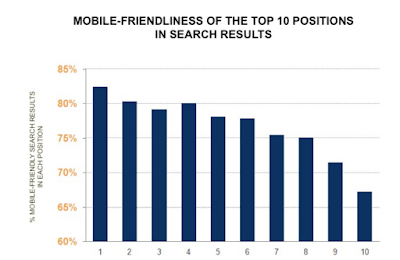
These charts leave one burning question in my mind - why is Google allowing non-mobile-friendly sites to be ranked in the top three?
Sources:
- http://www.practicalecommerce.com/articles/83483-SEO-Google-to-Make-Mobile-friendly-a-Ranking-Signal
- http://searchengineland.com/library/google/google-mobile-friendly-update
In April 2015, Google launched a new mobile-friendly ranking algorithm that greatly impacts how mobile sites are ranked. According to Practical E-Commerce, "the update improves rankings for sites that provide a mobile-friendly experience to searchers on mobile devices, and, by association, demotes sites that do not."
Google looks at websites on a page-by-page basis - meaning each page is analyzed separately - to determine if the entire site - or just part of it - is mobile-friendly.
Google provides a tool that confirms if your site is mobile-friendly:
https://www.google.com/webmasters/tools/mobile-friendly/
Why did Google change its mobile-friendly ranking algorithm? Google wants to make sure it is the search engine of choice for searches. To do this, it needs to make sure that searches come across mobile-friendly websites while Googling on their phones.
How much does mobile friendliness affect rankings? Moovweb, a cloud-based business that helps companies build out and optimize their mobile experience, recently performed a study on mobile-friendliness vs. search engine rankings.
Moovweb analyzed 1,000+ e-commerce companies to analyze how mobile-friendliness played into SEO. Per the graph below, Moovweb found that, on average, 80% of the top three Google mobile search results are considered mobile friendly.

As expected, Moovweb also discovered that mobile-friendliness holds a little less weight the further down you go into the rankings.

These charts leave one burning question in my mind - why is Google allowing non-mobile-friendly sites to be ranked in the top three?
Sources:
- http://www.practicalecommerce.com/articles/83483-SEO-Google-to-Make-Mobile-friendly-a-Ranking-Signal
- http://searchengineland.com/library/google/google-mobile-friendly-update
Tuesday, September 08, 2015
The decline of television
Online video streaming continues to climb significantly, and soon it is predicted that more people will consume online video content than TV content.
Ericsson, a Swedish communications company, recently published findings that illustrate how online video streaming has skyrocketed in the past several years (see graph below). The purple line illustrates typical television viewership, and the light orange line signifies on-demand video viewership from multiple sources (YouTube, movies, TV shows, etc). When the light orange and purple lines meet, online video streaming hours will meet (and quickly surpass) scheduled tv viewing.

These recent trends should not come as a surprise. The number of available platforms made for online streaming have skyrocketed in the past decade with iPads, large screen smart phones and lightweight laptops part of our daily lives. Online content is everywhere, and we have endless ways of enjoying it.
Cable and paid networks (HBO, Starz, etc) also add a boost to monthly bills. It's no surprise that young people are trending away from costly cable subscriptions, choosing instead to find free content online.
The advertising and marketing ramifications of these trends are massive. It is becoming ever more important for companies to market themselves online - not just in social media platforms, but across online streaming ones as well. We can expect online video companies like YouTube, Vine and Hulu to work to profit off this boost in online advertising as we move forward.
Subscribe to:
Posts (Atom)