Showing posts with label advertising. Show all posts

Friday, October 06, 2023

Trust and Transparency in Digital Ads: Building Authentic Connections in a Skeptical Age

In our digitized era, the deluge of online advertisements is both a boon and a bane. While brands have unprecedented access to global audiences, consumers are increasingly wary of the content they consume, particularly ads. Authenticity, once a desirable trait, is now a non-negotiable demand. So, how can brands ensure trust and transparency in their digital advertising campaigns?

1. Honesty is the Best Policy

First and foremost, be honest. Misleading advertisements might result in short-term gains but will harm the brand's reputation in the long run. As the old saying goes, "A lie can travel halfway around the world while the truth is putting on its shoes." In the age of social media, this has never been truer.

Mark Twain once aptly remarked, “If you tell the truth, you don't have to remember anything.” Brands would do well to heed this advice.

2. Embrace Authentic Storytelling

Storytelling isn’t about creating a fictional narrative but about genuinely sharing what makes your brand unique. Whether it's the story of your brand's inception or the tales of those it impacts, real stories resonate.

3. Prioritize Data Privacy

In a world post-Cambridge Analytica with GDPR in full swing, data privacy is not just recommended but essential. Brands must be transparent about how they collect and use data.

According to a survey by HubSpot, over 60% of users feel that their data isn’t being used in their best interests. Counteracting this sentiment means being clear about data use and giving users control over their information.

4. Engage in Two-Way Conversations

Engage with your audience. Respond to comments, take feedback seriously, and demonstrate that your brand isn't just about selling and building a community.

5. Showcase Real Reviews

Potential customers trust peer reviews more than brand messages. Flaunting genuine reviews, both positive and not-so-positive, showcases authenticity. Address negative reviews with genuine intent to solve, and you turn a potential PR crisis into a demonstration of customer care.

6. Collaborate with Genuine Influencers

Influencer marketing is powerful. However, partnering with influencers who resonate genuinely with your brand and have a history of authentic endorsements is crucial. A mismatch is not just ineffective; it's counterproductive.

7. Offer a Peek Behind the Curtain

Consider sharing behind-the-scenes content, introducing your team, or showcasing your production process. When customers feel they 'know' the people and process behind a brand, trust is organically nurtured.

In conclusion, trust isn’t built overnight, especially in the skeptical digital landscape we navigate today. However, with consistent efforts towards genuine transparency and authenticity, brands can not only build but also maintain and nourish this essential commodity called trust. Because in digital marketing, trust isn’t just an asset; it's currency.


My thoughts:

This time, I used ChatGPT to generate the post. At its core, the post tackled how brands can remain trustworthy in today's digital age. The platform used credible sources, like a HubSpot survey, to enhance its arguments, which showcases its ability to pull from reputable resources.

The language was clear and actionable, reflecting ChatGPT's knack for generating audience-friendly content. One particularly impressive aspect was how it seamlessly integrated quotes to emphasize points, like Mark Twain's perspective on honesty.

While the model understands context, giving clear instructions is key to getting the desired results. The experience with ChatGPT has been enlightening. It's fascinating to see AI generate content that's not just coherent but also engaging. It reflects the strides AI has made in understanding human language and context. Yet, it's also a reminder that while tools like ChatGPT are powerful, human oversight remains crucial to ensure accuracy and relevancy.

Friday, October 08, 2021

Lies, Damn Lies and Ads

 Lies, Damn Lies and Ads

Google bringing ethics to ads - by banning advertisements that deny climate change, Google is taking a big step towards bringing an expanded sense of right and wrong to advertising. However, it is also effectively proclaiming itself as an arbiter of "Truth". While most scientists agree on the realities of climate change, it is obviously still a contested issue politically.

This move raises additional questions about what other "Truths" Google shall seek to arbitrate.  Health claims of supplements and other health & wellness products is one possibility, the money-making potential of certain investments or investment platforms is another. While this certainly has the potential to have a positive impact in fighting misinformation and fake news, it feels like a slippery slope both from a social / public good perspective and from a business perspective for Google - does it create the precedent / expectation that Google polices all ads for truthiness?  If I make a purchase based on a Ad supported by Google and the claims turn out to be false, can I now sue Google?

As a digital marketer, we know the expectations are high for the ethical validity and truth in the content we put forth. Now the gauntlet has been thrown to the less ethical among us and challenged us to do better, to be better.

Now we wait and see. Will history judge Google as sage or folly?

Tuesday, October 05, 2021

Facebook outage costs Facebook, Inc $60m in ad revenue

Earlier this week, Facebook, WhatsApp and Instagram went down for a combined six hours, costing the platform over $60 million dollars in advertising revenue. The sites went down on Monday Oct 4th at noon Eastern time, and were largely restored at 7pm on the same day.

Fortune and Snopes were able to calculate the $60m loss by looking at annual revenues and calculating hour by hour and minute by minute rates.  Facebooks earns about $220k in ad revenue per minute.

What isn't clear yet is whether this advertising spend was diverted in any way during the outage. Did demand for Google Ads spike during the outage, resulting in higher clearing prices for keyword searches, or was this revenue loss simply unspent and returned to advertising budgets to be spent later? It would be interesting to review keyword prices during the outage, to see whether there was any impact.

The drop in revenue was however very small in comparison to the drop in Facebook's share price. A day later, Facebook's share price is 3% lower, representing an almost $7b drop in valuation - showing the company's sensitivity to anything that might risk it's access to advertising revenue.

The outage comes at a terrible time for Facebook, given a whistleblower is currently testifying to Congress that Facebook is aware of the effects of its algorithms on young people and that misinformation is spreading across its platform, but is not acting on it because of the negative effects it may have on its income streams.


Saturday, July 21, 2018

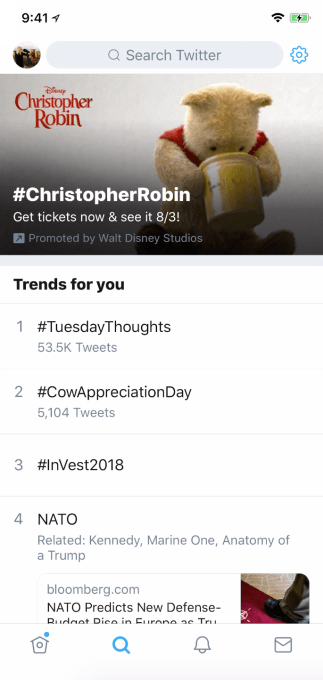
Twitter: The promoted trend spotlight ads testing on the explore tab


When you are using Twitter on mobile, you will generally see the ads post during you scroll on Home tab. But mostly, people notice and skip the ads, and focus on the post that they are interested. To make the ads more attractive, Twitter decides to test the ads on the top of the explore tab, called as the promoted trend spotlight ads, which everyone can see when they need to check about the trend or the highlight topic.
Source: Techcruch

With that position, it is the eye-catching area that can help the brands to create more brand awareness and impact on driving the conversation within Twitter. The ads can be the photo or GIF on the background to be attractive spotlight among the trend list on the explore tab. Moreover, people can seek more about the ads by clicking on it, and they can see the feed related to the topic on the ads. Compare to the regular ads on the home tab; it is just one ordinary twitter post that cannot be explored more and also blended with other posts on the feed.


This change is an opportunity for Twitter to earn more revenue from the great ads on the explore tab which impacts to its turnaround and financial statement as well.

Resource:
https://techcrunch.com/2018/07/11/twitter-promoted-trend-spotlight/

Thursday, April 14, 2016

Facebook and the Commodification of News

By Blaire Townshend

A recent article on Wired by Julia Greenberg outlines the symbiotic relationship that currently exists between Facebook and news content creators. In recent years, Facebook has become a major content outlet for news companies, and with good reason—as the article states, "600 million people see a news story on Facebook each week." However, Greenberg claims that Facebook is misleading news content creators regarding the benefits of targeting their vast online audience, and that it is using its current market dominance to acquire this rich content: "It's false hope, or at its worst, a threat."

Media companies feel compelled to put their content on Facebook because of the site's astounding membership numbers. But who does this best serve? It certainly benefits Facebook, as their users' are exposed to experiential, engaging content that Facebook does not have to create. Facebook is currently capitalizing on the potential of such news content, and has developed the following initiatives to do so:


  • Instant Articles: decreases loading time on users' phones
  • Live: allows users to interact with content subjects in real time
  • 360 Degree Video: allows users to experience news content as if they were there
  • API: allows users to communicate with a "newsbot" in Facebook Messenger

These programs greatly enhance user experience. Yet Greenberg argues that Facebook has used these programs to become a "crucial distribution platform" for news companies, and has thus made itself indispensable to these companies—and in turn made them dependent upon Facebook to reach their audiences. To me, this sounds familiar—Google has similarly used its dominance of the online search market to ensure that companies have to go through their system (and pay them) to get business. Essentially, Facebook has leveraged its power and insured that the relationship between itself (as distributor) and news companies (as content creators) is inherently unequal.

 This unequal distribution of power in turn ensures that Facebook has control over the content that is created—after all, they need not disseminate what they do not approve of, and can refuse to promote content that goes against their own ends. For example, Greenberg cites the creation of the above Facebook programs as being responsible for the decisions that news content creators are making—their content is conceived and structured to cater to these programs.

To me, this is a concerning development. Greenberg argues that the problem here is that news companies must use up valuable financial and human resources to develop suitable content. I, on the other hand, am more concerned with the ethical implications of the issue. Facebook's apparent power over the creation of news content is just one more element that biases news content creators away from what is "relevant" and "true" towards what is palatable to one company. Of course, a plethora of other business, political, and religious biases already plague the ideal of unadulterated news content. It is for this reason, however, that one more influencing factor is, in my opinion, distinctly unwelcome.


Greenberg, Julia. "Facebook Has Seized the Media, and That's Bad News for Everyone But Facebook." Wired. 13 Apr. 2016. Web. 14 Apr. 2016. 

Thursday, March 31, 2016

Instagram Update: The Algorithm Change Explained

By Blaire Townshend

A recent email blast sent out by Capacity Interactive—a digital arts marketing consultancy company—focused on the use of Instagram for digital marketing efforts, offering advice on best practices and updating its readership about the recent changes to Instagram—namely, the change from chronological feed to algorithm.

For those unfamiliar with how Instagram has worked up until this point, the platform has used a chronological approach on its users' newsfeeds since its inception in 2010. The projected change means that, rather than seeing your friends' posts in the order in which they were posted, you will now see posts "based on your relationship with the person posting and the timeliness of the post" (Valinsky 3.15.2016). The company has argued that the current format does not maximize viewing potential - in fact, they cited that users miss about 70% of the content on their feed. They believe that the implementation of an algorithm will curate content better suited to user interests. Instagram also assures its users that they will roll out this change slowly, and that it will not affect its advertising procedures. In fact, these adverts already utilize this same targeting technology to reach their intended audience—so in a way, the algorithm change is ensuring that social and marketing content operate in the same manner.

So what does this change mean for the 200,000 brands that utilize Instagram as an advertising platform (Instagram 3.29.2016)?

Not much, actually. At this point, you cannot actually directly target people with Instagram ads as you can on Facebook. On top of this, "organic" posts cannot be used for advertisements—the only promotional material allowed on Instagram is that which has been developed specifically for marketing purposes. On Facebook, on the other hand, marketers can post their own organic content and use it for promotional purposes. The algorithm will not change any of this (Instagram all).

However, Capacity Interactive made sure to remind its readership of a few important takeaways when considering Instagram advertisement for the arts: 


  • Make "thumb-stopping", visually arresting content a priority
  • Remember that Instagram is an overwhelmingly mobile platform, and plan accordingly
  • Make sure you are comfortable with Facebook first before graduating to Insta-advertising
  • And finally, don't worry about the algorithm change. It changes the user experience, not the advertising landscape.
As an Instagram user myself, I will be interested to see how my experience will change. I, for one, welcome the algorithm in theory, as I have often felt that the chronological template did not allow me to engage with my closest friends in a way that I would have liked. However, as a future arts marketer, it is heartening to know that this change will not negatively affect the advertising efforts of the organizations I hope to work for.  


Friday, February 05, 2016

Peer Promoting: The Benefits of Social Media Engagement for the Entertainment Industry

By Blaire Townshend

Though I am a member of the oft-mentioned Millennial generation, I am new to the world of social media. Unlike many of my peers, I don’t find that hashtags, retweets, and Instagram posts come naturally to me. However, in a quest to make myself less antediluvian, I have been attempting to understand the complexities of these vast online communities and their implications both for my field of interest (arts and entertainment) and for society in general. What I have gathered quite quickly is that social media not only has the potential to revolutionize marketing tactics, but has already done so. In the interests of time I will speak to this revolution as it pertains to digital arts marketing, but as I am sure you are well aware, no market is unaffected.  

What is truly incredible about these mediums is their capacity to encourage consumer driven marketing. A perfect example of this is live tweeting; the phenomenon of responding to events in real time on Twitter using predetermined hashtags pertaining to the subject material at hand. While I was observing arts events and bemoaning declining audiences and lack of widespread support, my peers were busy beaming relevant discussion topics to a global audience of millions and thus bringing exposure to the art. And this without any urging from the producers of these events! In essence, they were marketing arts events for these producers. On their own time. For free. In marketing parlance, these tweeters exemplify the ideal of the net promoter; an enthusiastic supporter of a good or event who takes it upon themselves to recommend that good or event to their peers. This is an incredibly cost-effective marketing base for organizations to tap into.    

In fact, a Forbes article from 2014 speaks specifically to the effects that live tweeting has on platform engagement (Bercovici). It claims that “programs whose cast members live-tweet when the show is airing generate 64% more discussion” (Bercovici). I can certainly attest to the fact that this is still the case two years later—when Grease Live aired this past week, and stars such as Julianne Hough and Aaron Tveit took to Twitter and Instagram to share their experiences backstage, express their excitement, and just generally check in, my social media feeds exploded. People could not seem to get enough of the up-to-the-minute, intimate feel of these posts. They responded in kind, and as a result, Grease Live was the main topic of conversation on Twitter and Facebook for hours that night.

The beauty of these scenarios is that the marketing personnel of these productions can do relatively little and reap fantastic rewards. Encourage your stars to engage in light commentary, promote a few backstage Instagram posts, and your fans will do the rest of the work for you. Obviously, this is an oversimplification of the marketing process. However, the fact remains that the resulting online conversations generate the very organic word of mouth that marketers lust after. And it is important to note that word of mouth is overwhelmingly what this generation responds to. The statistics say it: the Broadway League demographics report found that word of mouth and personal recommendations were the most popular methods for gathering information and making choices about arts events (Demographics). The experts say it: Chris Anderson reminds us that “fundamentally social media is a peer-to-peer medium”—in other words, the online generation values and trusts the recommendations of their peers (Anderson 242).

When marketers understand this and take advantage of this, they encourage the use of social media as a platform for “peer-production”, where “users happily do for free what companies would otherwise have to pay employees to do”—recommend these events to each other (Anderson 219). Anderson flippantly describes this as a transition from “outsourcing” to “crowdsourcing”, but I feel that his description is wonderfully apropos (Anderson 219). In a market such as the arts, where paying for wages and advertising campaigns is at a premium, who in their right mind would refuse the assistance of that crowd? I may be slow on the uptake, but even I can see that encouraging such collaboration is #ontrend.


Anderson, Chris. The Long Tail: Why the Future of Business is Selling Less of More. New York: Hyperion, 2008.

Bercovici, Jeff. “Twitter Quantifies Impact of Live-Tweeting on TV Engagement.” Forbes Tech. Forbes. 18 Sept 2014. Web. 4 Feb 2016.

“The Demographics of the Broadway Audience 2013-2014.” The Broadway League. The Broadway League. 2014. Web. 6 Dec 2015.


Saturday, November 07, 2015

VR video on YouTube--new media for Advertisers

YouTube is now supporting Virtual Reality(VR) videos. VR videos refer to a type of 360-degree immersive video which make the audience feel that they are actually being in the environment. VR content sounds very high-tech and not easily accessible before, especially for the high price of VR devices such as Samsung Gear VR, Oculus Rift etc.  But as Google is promoting Google Cardboard, a very simple and affordable viewer, where users can place their mobile phones inside and explore VR content on a variety of apps, the popularity of VR video will increase.

This new type of video will become a hot spot for creators and advertisers because of the engaging feature of VR videos. Google says that there are about 1 million Cardboard viewer owners and the New York Times will distribute 1.3 million Google Cardboard sets this weekend. And Youtube is promoting the idea of making VR accessible to everybody. The combination of this online and offline marketing will effectively wave huge interests among the public. And now, there are VR videos like the Hunger Games Experience and TOMS Shoes Giving Trip available on YouTube and the video platform is encouraging people to try this new and exciting VR experience.

Reference:
http://youtube-global.blogspot.com/2015/11/youtube-presses-play-on-virtual-reality.html
http://www.wired.com/2015/11/youtube-360-virtual-reality-video/?mbid=nl_11515

Thursday, September 10, 2015

Advertising Opportunities and Challenges with the new Apple TV--"the future of TV"

Apple released the new Apple TV yesterday and Tim Cook called it " the future of TV". Instead of switching among different programs, users can now swipe to or ask Siri to bring up what they want, ranging from games, shows, films to even shopping apps. It is all about apps. 
Picture from : gilt-apple-tv-800x409.png

On the event yesterday, Gilt Groupe’s CEO, Michelle Peluso, showed off the company's App designed specifically for Apple TV. Now, we can curl up in couch, browse pictures of models wearing our desired dresses or sneakers on the high-resolution big TV screen and just buy them directly with a click on "BUY NOW" as what we are so used to do on computers, laptops and mobile devices. 

Despite the innovative shopping apps, people also watch videos, shows and films and play games through different apps on Apple TV. Broadcasters can no longer force audience to watch commercials between and during programs. With the App Store for Apple TV, the functionality and possibilities with television will be expanded greatly. 

With all of these innovation, I see some challenges as well as opportunities. 

As mentioned in class, it is hard to measure a TV commercial's impact on audience's behavior, i.e. how much does the ad contribute to the final purchasing action? Now as consumers can shop directly on TV, it becomes much easier to track consumers' behavior and measure the effectiveness of ads. It may also help with cross-platform measurement since IOS users apply the same Apple ID to all Apple devices. 

Applications help strengthen customer loyalty. People are less likely to switch to other brands or platforms( for example, switch from Amazon to Walmart) when they make a purchasing action through an app. App store for Apple TV for sure expands the market size. However, a great challenge associated with apps, as what have been observed on mobile devices, is that it is hard to keep customers use them regularly. Maintaining the app for using on high-resolution TV and keep it compelling and consistent with mobile apps  is not an easy thing to do. 


Commercials have less control over audience since some platforms, such as Netflix and Youtube, provide ads-blocking or skipping ads services.Nevertheless, there are more opportunities to provide audience with customized and personalized advertising content on Apple TV. The potential of offering ads people want to see and capturing most of consumer surplus is greater. But obviously, proper customization is hard to realize and maybe too expensive to implement compared with traditional commercials on traditional televisions. 

Sources:
http://marketingland.com/gilt-shows-how-apps-and-online-shopping-are-coming-to-apple-tv-142067
http://www.wired.com/2015/09/first-look-souped-siri-powered-apple-tv/?mbid=nl_9915

Friday, February 27, 2015

Children are the future (of advertising)


YouTube Kids launched this week to a decent amount of fanfare, representing a safer, family-friendly alternative for allowing kids to interact with media on the internet.

The service touts features including: a timer (to limit the amount of time kids can spend watching clips); elimination of the search bar, which limits the content available for viewing to a preset menu; and obvious filtering of any content that could be deemed offensive or inappropriate for children. After all, you don't want your kid searching for "Power Rangers" and stumbling upon the awesomely violent unofficial Power Rangers reboot featuring James Van Der Beek.


Google is not the first to release a video service focused on children. Last year Todd Yellin, Netflix's Vice President of Product Innovation, came to talk with Columbia's Media Management Association. When asked about the biggest growth area for Netflix, Mr. Yellin spoke at length about the potential of Netflix Kids (which was already released to the public).

It is clear that the big digital media companies see children as a critical demographic for their business models. I chalk this up to three key themes. In order of increasing importance:

1. Stickiness- where the childrens' eyeballs go, so will the parents' (along with their subscription dollars)

2. Competitive advantage- these companies are chasing sustainable competitive advantage in the form of customer captivity- specifically, habit formation. Kids that grow up with YouTube or Netflix as their primary media vehicle will be much more likely to be heavy consumers as adults.

3. Advertising- this new, kids-only offering allows Google to provide advertisers (toymakers, cereal brands, etc.) highly targeted ad inventory that is guaranteed to be viewed by a captive audience of children. This should therefore command higher CPMs/CPCs with specific advertisers and represent a new revenue stream that Google hasn't been focused on before.

On the downside, parents have a right to be concerned about the frequency and other possible ill affects of all this targeted advertising. "What could possibly happen?", you may ask. Here's an anecdote: I had a manager who shared an iPad with his kid. About a month into letting his son download a game on the iPad, he received a bill from Apple well into the hundreds of dollars for in-game purchases that his kid was making to level up in a game. His kid had no idea of the consequences of clicking the button- he just thought it was part of the game!

Increased advertising to unsophisticated audiences will inevitably cause an increase in similar types of incidents across the board. It's ok to let your kid watch streaming content on kid-friendly providers... you just want to make sure that your credit card isn't connected to that service!


Sources:
http://www.digitaltrends.com/mobile/youtube-kids-app-launch/
http://www.geekwire.com/2015/parenting-youtube-kids-kid-curated-video-apps-wont-solve/

Saturday, February 14, 2015

Advertising in more personal communication channels

Recently, Wechat App announced that they would push out advertisements in the “moment” section in their app. This news immediately generated much discussion among the public, especially in China, where the majority of Wechat users live. This move, albeit within expectation, raised a lot of question on how to advertise in a more personal environment for communication. Why is that? Let me give you some background on the app itself first.

Wechat is an app across multiple mobile phone platforms that allows the user to send instant text messages to each other. It functions much like whatsapp, but with many more extensions that tap into different aspects of life: a personal page or “moment” much like the facebook idea, a payment system that can be linked with various bank account, a cooperation with a Chinese taxi hailing service make it possible to use it for better travel arrangements around Chinese cities, and they even have radio, audio and video chat functions that rivals with services such as Skype, facetime, gchat ,etc. Given its vast amount of functionality and ease of use, it has grown very fast in China and all over the world. Collectively, Wechat has attracted more than 400 million users globally, and almost the entire market in China.

Given such a huge user base, there is no doubt that marketers all have their eyes on the pie. Additionally, given all the chat history that the company holds, the data contain extremely high value in figuring out when and what to push to the user – data mining becomes super important and useful here. However, advertisements on such a platform are considered much harder than the other platforms since this platform is much more personal compared to the others. Looking back to when facebook initiated their advertisements on people’s timeline, there is no doubt that a fair amount of people would feel offended as they considered their facebook page to be very personal. If that has been the reaction, can you imagine if Whatsapp starts to put advertisements in to people’s phones? That is the danger Wechat is facing, and it is no small step, an inappropriate move could potentially drive away users and fuel rival apps’ growth. So what should they do?

Well, first of all, you can never be more careful in making this transition. So far the Wechat team has been extremely cautions in bringing marketers on board. They started with a Wechat team message that was posted on people’s moment section as part of the effort to educate their customers about the upcoming ads. Then, only a handful of prestige firms, such as BMW, Cadillac, were brought in to do the initial ads. This not only ensures the branding and image of the app itself, but also offers the best chance to bring high quality ads into the platform. More interestingly, the ads themselves are targeted based on users’ history, such that Cadillac can only target people who they thought be the most appropriate receivers, or likely car buyers. More interestingly, people in China actually took the ad injection very well. If anything, some people even refresh their pages many times a day in the hope to be targeted by the ad so that they can show to their friends how “high end” they are. We will see what is coming next after this initial round.


Monday, February 02, 2015

Facebook Is Trying to Perfect Newsfeed

Facebook has started trying to perfect what its users get out of Newsfeed by asking them directly what they like and want. Currently, Newsfeed is curated by an algorithm that processes what you like and comment on, but it turns out that our activity on Facebook is highly affected by the variety of content we're shown. As you might have guessed, we are disproportionately likely to react to and affirm emotionally compelling content. That ASPCA puppy video... we're all over it. Mainstream news content? Not so much...

As a result, Facebook has started trying to ask users directly what they like and want to see in order to better determine what users desire in their newsfeed.
"The project works like this: each of these 600 Facebook users is presented with 30 top News Feed stories in a random order. Then they go through each story one by one. They can comment, share, follow a link, or choose to ignore the story. After that they answer eight questions about each item, including how much they cared about the subject of the story, how welcome the story was in their News Feed, how entertaining it was, and how much the story connected them to friends and family. Finally, they are asked to write a few sentences describing their overall feelings about the News Feed story."
It is in Facebook's best interest to learn how to better curate content for its users:
"Facebook made $2 billion in ad revenue last quarter, more than two-thirds of its total $3.59 billion in ad revenue for 2014. And where do those ads live? In News Feed. If the social network can crack the problem of what users really want from News Feed, they can presumably apply those learnings to ads, too."
So, if this experiment pans out, it may make Facebook's advertising worth significantly more.

http://www.wired.com/2015/01/facebook-making-news-feed-better-asking-real-people-direct-questions/

Wednesday, January 28, 2015

Snapchat Launches Discover

Snapchat isn't just for silly videos and photos anymore. They have officially launched Discover, a new way for media companies to publish content for Snapchat users. Discover will allow Snapchatters to access special content which will only be available for a limited amount of time, keeping in line with the app's general theme. Currently, content is available from media outlets like ESPN, National Geographic, People, and Cosmopolitan and features interactive articles and photos designed specifically for the app.

Snapchat Discover Media Platform


This is the first time outside media creators have been able to post content to the app, but it is not Snapchat's first attempt at monetizing its service. Already companies have begun to leverage the popularity of Snapchat by posting advertisements as "snaps" to users' apps alongside other user generated content.

It will be some time before we see whether Snapchat's new move is a win, but for the time being, it is one more digital door allowing media companies to deliver content (and thus market to) users.

Sunday, January 25, 2015

Augmented Reality Is Changing the game for Advertisers

Where virtual reality exists to create rich computer-generated environments, augmented reality (AR) has the ability to project layers of graphics, animation, sounds and smell, https://www.youtube.com/watch?x-yt-ts=1421914688&x-yt-cl=84503534&v=si32CRVEvi4 ,  yes smell, onto real physical objects such as billboards, clothes, packaging etc.

While much of the technology is still in the early stages of commercial use, there are several AR products already in the marketplace with advertisers from luxury jewelry to beverage producers to musicians leveraging the technology to enhance their marketing campaigns.  As such, advertisers have the ability to engage with customers on a level previously not possible; https://www.youtube.com/watch?v=d6irc0jwKC8

The AR industry has been evolving for several years now and has shifted towards a more segmented structure.  Companies have the ability to leverage out of the box applications to create one-off campaigns, or decide to fully develop custom apps and solutions for their customers, such as the below furniture app; https://www.youtube.com/watch?v=5YV8lo-OxZQ#t=80


Forward looking, as applications for AR continue to evolve, where reality stops, advertisers have virtually unlimited options at their disposal to market their products in a digitally enhanced world.  Further, the benefits of AR go beyond the marketing budget, as AR will help marketers to not only better track advertising spend, but will also help companies become smaller in the brick and mortar sense, while expanding online.

Saturday, November 15, 2014

Facebook Reduces "Overly Promotional" News Feed Posts

Facebook has announced that starting January 2015, it would begin decreasing the number of brands’ organic, or unpaid, posts that it considers “overly promotional” on the social network’s News Feed.  The change wouldn't affect entire brands’ posts, only the ones that fit a certain criteria. According to the social networking website, surveyed users determined that the following characteristics of posts were deemed too promotional:

  1. Posts that solely push people to buy a product or install an app
  2. Posts that push people to enter promotions and sweepstakes with no real context
  3. Posts that reuse the exact same content from ads
Examples of these posts include:


A Facebook spokeswoman explained that the company’s algorithm will assess the promotional posts with the same filters it puts on ads.  Facebook will check how many people will engage or hide the ad to determine whether to allow these posts on people’s news feeds. This change is the latest move by Facebook to maintain quality control on the best content that is projected on News Feeds so that users will still continue to check the social network.

The number of advertisements that appear on a News Feed will not decrease, but the content will be more relevant to each individual’s tastes.  With this organic content change, Facebook is intelligently paving the way for increased advertising spending on the platform to compensate for the decrease in unpaid posts. By increasing advertising demand but not space, marketers could see the price of Facebook ads rise in the future, driving future profits for the company.


Wednesday, October 29, 2014

Kraft Concerned Over Digital Ad Impressions

Consumer brand, Kraft--one of Ad Age's 100 leading national advertisers--spent more than $35 million dollars on digital advertising in 2013. Recently, the brand has been extremely concerned with advertisement fraud and viewability. Kraft has rejected close to 85% of real-time ad impressions that are offered to them due to quality concern, leaving executives at the brand slightly worried. When Kraft puts in it's "pre-bid" tools, the company rejects anything that appears unsafe, doesn't meet the brand requirements, and is not viewable.

According to the company's director of data, content and media, "75% - 85% is either deemed to be fraudulent, unsafe or non-viewable or unknown." This statistic brings to light conversations about digital advertising "supply-chain" corruption, and raises industry-wide concerns. This analysis from Kraft was only recently highlighted, so time will tell what this really means for the brand and the consumer industry. 

Kraft representatives say that if they do not know where that advertisement is going to end up, they will treat it as unsafe, and end up rejecting the vast majority of impressions out there. Does this drive up their costs? Because there is such a huge pool of inventory, Kraft has been able to achieve it's deliveries without having to pay more.  

SOURCE:

http://adage.com/article/datadriven-marketing/kraft-rejects-75-85-impressions-due-quality-issues/295635/

Tuesday, October 21, 2014

Foursquare Launches First Advertising Campaign


Foursquare launched its first outdoor advertising campaign yesterday in hopes of educating non-users that the mobile application is more of a personalized local search and no longer a check-in service.  The main purpose of this campaign is to drive awareness of the new Foursquare.  A couple months ago, Foursquare splits its core business into two applications - Swarm, the application where users can check in to places and see where their friends are, and Foursquare, the application to discover new places.

This six-week campaign will appear in bus stops, train stations, and phone kiosks in Chicago and New York, and at bike share stations in Chicago.  The company was not allowed to advertise at bike share locations in New York because Citibank is the program's exclusive sponsor.  This is the company's first advertising campaign in an attempt to simultaneously rebrand Foursquare and jumpstart stagnant user growth.

Foursquare decided to launch this outdoor campaign after Seamless and Venmo reported that their outdoor campaigns were successful in driving app downloads. Foursquare COO Jeff Glueck said the company hopes the ads will display how Foursquare can be used by anyone. Each ad has two people with contrasting tastes having an encounter, Glueck said.

As an avid Foursquare user, it will be interesting to see the results of this branding campaign.  I am probably one of the top users of Swarm out of my entire community.  However, I mainly use Swarm to check in to places and rarely use the search function to find localized places.  I personally wouldn't use the Foursquare application so it will be interesting to see how the NYC/Chicago community responds to these outdoor advertisements, and whether the campaign will be successful.


Source: http://digiday.com/platforms/check-foursquares-first-advertising-campaign/ 

Monday, October 06, 2014

Marriott Launches Global Creative and Content Marketing Studio

Aims to be the go-to brand publisher for travel entertainment


Following the trend of marketers becoming publishers, Marriott International is launching a global creative and content marketing studio to handle internal work for its portfolio of 18 travel-related brands. They view it as the opportunity to be the world's largest producer of travel-related content.

As the largest hotel chain in the world, Marriott aims to leverage its expertise on travel. Similar to the approach that Red Bull and GoPro take with action sports, Marriott wants to own the travel entertainment space—and, in turn, gain the recognition as a trusted source for all travel needs.

"You're most likely to remember something if a friend recommends it," David Beebe, Marriott's vp of creative, content marketing and global marketing said. "We want to take that same approach as a brand through building engaging content communities through social platforms."

The in-house division will have three parts: content development, which will be the personal creative agency; production, or the entertainment division responsible for video content ranging from Web clips to TV shows; and distribution, a real-time marketing group that will monitor social media to ensure immediate interaction with trending topics. Marriott will continue to work with external agencies and other production companies as needed.

Marriott has signed a stable of exclusive talent from the online space, including Sonia Travel's Sonia Gil, stunt team Substance Over Hype, social media news purveyors What's Trending and comedian Taryn Southern. Shows in development include Renaissance Hotels' indie music performance series The Navigator Live; action-comedy stunt show Two Bellmen; and Web series Marriott Rewards' Year of Surprises, which will honor people in the community for their contributions to society. Online series will be broadcast on Marriot.com and Marriot Mobile and through Marriott Rewards and other media channels like YouTube.

Gartner's Andrew Frank said Marriott's in-house approach reflects a general trend in the industry that meets the increasing demand for content marketing, particularly ongoing interactions for long-term campaigns. It can be a risky move, however, because brands can be less experienced in creative and media strategy compared to agencies, but widening media access has made it easier. "Since most agencies are not organized to support content marketing engagements, at a certain scale it can be more cost-effective to bring it in house," he said.

Larry Woodard of digital advertising Graham Stanley Advertising added that brands like Pepsi and Nike have had internal resources for years, and it can be a smart way to create a following and get in touch with your consumer base. "Things are growing so fast and are so divergent from traditional marketing that you need to cast a wide net just to stay relevant,” he said.

Still, Frank noted that it isn't easy to become a global entertainment entity. Marriott, in particular, has an uphill battle considering how many travel programs are already established online and offline. "For every brand do-it-yourself content publishing success story, there's a much larger number of failed attempts. Brands that lack creative core competencies may be surprised at the costs and cultural challenges involved in building a world-class in-house capability," Frank said.

Woodard was skeptical as well. "Neither Marriott nor any other travel giant will be able to own travel entertainment online. For the foreseeable future consumers will be the leading edge of content creation," he said. 

Source: www.adweek.com by Michelle Castillo