Showing posts with label Twitter. Show all posts

Friday, January 18, 2019

Are they trying to steal my face?


While some people find it funny to participate in #tenyearchallenge (303k posts Instagram as of today), others are concerned that it was initiated by Facebook in order to collect even more personal data for their own sake. It sounds quite logical that it might be a perfect database for creation and training of a mechanism, which will generate an image of a person in different age stage as well as recognize a current age.

“Imagine that you wanted to train a facial recognition mechanism on age-related characteristics and, more specifically, on age progression”, O’Neill.

However, Facebook representatives deny the fact that this challenge is initiated by them and have benefits to their company. Even though they are trying to be convincing, let’s not forget the Facebook-Cambridge Analytica scandal, when data of millions people was used without their agreement.

Why are we so afraid of companies having our face information stored? In fact, a huge amount of data has already been generated on each of us related to our preferences in food, web search and other intimate questions, and we just don’t want to admit it. According to The Guardian, in 2016 already a half of US adults’ faces were stored in police databases. It sounds scary that someone is watching you, but we also should not deny that it can do our lives better.

Firstly, face recognition system can make the World a better place. It can definitely serve the need to find people, who were lost, or those, who committed a crime. Aging part of the mechanism might be especially useful for searching kidnapped children after a long period of time. There is a case when facial recognition helped to find a child after 27 years.

Secondly, it might be an aid for providing a better customer experience using targeting. I can imagine Sephora scanning my face in order not only to know my skin tone, but also my age, making a better recommendations as a result.

It is a personal choice whether or not to raise a concern about privacy of personal data. But if it is inevitable, why not to focus on the bright side?

Saturday, July 21, 2018

Twitter: The promoted trend spotlight ads testing on the explore tab


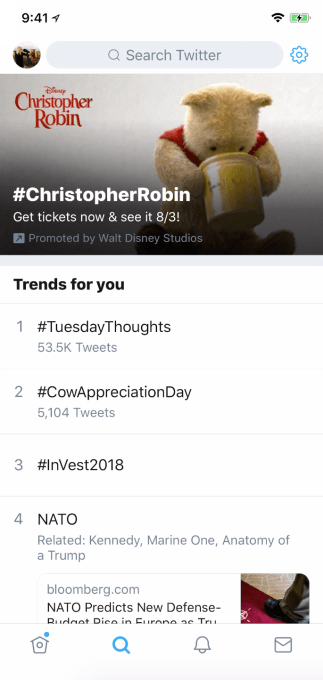
When you are using Twitter on mobile, you will generally see the ads post during you scroll on Home tab. But mostly, people notice and skip the ads, and focus on the post that they are interested. To make the ads more attractive, Twitter decides to test the ads on the top of the explore tab, called as the promoted trend spotlight ads, which everyone can see when they need to check about the trend or the highlight topic.
Source: Techcruch

With that position, it is the eye-catching area that can help the brands to create more brand awareness and impact on driving the conversation within Twitter. The ads can be the photo or GIF on the background to be attractive spotlight among the trend list on the explore tab. Moreover, people can seek more about the ads by clicking on it, and they can see the feed related to the topic on the ads. Compare to the regular ads on the home tab; it is just one ordinary twitter post that cannot be explored more and also blended with other posts on the feed.


This change is an opportunity for Twitter to earn more revenue from the great ads on the explore tab which impacts to its turnaround and financial statement as well.

Resource:
https://techcrunch.com/2018/07/11/twitter-promoted-trend-spotlight/

Thursday, July 27, 2017

AdWeek: Despite High Hopes, Twitter’s User Growth Fell Flat in the Second Quarter of 2017


Twitter's uneven performance continues. After rumors of it being acquired, and a change in management, it seemed as if Twitter was moving in the right direction. It introduced videos to its platform, managed to see subscriber growth, and had some positive trends in its stock price. All of that changed when it announced 2Q results.

In 2Q, even with Mr. Trump using the platform as his public communication of choice, subscribers remained flat in the U.S. This is very tough to swallow given the growth of subscribers by Facebook, Instagram, and Snapchat. It's also not reassuring that management didn't really have a good answer to the stagnant growth, and that Twitter reduced expectations for the rest of the year. This could also be a conservatism tactic, but even so, most people were expecting growth.

As the article states, there were some positive developments. Twitter stated that sub count grew in their largest 12 markets.

Unfortunately, some of the skeptics are being proven right that Twitter is a nichey product with little mass appeal like a Facebook. That said, I still think they are still valuable in the internet landscape, and in the right hands could be economically viable. I anticipate an acquisition, just a question of what price to buy shares.


http://www.adweek.com/digital/despite-high-hopes-twitters-user-growth-fell-flat-in-the-second-quarter-of-2017/

Friday, February 05, 2016

Peer Promoting: The Benefits of Social Media Engagement for the Entertainment Industry

By Blaire Townshend

Though I am a member of the oft-mentioned Millennial generation, I am new to the world of social media. Unlike many of my peers, I don’t find that hashtags, retweets, and Instagram posts come naturally to me. However, in a quest to make myself less antediluvian, I have been attempting to understand the complexities of these vast online communities and their implications both for my field of interest (arts and entertainment) and for society in general. What I have gathered quite quickly is that social media not only has the potential to revolutionize marketing tactics, but has already done so. In the interests of time I will speak to this revolution as it pertains to digital arts marketing, but as I am sure you are well aware, no market is unaffected.  

What is truly incredible about these mediums is their capacity to encourage consumer driven marketing. A perfect example of this is live tweeting; the phenomenon of responding to events in real time on Twitter using predetermined hashtags pertaining to the subject material at hand. While I was observing arts events and bemoaning declining audiences and lack of widespread support, my peers were busy beaming relevant discussion topics to a global audience of millions and thus bringing exposure to the art. And this without any urging from the producers of these events! In essence, they were marketing arts events for these producers. On their own time. For free. In marketing parlance, these tweeters exemplify the ideal of the net promoter; an enthusiastic supporter of a good or event who takes it upon themselves to recommend that good or event to their peers. This is an incredibly cost-effective marketing base for organizations to tap into.    

In fact, a Forbes article from 2014 speaks specifically to the effects that live tweeting has on platform engagement (Bercovici). It claims that “programs whose cast members live-tweet when the show is airing generate 64% more discussion” (Bercovici). I can certainly attest to the fact that this is still the case two years later—when Grease Live aired this past week, and stars such as Julianne Hough and Aaron Tveit took to Twitter and Instagram to share their experiences backstage, express their excitement, and just generally check in, my social media feeds exploded. People could not seem to get enough of the up-to-the-minute, intimate feel of these posts. They responded in kind, and as a result, Grease Live was the main topic of conversation on Twitter and Facebook for hours that night.

The beauty of these scenarios is that the marketing personnel of these productions can do relatively little and reap fantastic rewards. Encourage your stars to engage in light commentary, promote a few backstage Instagram posts, and your fans will do the rest of the work for you. Obviously, this is an oversimplification of the marketing process. However, the fact remains that the resulting online conversations generate the very organic word of mouth that marketers lust after. And it is important to note that word of mouth is overwhelmingly what this generation responds to. The statistics say it: the Broadway League demographics report found that word of mouth and personal recommendations were the most popular methods for gathering information and making choices about arts events (Demographics). The experts say it: Chris Anderson reminds us that “fundamentally social media is a peer-to-peer medium”—in other words, the online generation values and trusts the recommendations of their peers (Anderson 242).

When marketers understand this and take advantage of this, they encourage the use of social media as a platform for “peer-production”, where “users happily do for free what companies would otherwise have to pay employees to do”—recommend these events to each other (Anderson 219). Anderson flippantly describes this as a transition from “outsourcing” to “crowdsourcing”, but I feel that his description is wonderfully apropos (Anderson 219). In a market such as the arts, where paying for wages and advertising campaigns is at a premium, who in their right mind would refuse the assistance of that crowd? I may be slow on the uptake, but even I can see that encouraging such collaboration is #ontrend.


Anderson, Chris. The Long Tail: Why the Future of Business is Selling Less of More. New York: Hyperion, 2008.

Bercovici, Jeff. “Twitter Quantifies Impact of Live-Tweeting on TV Engagement.” Forbes Tech. Forbes. 18 Sept 2014. Web. 4 Feb 2016.

“The Demographics of the Broadway Audience 2013-2014.” The Broadway League. The Broadway League. 2014. Web. 6 Dec 2015.


Monday, November 23, 2015

Real time marketing examples

Real time marketing examples

To continue with the fun examples from class, I wanted to talk about real time marketing. Real-time marketing occurs when brands react quickly to local, national or global events happening online or offline. It is basically the art of getting your brand involved with the latest news story. It works even better on social media because you can get your message out there much quicker than any other medium.

Several great examples are:
  • Arby's at the Grammys with the following twee:


Hey @Pharrell, can we have our hat back? #GRAMMYs
Pharrell Williams was wearing a hat during the Grammys that looked similar to Arby’s logo. This tweet received 75,000 retweets and more than 40,000 favorites by the following morning. Moreover, it received kudos from other brands like Pepsi and Hyundai.
  • KitKat after the news that the iPhone 6 plus could bendthe brand tweeted the following:


We don’t bend, we #break
This real time marketing was retweeted over twenty-five thousand times
  • Jeremy Clarkson was reported to have punched a producer. Snickers quickly capitalized the event with their ‘You’re not you when you’re hungry’ tagline an tweeted the following:


@JeremyClarkson you may want to have some of these on set next time you are #hungry…
It has received 4,974 retweets and 3,748 likes.

To get real-time social media right, you need an active follower base that regularly engages with your brand on social media. When done correctly, interactions of this type increase engagement, boost earned media, and help humanize large brands. "Nearly half (49%) of marketers believe real-time marketing needs to happen within minutes, and a quarter (26%) say seconds. Still, 46% of real-time marketers require 30 or more minutes to respond to breaking news and events on social media."


Sources: socialmediaweek.org, marketingland.com, twitter.com, Michael Brito LinkedIn, adage.com

Tuesday, November 03, 2015

Twitter And Vine Choose Hearts Over Stars and Smileys

At first glance, it may seem like an inconsequential tweak, but switching the way users interact with content on the Twitter managed platforms may actually have a significant impact on engagement and the metrics generally used to measure it. Indeed, by aligning the "visual" language with that of other popular social networks like Pinterest or Instagram, it may lead users to engage more with the content that is generated on both Twitter and Vine. By including and testing the new "likeability" combo on Twitter and Vine, the company has been able to gage how much users appreciate a more global language to signify appreciation and engagement on the platforms they interact on daily/weekly.

Original article: http://techcrunch.com/2015/11/03/heart-heart-heart/#.dc3kwd:v2C5

Tuesday, October 27, 2015

Brand related analytics by Twitter!

Twitter recently launched its brand analytics product called Brand Hub. The product helps brands gauge the conversations around itself on Twitter. The product also helps gauge the 'brand presence' of a company/brand/product with respect to its competitors. It's an important tool for advertisers as its a way to figure out which segments of the target audience to target with specific campaigns (depending on the type on conversations they are having online). That's the power of digital social networks. They allow brands to create customized campaigns and target individual consumers.

What this also implies is that social networking platforms like Facebook, Twitter, Instagram and Pinterest are trying to figure out (acquire or create) the best technologies in the AdTech space. This has been the reason why these massive online networks have acquired a bunch of smaller AdTech firms in the last few years. Twitter's Brand Hub product is an additional step in that direction where these mega firms are trying harder and harder to develop the best technologies that can help match advertisers to customers with the best possible financial return to the advertiser (brand).

For further info on the Brand Hub product, you can check out the link: http://techcrunch.com/2015/10/26/twitter-brand-hub/#.5pknuq:dVcx 

Friday, October 09, 2015

Twitter Expands Pre-roll Video Ads

Publishers who post videos on Twitter will now be able to more effectively monetise their content by having Twitter add pre-roll video ads in front of the clips. This change will simplify the video advertising process dramatically, with advertisers no longer need to work with specific publishers. Instead, they will be able to simply choose a content category (along with any other targeting specifications) and Twitter will pair their ads with appropriate content.
This approach is very similar to YouTube’s pre-roll advertising, which enables content creators to monetise their videos. However, I believe it would be better Twitter to only focus on shorter ads, instead of 2-3 min ads which Youtube's currently focusing on, considering the typically fast-paced nature of Twitter.
Article Link: http://mobilemarketingmagazine.com/twitter-expands-pre-roll-video-ads/


Tuesday, October 06, 2015

Twitter's snazzy new Project Lightning is going to save everything (they hope)

Few were surprised when Twitter's founder and interim CEO, Jack Dorsey, was appointed the company's new CEO this week. Back for a position he already held in the past, investors hope that Dorsey's return will help the company enter a new era of growth.
Under his new leadership, Twitter seeks to re-establish itself as a key player, thanks to product launches and updates in the pipeline.
Twitter has been struggling to keep users and to attract new ones recently. Competition is fierce and the platform does not seem to offer any particular differentiating advantages with respect to other social networks. The announced launch of Moments, a feature which will allow users to add snippets of video to their feeds for live event coverage is part of a larger strategy to turn the network into the choice destination for news, a market that Facebook seems to be taking over quickly than expected.

Original article: http://mashable.com/2015/10/05/twitter-project-lightning-dorsey/#.DT.u1QtIZqM

Sunday, September 27, 2015

Twitter Polls Are An Awful Idea

Twitter's financial difficulties were broadly covered when former CEO Dick Costolo stepped down and Jack Dorsey returned to temporarily run the company. Since then, we've been waiting for the social sharing site to roll out new features, hoping that they'll be groundbreaking enough to revive the company.
Yesterday, the possible imminent launch of polls were announced. Users will be able to introduce polls in their tweets. The ability for individuals or brands to gage interest in a product or an opinion by simply asking a yes or no question. The article makes a fair point. While technically this would provide Twitter with the substantial data it craves, it also limits the provision of nuanced opinions, limits the freedom of expression that lures users onto the site to begin with and seems to benefit brands more than it does consumers.
The feature has not yet been rolled out and while it may be an interesting thing to explore, it also displays its many limitations for a company that was built on freedom of expression.


Original article http://techcrunch.com/2015/09/25/twitter-polls-are-an-awful-idea/

Monday, September 07, 2015

Millennial Marketing Tips from 4 of the World's Biggest Digital Platforms

Executives from Facebok, Snapchat, Twitter and Pandora gathered at ZenithOptimedia Group's Mobile Day event to give advertisers tips on how to more effectively reach millennials - adults ages 18-34 who don't respond to traditional advertising and are increasing "cutting the cord" (consumers who ditch TV sets to watch videos on smartphones and tablets). Four interesting insights for the digital players are:

1. Get Local

Steve Hwang, director of operations and strategy at Snapchat, said brands should be involved on a more local level in the real world. Snapchat's core group of 18- to 24-year-olds hate feeling like they are being marketed to. Instead they want to watch videos and look at photos their friends are sharing. Snapchat has a "Live Story feature" that curates streams about nearby events that brands can buy full-page placements in. 

2. Less is more with video

Although it seems like autoplay video has taken over Facebook, brands are still struggling with building the right content for the platform. Facebook advises brands to make four, eight- and 10-second videos that grab people's attention in a news feed. Once people tap on a video, the sound automatically kicks in, which helps hook them to watch longer clips. 

3. Find social's new celebrities

According to Twitter, vine stars are hotter than Hollywood A-listers for millennials. Some influencers have followers and a social graph that is far bigger than any celebrity, and brands should try to emulate or work with these people when posting videos, photos and GIFs to Twitter.

4. Data-backed creative

Pandora revealed that women age 18 to 34 like to listen to YouTube violinist Lindsey Stirling on the Pandora, and they overwhelmingly listen to her from the company's app. This is an example of data that can shape a campaign and determine if it should run on mobile or desktop. Brands should tailor creative message to the environment and mindset. 

Source: 
http://www.adweek.com/news/technology/top-millennnial-marketing-tips-4-worlds-biggest-digital-platforms-165888

Saturday, March 28, 2015

"Explore the world through someone else's eyes"... and no I'm not referring to a warg.


Last month I wrote a post about a few of Twitter's aggressive growth initiatives. Today, I share with you their newest one, Periscope.

Launched just two days ago, Periscope is Twitter's response to Meerkat, a live-streaming video app.  Although it is only available on iOS devices, the product has attracted the attention of many users and brands.

What is Periscope?  It is a platform for streaming live video from your iPhone from anywhere in the world (that has a connection). Just download the app from the Apple store, log in, enable the camera and become a broadcaster.  Not in the mood to be famous yet?  Well, you can always watch other peoples' videos instead.  The popularity of live-streaming videos is the idea of discovering the world through someone else's eyes.  As described by the creators of Periscope, " a picture may be worth a thousand words, but live video can take you someplace and show you around." As with Twitter, this app allows you to follow people and be alerted of their new broadcasts.  You also have the option to browse around for something that catches your eyes.  And if you don't have enough time to watch the entire video, you can always save it and watch it later.


And the most loved feature of Periscope... the hearts that you can give to the videos you like or love.  Similar to a "like" button, this feature lets you send a heart or even many hearts to the broadcaster of your choice and with enough hearts, this person can be featured as a "most loved".


The product has already gained some early adopters.  Adweek, shared information on how 4 brands are already using the Periscope app.


Spotify, a music-streaming service posted a behind-the-scenes video with Conor O'Brien from the band Villagers.

"During the live stream, 382 viewers tuned into the live stream, racking up 1,534 hearts—the equivalent of "liking" something on Facebook.  As of 6 p.m. last night, the video had been replayed 99 times and received 255 hearts."


The brand used the app to create a short video titled "Stop by to say what's up."

"The short clip showed a girl spelling out the word "Swag" on a chalkboard with a table full of branded T-shirts and hats in front of it."


Red Bull, known for their sense of adventure and risk, always open to trying new things, experimented with Periscope during Miami Music Week this weekend. 

"The brand will live stream events happening at its Red Bull Guest House. Social content will also be pushed out via Twitter and Snapchat."


And the fourth brand, DKNY, gave viewers a look into its fashion closet last week, shortly after announcing it had opened an account via Twitter.

"Fashion brands already regularly employ Facebook, Twitter and Instagram to give folks a peek into its world, so it's likely that fashion-minded marketers will embrace Periscope."


Are you willing to give Periscope a try?


Sunday, February 15, 2015

One Tweet Can Define Your Brand (Forever)

If anyone still doubts the power of social media, look no further than the case of Justine Sacco (story available here).

While en route between NYC and Cape Town she posted several insensitive tweets. By the time her flight had landed, her tweets had gone viral, becoming the number one trending topic on Twitter- and it wasn't a positive response. Even though her Twitter account was deleted and the posts taken down, her name will now be inextricably linked with those posts forever.


Her comments were incredibly stupid, inappropriate, and indefensible. At the same time we have all dealt with the frustrations of travel and I'm sure can understand her mindset at the time of posting these tweets. Should she have lost her job (in PR, nonetheless)? Absolutely. However, should Justine Sacco be forever defined by one careless mistake? I'm not so sure...but permanence and virality are the rules of the social media landscape, and by playing the social media game you are tacitly agreeing to abide by its rules.

There is a lesson here not only for individuals, but brands as well. As brands dive headfirst into social media as new way to connect with customers, structure needs to be put in place. Social media can be a powerful tool for defining a brand, but is wrought with the same dangers that individuals face, and more.

There are numerous examples of successful social media campaigns reinvigorating brands (see some examples here), but there are also instances of rogue tweets/posts tarnishing brands, sometimes irreparably. Companies should have a clearly defined process, with checks and balances or editorial oversight, to ensure all social media posts are on message and don't cause any (unintended) controversy.

On a personal note, I do feel concerned about how social media will impact future generations. Most of my youthful transgressions preceded the existence of Facebook, but our children may not have the same freedom to make mistakes and learn from them- instead of being defined by them.


Sources: http://www.nytimes.com/2015/02/15/magazine/how-one-stupid-tweet-ruined-justine-saccos-life.html?_r=0

http://www.adweek.com/news/advertising-branding/here-are-finalists-years-best-brands-twitter-vine-and-everywhere-else-156122

Wednesday, February 11, 2015

Twitter has been keeping busy


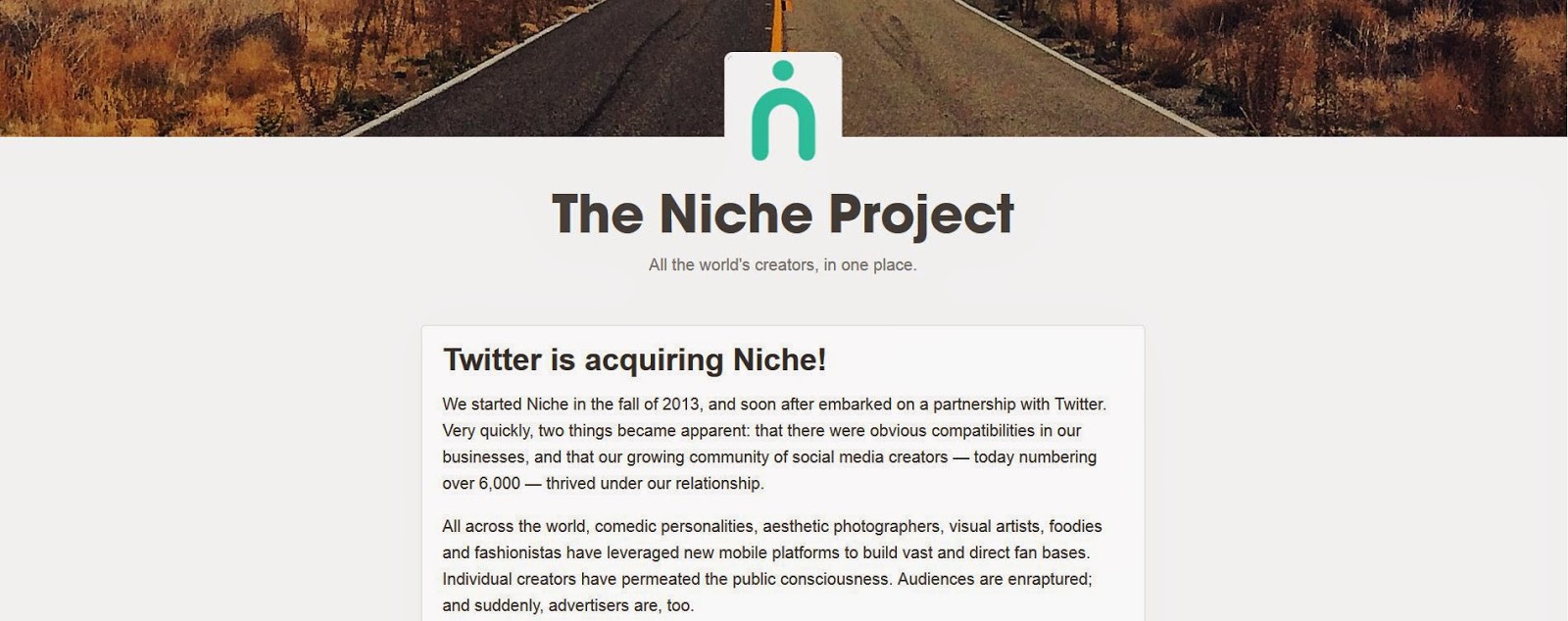
http://blog.niche.co/post/110747993803/twitter-is-acquiring-niche

Twitter has taken an aggressive approach with growth this year.  In the last few weeks, they have rolled out group direct messages and native video sharing, entered into a deal with Google search results, launched Curator, and just today, announced the purchase of Niche.  The acquisition price has not been officially announced but a report estimated $30 million.

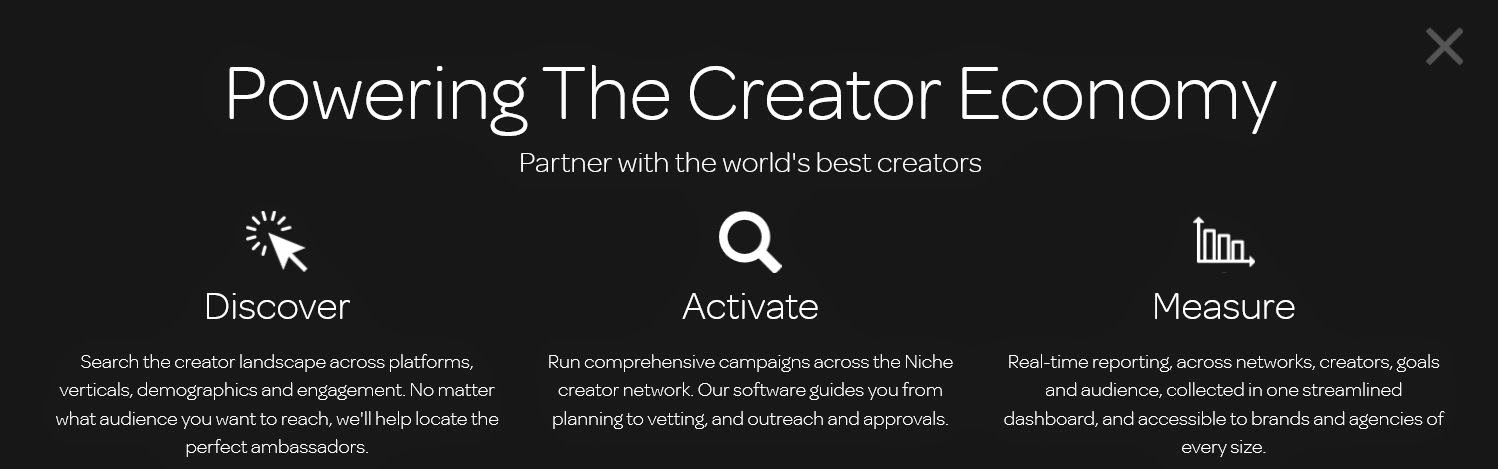
Niche is a service that connects top social media users with brands.  The New York based start-up helps creatives make money by matching them up with advertisers and brands.  Niche also offers free analytic tools to creatives so they can see what is and isn’t working, while allowing brands to browse leader boards and collaborate with top creators on marketing campaigns.  It’s all about big data and analytic.

The director of product management at Twitter, Baljeet Singh revealed in his post that over the past year “Niche has been a key partner to Twitter and Vine” and that “the company has helped fuel the creator economy by developing leading technology, consisting of free, cross-platform analytics, as well as connecting the creative community directly with the world’s biggest brands."

https://www.niche.co/#


What does this mean for Twitter?  This move means that they are now the owner of a social media talent agency. Twitter can now tap into a revenue stream it wasn’t previously partaking in.   

What does this mean for Niche?  "More tools, more platforms, and even more opportunities to team up with the best advertisers in the world."

Twitter (TWTR) closed the day up $1.24 per share.