"A picture is worth a thousand words, especially when those words are passwords you can’t remember."
This is the tag line for a new web business trying to solve a problem that many of us are faced with day to day. A dilemma exists for people who find themselves signing on to more and more password protected sites and services everyday - signing on to social networking sites, bank account and credit card statements and everything in between. The dilemma is whether or not to stick to one password for every site, thereby putting not one but all of your accounts at risk of being compromised in an identity theft situation, or to create multiple, unique passwords for all of ones online accounts at the risk of spending 15 minutes typing in 100 different username/password combinations every time you want to check in on your bank balance.
Vidoop offers a password "keychain" for all of the accounts you log into online! Vidoop then protects your passwords by creating an image based authentication system (obviously not another username & password combo!). In other words, Vidoop provides "a visual grid of images that fall into particular categories. When you first create a myVidoop account, you pick 3-5 types of images (e.g. birds, skyscrapers, flowers, cars). Then whenever you need to authenticate with myVidoop, you simply type the letters of the images in a randomly generated grid that fall into your chosen categories."
And of course, this approach is way more secure than your traditional online password process as it is impossible for a computer to distinguish between the encrypted pictures.
www.vidoop.com
Monday, December 03, 2007


New spam-blocking technology?
There's an article in today's NYT about a new technology developed by Steven Kirsch (who founded Infoseek) to block spam. According to Kirsch the technology will be much more effective than current spam blockers, though its effectiveness depends on the number of people who use it. Below I've pasted how the article says it works.
I don't get it. Can anyone explain to me what the reputations of recipients are? Or how this works? I understand that it doesn't simply scan emails for signs of spam. But that's about it.
Any help would be greatly appreciated.
Sunday, December 02, 2007
Has AOL Figured Out Video Advertising?
AOL recently announced plans to introduce a new ad format to integrate into online videos. Advertisers know that users hate pre-roll ads but these are much more valuable than post-roll ads since viewers can't skip them. Nevertheless, the ad industry is eager to find the best way to include advertising in video without alienating consumers.
AOL's new ad format is a way to address the issue and it may be a real leap forward. Basically AOL will be offering "video ticker ads," a graphic banner ad that is integrated directly into streaming video content. The ads will appear for a short time and disappear if the user doesn't click on it. If the user does click on it, the video will pause while the a full ad (e.g. - video or Flash) is launched.
The real beauty of this new format is that it could also be adapted in the future for interactive television advertising. We are already accustomed to tickers (aka - "lower thirds") that contain information or network promos. The next step could be advertisements that could be triggered by pushing a button on your cable remote that would pause your program and launch an interactive ad.
Sounds promising. Here's a link to the full announcement from a couple of weeks ago:
http://publications.mediapost.com/index.cfm?fuseaction=Articles.san&s=71229&Nid=36507&p=216556
Black 20
Prof. Kagan highlighted Heavy.com as a content site, sponsored by AXE.
I recently came across this site, Black20.com, that creates it own content and posts new material every day. The founders were formerly of NBC Digital Studios but left to form their own broadband content company. See this article from the New York Times for more: http://www.nytimes.com/2007/05/01/arts/television/01heff.html.
I recently came across this site, Black20.com, that creates it own content and posts new material every day. The founders were formerly of NBC Digital Studios but left to form their own broadband content company. See this article from the New York Times for more: http://www.nytimes.com/2007/05/01/arts/television/01heff.html.
Saturday, December 01, 2007
Google Maps Adds Locator
Google Maps Adds Locator, But Not For iPhone
Google has updated its Google Maps application adding a new feature called My Location.
Google has updated its Google Maps application adding a new feature called "My Location." While the new feature is available for many phones, Apple's iPhone is not among them.
My Location approximates your location by using the surrounding cellular towers instead of GPS data, which is often associated with such features.
"It's not GPS, but it comes pretty close (approximately 1000m close, on average)," said Google. "We're still in beta, but we're excited to launch this feature and are constantly working to improve our coverage and accuracy."
To find your location, you simply press the "0" button while in Google Maps. Your approximate location is shown with a blue dot on the map.
Google said the My Location feature is available for most web-enabled mobile phones, including Java, BlackBerry, Windows Mobile and Nokia/Symbian devices.
User interest in the discussion area for an iPhone version seems high, but the feature is not compatible with the iPhone>> Comments from Sanne: I installed the update on my Blackberry and am surprised by the accuracy. At most, it locates you in the next street. I estimate that the accuracy is in the range of 100m
More Privacy from Google Street View
Google Street Views Hides Your Face. What Took So Long?
November 30, 2007 — 05:35 PM PST — by Kristen Nicole
November 30, 2007 — 05:35 PM PST — by Kristen Nicole
Finally, Google’s thinking about making its Street Views map completely anonymous, to protect the privacy of people that show up in the photographs. For its Europe Street Views version, Google will be modifying all photos to ensure that faces and license plates are not visible. It may do the same with the US version, which launched months before Street Views in Europe.

So what took so long? Privacy advocates were all over Street Views when it first came about. And while Google made a few concessions to appease those with privacy concerns by offering to alter images upon request, it looks like Google may finally be doing the right thing when it comes to these Street Views maps.
This could be in part because of the increased amount of pressure being placed on Google as it expands globally. Other countries are far more strict about privacy standards than the US. Thankfully, Google’s announced that it will be thinking about making changes accordingly to the US version as it takes these steps for meeting privacy standards across the world. This will be something that other services, like EveryScape, will have to keep in mind for their own expansion as well.
A possible downfall of modified street views images–getting slightly less funny pictures to poke fun at. What do you think: good for Google, or waste of time?
Friday, November 30, 2007
Hyper-connected generation rises
Hyper-what?
that's right. we're part of a new generation, well those kids just younger than us at least. People are becoming hyper connected. That means every part of your daily activity can now be shared with your friends. From when you wake up to what you're eating, where you're going out, what TV station you're watching when, and when you are asleep.
This may seem a bit bizarre from the view point of do you really want people to know so much about you. But human psychology tells us that we do have a need for other people to feel connected to us, and whether this is at a superficial level or not. Jaiku is one such "microblogging" service that allows friends to inform each other of their activities across a range of devices. Comments can be sent and received via a cell phone or the web.
See for more details: http://news.bbc.co.uk/2/hi/technology/6637865.stm
http://news.bbc.co.uk/2/hi/technology/6637865.stm
Young warned over social websites
Well, there you have it. A watch dog group in the UK has warned that young adults could damage their careers with details about themselves on social networking websites.
This is a real spoiler. If we all become conscious of what we're putting up because we think a nosy employer, school or parent will check us up, the beauty of online freedom is eroded. Social networking sites let you be you, and broadcast that image to your friends around the world. But when faced with a situation like this, people may button up and social networking websites lose their cache.
Personally, even though there is some concern in terms of posting those drunken club pictures, I think as society evolves, we will learn to separate professional and personal lifes. It will become less taboo. But until that times comes, better watch those postings while job hunting - you've been warned!
See the BBC article for more details:
http://news.bbc.co.uk/2/hi/technology/7108627.stm
Facebook Backtracks on Beacon
The launch of Facebook's Beacon system a few weeks ago triggered an outcry among users and privacy advocates, who found the automated posting of purchases and other activities on third party websites to users' Facebook news feeds intrusive. Facebook was even likened to the Grinch, for ruining users' holiday surprises by posting the gifts they had purchased online for all to see. In response, Facebook has made important changes to the Beacon functionality. The policy for posting Beacon activity to a user's news feed has changed from opt-out to opt-in, and the opportunity to control one's privacy settings have been made more prominent in the site's interface. Score one for user privacy rights?
More on the development here: Breaking: Facebook Updates Beacon
Facebook's official Beacon FAQ
More on the development here: Breaking: Facebook Updates Beacon
Facebook's official Beacon FAQ
Thursday, November 29, 2007
Yahoo and Adobe team up to put online ads in PDFs
http://news.yahoo.com/s/infoworld/20071129/tc_infoworld/93723_1
The way it works: "Publishers will upload to an Adobe/Yahoo portal the PDF files on which they want to display dynamic ads. The vendors will send the files back after reconditioning them to display dynamically generated Yahoo text ads whenever a Web site visitor calls them up."
Benefit for PDF publishers - Publishers will offer ad space to advertisers on their PDFs.
Benefit for advertisers: A new advertising channel for them.
Benefit for consumers: Publishers that were charging for their PDFs before may decide to offer their PDFs for free or at reduced prices.
One example that comes to mind is the Vault Career Guide books that consumers can buy and download in PDF form. These could be offered at reduced prices while showing ads for job-sites such as Monster.com, etc.
One major drawback I see (although it doesn't get much play in the article): "Situations in which the ads will not be displayed include if the user is offline when opening the document ... "
Netflix & the Value of Consumer Information
This is a little bit old but it's still going on and really shows the value of consumer data. Netflix has agreed to give $1 million to anyone who can improve their DVD recommendation system. They have a particular algorithm to evaluate how good the improvements are and have a target score that gets someone the million dollar prize. It's pretty clear that Netflix must believe that even incremental improvements to its recommendations will continue to drive customers to its service.
Facebook - Platform Applications Terms of Use
So a buddy of mine asked to add a separate application on facebook this week. I was going to add it, but i decided to read the terms of use firts. After reading the terms of use, i decided there was no way i was going to add the application.
I never used to pay attention to the "fine lines" of wording, but i will now think twice before adding any applications.
The Facebook SiteInfo rmation may include, without limitation, the following information, to the extent visible on the Facebook Site: your name, your profile picture, your gender, your birthday, your hometown location (city/state/country), your current location (city/state/country), your political view, your activities, your interests, your musical preferences, television shows in which you are interested, movies in which you are interested, books in which you are interested, your favorite quotes, the text of your "About Me" section, your relationship status, your dating interests, your relationship interests, your summer plans, your Facebook user network affiliations, your education history, your work history, your course information, copies of photos in your Facebook Site photo albums, metadata associated with your Facebook Site photo albums (e.g., time of upload, album name, comments on your photos, etc.), the total number of messages sent and/or received by you, the total number of unread messages in your Facebook in-box, the total number of "pokes" you have sent and/or received, the total number of wall posts on your Wall™, a list of user IDs mapped to your Facebook friends, your social timeline, and events associated with your Facebook profile.
http://developers.facebook.com/user_terms.php
Facebook clearly tells you in these terms what they are providing to the developer (it's different for every application) -- in summary, for this particular application, they provide your picture, name, b-day, hometown, political views, activities, interests, dating interests, relationship interests, and much more etc -- the full text is below. Facebook also releases itself from any liability from including this info --I never used to pay attention to the "fine lines" of wording, but i will now think twice before adding any applications.
The Facebook Site
Have fun with extra phone numbers
I was reading another blog and found a reference to this awesome online service.
Basically, you can get a free phone number to give people that you can then retire at any time (even within an hour). You can see who's called it and they can leave messages and everything.
Applications for this sound great - you could link it to your business and retire the number and change it regularly to avoid spam callers. You could use it for managing interviews.
Ladies - you could even set up a number before hitting Jakes Dilemma so that you have a plausible one to hand out to leeching banker sharks...
http://www.numbr.com/
iTV? Not so fast my friend.
Perhaps you have wondered how to go about navigating the entirety of your home entertainment experience from the comfort of your living room sofa through your HDTV. Where can you go to get your very own iTV?
Not surprisingly, there are a lot of big players in the entertainment space with a lot to lose when the iTV begins to takeover households all over the world. Not surprisingly, most of the technology that is needed for the iTV already exists. Surprisingly, the iTV still doesn’t exist.
http://www.businessweek.com/magazine/content/07_47/b4059401.htm?campaign_id=rss_daily
Yahoo to put adverts in PDF files
Yahoo has reached a deal to start running advertisements in PDF documents - a further example of advertising developing on the net.
The service will allow publishers to make money by including adverts linked to the content of a PDF document in a panel at the side of the page.
http://news.bbc.co.uk/1/hi/business/7118363.stm
Wednesday, November 28, 2007
What Is Web 2.0
There is a huge amount of disagreement about what Web 2.0 means amongst the geeks out there. And for the jocks that don't even though what that means, well, this is an interesting article to read.
http://www.oreilly.com/pub/a/oreilly/tim/news/2005/09/30/what-is-web-20.html
http://www.oreilly.com/pub/a/oreilly/tim/news/2005/09/30/what-is-web-20.html
Doodle
I just used this website to find a common meeting time for 7 people and it worked quite effectively.
The way it works is:
http://www.doodle.ch/main.html
Not going to be the next biggest thing, but still is a handy tool!
The way it works is:
- Create a poll.
- Forward the link to the poll to the participants.
- Follow online what the participants vote for.
http://www.doodle.ch/main.html
Not going to be the next biggest thing, but still is a handy tool!
Can Facebook Make Me Rich??
I have long wondered this and thought of many ideas that could generate revenue from this mega social website. However it seems the very next time I log in, there's already a "Ilike" or "xmas tree" or "amazon books" application. But this is a good article on "howstuffworks.com" on how to make money on facebook.
http://money.howstuffworks.com/facebook-rich.htm
If you're a software developer with a little ambition and a good idea, then Facebook may be the company that makes you a very wealthy person. The social networking site that began in 2004 as a way for college students to keep in touch has expanded to allow everyone to create their own Facebook page. Since then, Facebook has carved a niche for itself in the tech world as a company that is willing to break through the traditional barriers of business.
Facebook Feeling the Heat
Looks like the execs at Facebook are finally getting the message from its users that they feel uneasy about their new Beacon system. Changes to the system could be announced as early as tomorrow. You figure they're going to try and doing everything possible to maintain that $15 billion valuation.
http://www.businessweek.com/technology/content/nov2007/tc20071128_366355.htm?chan=top+news_top+news+index_businessweek+exclusives
Search Marketing Tools for The Long Tail Advertisers
If you weren't paying attention then you would have missed the fact that 2007 was the year that online advertising started getting serious with major players (ie. -- Google, Microsoft, AOL, Yahoo, etc.) acquiring the large companies responsible for aggregating banner ad inventory and/or delivering that advertising to publishers.
Well, while the heavy hitters of the ad network industry were finally realizing their "exit strategies" a new company has sprung up to help deliver big agency campaign management to the thousands of firms in the long-tail of the search advertising marketplace. Over the last several weeks, executive announcements have been made regarding this new firm, Clickable, a company that will help micro advertisers and mid-size marketers optimize their search campaigns across the major search engines and advertising networks with minimal complexity.
According to Max Kalehoff, who was vice president of marketing at Nielsen BuzzMetrics and is assuming the same role at Clickable, "the top 1,000 search advertisers [the Google 1000], ....comprise about half the online search advertising marketplace. The balance, is the so-called long-tail, ranging from micro advertisers to mid-size marketers, who comprise the other half of the search advertising marketplace. The problem is when small and mid-size businesses start to scale up, they very quickly start to run into complexity in terms of managing different spreadsheets, dashboards and payment systems."
This new agency's campaign management engine will help these small advertisers compete with the Google 1000 companies that have dedicated agencies managing their campaigns. The Clickable "engine" will launch in 2008 and should help the search marketing field become even more robus by leveling the playing field further for the myriad of small advertisers.
Some recent articles on Clickable include:
BuzzMetrics' Kalehoff Joins Search Start-Up, Wants To Bring Optimization To The Masses
http://publications.mediapost.com/index.cfm?fuseaction=Articles.san&s=70987&Nid=36372&p=430092
Former AOL Chair Backs New Search Tech Startup 'Clickable'
http://publications.mediapost.com/index.cfm?fuseaction=Articles.san&s=71293&Nid=36546&p=430092
Tuesday, November 27, 2007
Talk about the end of privacy...
If you thought what Facebook is doing with selling our profiles to advertisers so they can target us better, how about Google's new investment in healthcare: 23andMe? It's a self-administered genetic test you can get online for $999 and mail in your spit so that you can learn about your genes and your families' genes (and so pharma companies can advertise to you better).
See the full article in the IHT: DNA testing comes for the masses
See the full article in the IHT: DNA testing comes for the masses
Monday, November 26, 2007
Cyber Monday - Survey data with some interesting notes
Spurred by study saying that up to 3/4 of web shoppers were unsatisfied with the experience, Future Now designed a survey to see who was leading in online retail. They then sent out an army of mystery shoppers to rate the sites. There were some very interesting results.
http://www.grokdotcom.com/2007/11/26/cyber-monday-future-nows-2007-retail-customer-experience-study/
Interestingly, a whopping 35% had a checkout process with more than 4 steps.... As we all go online to buy presents, helping us speed through the process should be a priority...
More data can be found here:To analyze the extent to which websites focus on the customer experience, Future Now sent mystery shoppers and Conversion Analysts to over 300 retail websites to gather information for our 2007 Retail Customer Experience Study.
What the Customer Focus Study Reviewed
The study consisted of visiting a retailer’s website and answering a series of Yes/No questions about the availability of 69 different factors that reflect a focus on customer experience. These factors were weighted based on our 10 years of optimizing retail website experiences and totaled to arrive at an eventual score for each site. The features we asked our shoppers and analysts to address include:
• Quality and detail of images (e.g., “Could the shopper zoom in?,” “Did the retailer provide product images from multiple angles?”)
• Product copy description answering the shopper’s implicit questions
• Whether the retailer offers customer reviews
• How the retailer met the shopper’s gift buying needs (e.g., “Did the retailer offer gift wrapping, messaging or gift certificates?”)
• Ease and simplicity of checkout (e.g., “How many pages did it take to check out?” “Did the retailer provide a progress indicator?”)
• Retailer’s ability to address the shopper’s concerns (e.g., return policies, guarantees, third-party seals and security assurances)
• Ease and clarity of retailer return policies
• Providing of shipping and tax totals early in the checkout process
• Offering multiple payment options (e.g., pay-by-check, PayPal, etc.)
• Offering estimated delivery times and showing in-stock availability for items
• Offering in-store pick-up where physical stores existWe specifically asked the mystery shoppers to ignore:
• price points (inclusive of tax, shipping and handling);
• the ease in locating the products;
• the efficacy of the brand in conveying confidence;
• the impact of overall design on credibility and sales;
• the entire customer experience from search to purchase fulfillment.Rather than evaluating the entire customer experience, this study provides a benchmark for retail sites based on more objective criteria. Therefore, our 2007 Retail Customer Experience Study provides a thumbnail view of how businesses speak to the needs of their customers.
There’s much work still to be done and plenty of opportunity for improvement. The top-rated site in this study scored only 67 out of a possible 100. Even the top-rated company has plenty of room to grow before it has thoroughly delighted its customers and improved its bottom line.
http://www.grokdotcom.com/2007/11/26/cyber-monday-future-nows-2007-retail-customer-experience-study/
Interestingly, a whopping 35% had a checkout process with more than 4 steps.... As we all go online to buy presents, helping us speed through the process should be a priority...
Be careful what you post on Facebook
A security company has contacted Facebook to improve its settings to keep network members from seeing so much information about other people in the same network, even though those members may not be that user's friend. For example, if I join the "New York City" network and put my full birthdate on the site, another "New York City" network member who is NOT my friend could view all the info on my profile, and potentially use my birthdate to commit identity theft. Yet another example of being aware and savvy of how your information on the net can be used against you. More details: http://www.informationweek.com/showArticle.jhtml;jsessionid=QZMSPJCMDFJL4QSNDLRSKHSCJUNN2JVN?articleID=202200395
ABC News teams with Facebook
ABC News is helping power Facebook’s politics section with video, polling, surveys, and discussions. This is Facebook's first formal partnership with a news organization. ABC News’ political reporters are also on Facebook.
http://www.nytimes.com/2007/11/26/technology/26abc.html?_r=2&ei=5088&en=0195c7c10f17aeb5&ex=1353733200&adxnnl=1&oref=slogin&partner=rssnyt&emc=rss&adxnnlx=1196049876-uRv/KEmSU+LQhl/ya8Lp0g&oref=slogin
http://www.nytimes.com/2007/11/26/technology/26abc.html?_r=2&ei=5088&en=0195c7c10f17aeb5&ex=1353733200&adxnnl=1&oref=slogin&partner=rssnyt&emc=rss&adxnnlx=1196049876-uRv/KEmSU+LQhl/ya8Lp0g&oref=slogin
Will it Blend? WSJ on youtube marketing:
The Journal has an article on youtube viral marketing and features my favorite viral marketer, the Blendtec guy. This nut is in my parents neighborhood, I don't know if they should be concerned. Certainly they shouldn't leave stuff lying around. Here are a few good ones for the unfamiliar:
Guitar Hero III
Chuck Norris
iPhone
Glowstick
Guitar Hero III
Chuck Norris
iPhone
Glowstick
Saturday, November 24, 2007
How facebook stole christmas...
So, with facebook's beacon advertising program, online retailers can track the purchasing habits of facebook subscribers then broadcast recent purchases to all their friends in the hopes to leverage the Joneses theory
The result?
My friends can now figure out exactly what I got them for Christmas...
Thanks alot facebook.
linky
The result?
My friends can now figure out exactly what I got them for Christmas...
Thanks alot facebook.
linky
As discussed in class...
Young warned over social websites, BBC News article on potential hazards due to what you put up social websites such as facebook
http://news.bbc.co.uk/1/hi/technology/7108627.stm
http://news.bbc.co.uk/1/hi/technology/7108627.stm
Friday, November 23, 2007
Interesting articles on Social Networking future
Social networking faces uncertain future
http://www.news.com/Analyst-Social-networking-faces-uncertain-future/2100-1025_3-6214355.html
Few people would pay to use social networking sites
http://industry.tekrati.com/research/9545/
http://www.news.com/Analyst-Social-networking-faces-uncertain-future/2100-1025_3-6214355.html
Few people would pay to use social networking sites
http://industry.tekrati.com/research/9545/
Retail Store Fronts - Just an appetizer to the online store?
Nau (pronounced "now), a new outdoor apparel and sports wear company, is breaking new ground with its "web front" store concept, promoting a design philosophy based on performance, sustainability, and beauty.
The idea is that the physical retail store will push consumers onto their online site to buy the gear. How do they do it? They offer you discounts to buy online and then entice you to become part of their online world with a website with more depth than your average retailer...
-Invitations to blog about social sustainability (http://blog.nau.com/)
-$1500 prize money "what moves you" competition
-Each apparel description includes something on performance and sustainability and the picture of the garment should take care of the beauty angle.
Why do they do it? They would argue it is about sustainability - less use of natural resources and online is "now". Of course there is always the economic argument that an online retail site can be a darn site cheaper to run than a chain of retail stores with a load of stock out the back. With this concept they only have enough stock on hand for walk-ins to try them on for fit.
Would you go to their retail store? online store? or both?
Shopping via cellphone - when will the US catch up??
I heart Google. Sounds like we will be able to purchase things via cellphone sooner than later.
I'm always disappointed at how far behind the US is on this as I think it could be a very convenient and useful application.
"Payments by cell phone? Its 2007, we should have had that by now! (as well as flying cars) Not to worry, Google is on it. Apparently the team in Mountain View California does have a patent describing how to make payments via cell phone by texting the sum to a processing server. Person to person transactions can also be made using cash by the integration of Google Checkout into the mix. As it sits now, Google Checkout is not currently accepted in as many places as its rival PayPal is, so unless Google does a little teaming up or offer some hardcore incentives, Gpay could be in trouble. However, at least there is a plan in effect to get those ridiculous wallets out of our pockets to make room for the highly anticipated Gphone."
Now if only this alleged "Gphone" people could work with the "iPhone" people so that we could have all the best from Google and Apple on one device.
Thursday, November 22, 2007
Google Search vs. MSFT Live Search
I heard from a former MSFT employee that his colleagues use the best product out there regardless of brand. In the past month, many MSFT employees have supposedly been switching from the Google search engine to MSFT's Live Search (www.live.com). Even if MSFT's Live Search is better, are the majority of today's users too entrenched with Google to consider switching?
I went to Live Search and tried it out. IMO, I don't think it's any better than Google's or Yahoo.
On another note...if you guys haven't purchased www.YourName.com, you should before someone else does! :)
Happy Thanksgiving!
I went to Live Search and tried it out. IMO, I don't think it's any better than Google's or Yahoo.
On another note...if you guys haven't purchased www.YourName.com, you should before someone else does! :)
Happy Thanksgiving!
Wednesday, November 21, 2007
'Why don't you shut up?'
A clip of the King of Spain saying "Why don't you shut up" to Hugo Chavez has become a ringtone hit in Spain and Venezuela, reports say.
An estimated 500 000 people have now downloaded the insult, generating a reported £1-million (about R14-million). King Juan Carlos asked the Venezuelan president to "shut up" at a summit in Chile after the president said Spain's ex-PM Jose Maria Aznar was a "fascist".
In Venezuela, a group of students who oppose Chavez's government have been downloading the ringtone. "It's a form of protest," a 21-year-old student in Caracas told the Miami Herald. "It's something that a lot of people would like to tell the president."
For downloads: http://alt1040.com/wp-content/uploads/2007/11/pq-no-te-callas-remix.mp3
Microsoft has once again approached Yahoo!
Microsoft has once again approached Yahoo!, asking the Sunnyvale based search portal and content destination to come to the table and negotiate a friendly takeover by Microsoft.
The same report values Yahoo! at $50 billion; the interest by Microsoft is said to be serious to the point that world renowned bankers Goldman Sachs are advising Microsoft on the deal.
If the deal comes to fruition, the takeover would be one of the largest corporate takeovers in American corporate history, and likely the largest ever in the Tech sector.
It’s also interesting to observe the continued attempts by the any one but Google crowds’ attempts to win marketshare, from Ask’s bizarre viral marketing efforts (The Algorithm advertises above urinals), country specific deals such as Testra’s tie up with Microsoft’s NineMSN destination in Australia, to even this story now. It certainly is a strange time when Microsoft accuses Google of anti-competitive behavior one day, then actively seeks to acquire a leading competitor for the sole purpose of trying to compete with the Mountain View based uber company the next.
The market is taking the NY Post report seriously with Yahoo! stock up 18% at the time of writing and increasing on volume of 90m after only 20 minutes of trading compared to the 3 month daily trading average of 23m. The continued rise in Yahoo’s share price can naturally be tracked at Yahoo!Monday, November 19, 2007
Inspiration to blog
Sometimes blogging takes a little inspiration...
http://www.bbspot.com/comics/PC-Weenies/2007/11/3128.php
Note: This is not the type of post you should aspire to... I just couldn't resist.
http://www.bbspot.com/comics/PC-Weenies/2007/11/3128.php
Note: This is not the type of post you should aspire to... I just couldn't resist.
Saturday, November 17, 2007
Online Snooping Gets Creepy...
Here's a Time.com article that made me remember our conversation last class...
When Nazira Sacasa sent me a press release for a new clothing boutique late last month, she didn't know that I would launch a full-scale web search to learn everything I could about her. But I needed a victim to test out the new breed of people-search services on the web, and a paid publicity seeker seemed like fair game. And so, after just a few minutes of clicking around, I had found Sacasa's MySpace page, her age, home address and what appears to be quite a lot of information about her family in Florida — all without using Google or any other popular search site.
As recently as six months ago, online snooping was mostly done surreptitiously or under the polite guise of "social networking." Now all subtlety has been cast aside. An estimated 30% of all Web searches are aimed at finding people, according to industry statistics, and upstarts like PeekYou, Pipl, Spock, and Wink are vying for a piece of this potentially huge market. These free sites work by scouring the Web for any virtual footprints you might have on MySpace, Facebook, Friendster, Yahoo!, Flickr and elsewhere, and then creating a fresh profile that organizes all that information on one page. Even Whitepages.com recently expanded its phone listings to include business addresses and other contact information culled from all sorts of mail-order marketing lists and business directories.
What makes these sites controversial is that they gather all this information without your permission. The resulting profiles can be embarrassing or simply wrong. And getting those profiles removed or changed can be impossible. While some sites say they will honor your request to have your profile deleted, they steer you toward "claiming" your profile and making corrections to it instead. Even then, you have limited control over the content and the way it is presented. (TIME.com got Sacasa's permission to mention the results of our search on her before posting this story.)
One of the most popular people search sites today is ZoomInfo, which in June got 824,000 unique visitors in the U.S., according to comScore Media Metrix. Focused on business profiles, it currently has 37 million of them posted online, which it culls using its own natural language search technology. Inaccuracies abound, as I learned firsthand when I checked my own profile and saw that everything from my telephone number to my full name were flat out wrong. "We're the first to admit that they are not 100% accurate," says ZoomInfo COO Bryan Burdick, who estimates that only 500,0000 — just 1% — of the profiles have been verified by the person they claim to identify. (To remove your profile, email your request and a link to your profile to remove@zoominfo.com.)
The newest people search site to launch is Spock, which received $7 million in venture capital financing last December, and came out with its invitation-only beta version on Aug. 8. Aside from trolling the big social networks to populate its database, it also searches blogs, Yahoo! profiles, Wikipedia, and company sites to identify both you and other "related" people. (It lists Al Pacino, for example, as being related to Matt Damon and George Clooney.) To improve accuracy, the site lets users vote on all the information it has teased out in tags, such as "male", "Italian-American", "actor" and so on. If it turns out that you are Irish-American, and not Italian-American, for example, your friends (and even strangers) can weigh in and have the offending tag removed. And while anyone can "claim" their existing profile and make corrections, the Spock community gets the final vote on whether the information and links you provide are accurate.
Want to opt out? If politely asking to have your listing removed doesn't work, don't expect a lawsuit to help much either. According to Daniel Solove, a George Washington University law professor and author of the book, The Future of Reputation: Gossip, Rumor and Privacy On the Internet, it's difficult to argue that these sites are either defamatory or a breach of privacy since the information is publicly available on the Internet. "It's very problematic, but it's also very difficult to solve," he says. "On the one hand you have freedom of speech, and on the other you have privacy. Both involve people's freedom."
Solove does question the sites' viability, however. "If these things are highly inaccurate, what's the business model?" says Solove. While advertising revenue for online search as a whole reached $17 billion in 2006, almost none of it comes from searching for ordinary people. (When I type "Nazira Sacasa" or my own name in Google, for example, no ads pop up.) "It's challenging to construct a business model that does not generate revenue," notes Internet analyst David Card of Jupiter Research. Spock aims to get around this problem by offering broader people-search offerings on celebrities, people in the news and general categories like plumbers or singles. Meanwhile, ZoomInfo is selling a premium version of its service to recruiters and businesses. It might help if they got their facts straight first.
Thursday, November 15, 2007
Maghound
Looks like the magazine industry is finally trying to modernize itself. They're developing a Netflix-like system where a user can subscribe to some number of magazines on a monthly basis - no need to commit to a year at a time. It's being developed by Time Inc. and seems to have been in the works for some time - I wonder when it's finally going to come out. Do you think this will help in getting more people to subscribe to more magazines?
Maghound
Maghound
Google Doubleclick to be investigated in the EU
Following on the conversation about Google and Doubleclick, the deal is being investigated by the EU competition authorities. A deadline of April 2008 has been put on the investigation so more to follow.
http://news.bbc.co.uk/1/hi/business/7093379.stm
http://news.bbc.co.uk/1/hi/business/7093379.stm
Interactive advertising and the need for independence from Google/Yahoo/Microsoft
According to an article on paidcontent.org, everyone expected Microsoft to win its bid to buy interactive ad agency 24/7 Real Media. Microsoft would want something in its portfolio to compete with Google's acquisition and assimilation of DoubleClick's know-how.
Instead, 24/7 chose to merge with major ad agency WPP.
Why? WPP and 24/7 combined are now the largest purchasers of search marketing across Yahoo, Google and Microsoft. Advertisers like the fact that they're dealing with a 3rd party intermediary, rather than giving their ad dollars directly to the YGM triumvirate.
link to article here:
Craigslist & Test Copy
There's a great article in Thursday's (Nov 15th) NY Times that highlights the mass of awful wastes on space on the internet. The article shows how many aspiring writers are creating supposed ads on Craigslist that are actually attempts at funny and satirical columns. The Times uses an example of someone pretending to be looking for a new boyfriend called 'Roy.' The 'seller' currently has a tattoo that says Roy due to having had a boyfriend of the same name, and rather than getting rid of the tattoo, would like to find a replacement boyfriend.
I'm all for satirical writing, but why waste our time putting it places that people aren't looking for it? Grrrrr
http://www.nytimes.com/2007/11/15/fashion/15craigs.html?_r=1&th&emc=th&oref=slogin
I'm all for satirical writing, but why waste our time putting it places that people aren't looking for it? Grrrrr
http://www.nytimes.com/2007/11/15/fashion/15craigs.html?_r=1&th&emc=th&oref=slogin
The Race to Critical Mass in the Fashion World...
You know you've reached the tipping point when something tech related becomes big news in the slow to move fashion world! So the fact that Womens Wear Daily had a large article yesterday entitled "What's Next for Fashion Networks?" made me think it was time to jump on the bandwagon! This whole internet thing might really be catching on ;) In all seriousness, it raised a couple of interesting questions: what can fashion sites offer beyond online shopping? Is there room for a niche, fashion-based social networking site (like the one MySpace has created, which in my opinion will never succeed because fashionistas would never be caught dead on MySpace - only A Small World for those ladies)? In our voyeuristic society, where every day people are willing to take the time to post and critique outfits in front of thousands of strangers, is there a way to reach critical mass and can it be monetized? As we've discussed in class, perhaps the most promising aspect of this model, if someone can do it right, is the targeted database of information that could be created on users, which would be incredibly valuable to retailers and fashion companies looking to make that incremental dollar...
Wednesday, November 14, 2007
Warner Music Group Praises iTunes
Warner Music Group chairman and CEO, Edgar Bronfman, said recently that the iTunes store is "digital music done right" and admitted that fighting consumer demand for digital music fueled illegal downloading. Great timing as I think this week's guest speaker is from Warner Music.
See the Wired article below:
http://blog.wired.com/business/2007/11/hell-freezes-ov.html
See the Wired article below:
http://blog.wired.com/business/2007/11/hell-freezes-ov.html
Monday, November 12, 2007
OMG!!!! We can end Global Warming!!!!
Look at this:
http://www.google.com/trends?q=free+movies%2C+global+warming
Notice how as more people download free movies (spikes up in blue line), Global Warming decreases (dips in the red line).
Go spread the word!!!!!
http://www.google.com/trends?q=free+movies%2C+global+warming
Notice how as more people download free movies (spikes up in blue line), Global Warming decreases (dips in the red line).
Go spread the word!!!!!
Speaking of buzz words...
What exactly does Wed 2.0 mean anyway?
I find it interesting that we add a slew of new tech words to the Oxford English dictionary every year, words that just slip into our everyday vocabulary without us really being conscious of when or how exactly we adopted them.
According to Wikipedia: "Web 2.0 refers to a perceived second generation of web-based communities and hosted services — such as social-networking sites, wikis, and folksonomies — which aim to facilitate creativity, collaboration, and sharing between users."
I love that "wikis" is included in their formal definition. Also, considering origin, Web 2.0 is generally attributed to Tim O'Reilly of O'Reilly Media in 2004 when the company held their first "Web 2.0 Conference". The conference also presented what they thought would be the major themes of Web 2.0 as follows:
- the web as a platform
- data as a driving force
- network effects created by an architecture of participation
- innovation in the assembly of systems and sites composed by pulling together features from distributed, independent developers (a kind of "open source" development)
- lightweight business models enabled by syndication of content and of service
- an end to the software-adoption cycle (the so-called "perpetual beta")
- software above the level of a single device, leveraging the power of the "Long Tail"
- ease of picking-up by early adopters
- Infobahn (noun)
- technopreneur (noun)
- tighty-whities (noun)
- virtualize (verb)
- undelete (verb)
Saturday, November 10, 2007
Web 2.0 and Ethics
http://news.sky.com/skynews/article/0,,30100-1290719,00.html
Very interesting ramifications for web 2.0
There have been several high-profile cases in which users in Second Life were found to have been creating or exchanging child pornography. This includes both real-life photographs and virtual recreations of pornographic scenes involving children, which are illegal in certain countries (including Germany) due to the corrupting effect of the material, even if no actual child was involved.
Although this problem could occur on any internet site which allowed material to be freely uploaded, it is notable on Second Life because of its substantial size, centralized hosting model, opportunities for private transactions, and strong support for content crossover. Second Life is quite deliberately designed to ensure that content, especially avatar-related content, can be mixed and matched: almost any content can be combined with any other, and restrictions cannot be easily imposed on this, not even by the content creators. Thus there is no way to prevent a paedophile purchasing a child avatar and having it run a sexual animation, other than removing child avatars and/or sexual animations from the world entirely and denying them to players who wish to play sexual activity with adult avatars, or who wish to innocently role-play children or child-like characters. The problem is compounded by the full customizability of Second Life avatars; it is easy to create an avatar which has the height and stature of an adult but appears child-like with regard to body development, or vice versa, and a person's belief regarding the age their avatar appears to be may not match other people's.
Friday, November 09, 2007
Facebook to fight The Law?
According to the NYTimes and a Michigan State law professor, it's possible that the recently announced advertising method may be illegal in New York. Showing users pictures of their friends who liked advertiser's products conflicts with a 100 year old New York law:
Seems pretty straightforward to me. Either Facebook will have to add a paragraph to the terms of service or they'll have to spend some of that Microsoft money in Albany.
any person whose name, portrait, picture, or voice is used within this state for advertising purposes or for the purposes of trade without the written consent first obtained
Seems pretty straightforward to me. Either Facebook will have to add a paragraph to the terms of service or they'll have to spend some of that Microsoft money in Albany.
Thursday, November 08, 2007
Open vs. Closed Source Economy
The recent post on Google’s “Android” mobile phone project shows that open-source software, and by extension characteristics of the new Web 2.0 economy (harnessing collective intelligence, end of the software release cycle) are becoming the norm. What does this development mean for the economics of mobile phone companies? Which is better for consumers – open or closed-source?
A couple of articles I found comparing closed- and open-source environments reveal that there are advantages and disadvantages to both:
Proprietary Technology:
Revenue model: built on artificial scarcity – companies release upgrades and people buy them
Competitive Advantage: based on barriers to entry: the market leader attempts to keep its products at least one step ahead of the competition by adding new versions and features. Results in a less flexible product which can be bloated with too many features. Is this advantage sustainable?
Pluses:
+ clean product releases (driven by deadlines/market expectations)
+ good product documentation (for an example, see Apple’s IPod troubleshooting site)
Minuses:
- company reliance on future sales means that the corporation is always focused on the upgrades, older products may become neglected
- incompatibility
Open-source Technology:
Revenue model: based on what customers can be persuaded to pay. Open-source vendors can also charge for installation and support, or sell complements to the open-source software (i.e. mobile handsets). Open-source vendors also enjoy greatly-reduced development costs by spreading these costs among all who are contributing to the product.
Competitive Advantage: low barriers to entry, but arguably able to reach a bigger market due to greater compatibility. Is this advantage sustainable?
Pluses:
+ an open-source vendor is liberated from the requirement to re-invent product in the name of product differentiation. Development is more organic and consumer needs-driven
+ releasing source code spreads development costs
+ better compatibility
- lack of centralized support/documentation/assistance
- lack of innovation incentives
In my opinion, as long as the particular market (software, mobile technology, etc. is growing), there’s space in the markets for both variations. If we look at computer software vendors, we have Microsoft as the market leader for proprietary software and Linux as the leader for open-source SW. With web browsers, we have Microsoft IE as the proprietary leader and Mozilla Firefox as the open-source leader. Apple’s IPod and ITunes leads the proprietary market for mp3 devices.
Will Google’s new venture and the Web 2.0 phenomenon turn consumer preferences towards all open-source products? I’m curious to hear your thoughts!
References to the articles:
1. http://www.zdnet.com.au/news/software/soa/Open-source-vs-proprietary-Both-have-advantages/0,130061733,139148762,00.htm
2. http://en.wikipedia.org/wiki/Comparison_of_open_source_and_closed_source
Personal Finance site from Dow Jones and IAC...
FiLife (www.filife.com), a joint-venture between Dow Jones Consumer Media Group and IAC, subtly debuted over the summer, with a full site launch coming later this year. Basically, it's a blog with finance "experts" that write about money and personal finance-related topics with a young and hip voice. I do like the tone of the writing and find many of the posts relevant and interesting.
Given the recent breaking up of IAC, it should be interesting to see what happens with FiLife.
Given the recent breaking up of IAC, it should be interesting to see what happens with FiLife.
AOL is buying an ad serving company
AOL is buying the ad serving company Quigo for $340M in order to become more competitive against Yahoo and Google. With Google’s acquisition of DoubleClick and Microsoft's acquisition of aQuantive, the Mergers & Acquisition market for ad technology companies is currently hot.
Wednesday, November 07, 2007
Relevance.
There are many buzz words you hear in business school - beta, competitive advantage, scale, synergistic cost efficiencies. You get the picture! Relevance is often among those overused words, as most brands see relevance as the proverbial pot of gold, and yet many will argue that it is the hardest objective to achieve. There are entire jobs built around ensuring a brand remains relevant in the eyes of its consumers because if it doesn't, its sales will suffer and a private equity company flush with cash will look to buy low and sell high. Adding to this challenge is the fact that we've reached the age of fast, cheap information so consumers are more knowledgeable and have more options than ever before. So what is a brand to do? How can a brand stay ahead of the curve and remain relevant when consumers are more demanding then ever? This article gives a few examples of how properly utilizing proprietary customer data from website usage can help in this more sophisticated and challenging retail environment.
Get paid to blog!
I just learned about a website that pays people to blog (payperpost.com) on their own websites. In order to get paid, you need to blog about a topic from a given list and submit it for approval. If your post is approved, you'll get paid via PayPal. It seems like you can actually make a good amount of money - up to $235 per post.
I think this is an interesting concept. It's a new way for companies to enter viral marketing and will help in SEO from the links within the blogs.
I think this is an interesting concept. It's a new way for companies to enter viral marketing and will help in SEO from the links within the blogs.
And so the post microsoft decline of facebook begins...
So facebook just announced a new way to create marketing revenues. The basic jist is that consumers, based on their profiles, will be contacted by branded companies and asked to promote the brand among their friends. It sounds like most marketers are pretty excited about this and are comparing the ingenuity of it to that of adwords, when it was first released.
My own gut tells me that this may work initially and that some people will feel honoured Americans take note of the correct way to spell this word) to have been selected as a 'social networking hub/leader/influencer' and will probably start encouraging their friends as designed. However, as soon as people start to feel like branding tools, they will rail against what's going on. Additionally, formerly 'cool' friends may quickly turn into 'spammer buds' that are to be avoided at all costs. Then people will see facebook as not being a safe online environment anymore and will feel tracked and monitored too much. What will they do? They'll leave and go wherever is next.
If you want to read more about this, there's a decent enough article on adsense
Monday, November 05, 2007
MySpace fights back
Or maybe i should say... MySpace punches first.
Just one day before the announcement of the new advertising technology of facebook, Myspace upped the stakes by announcing their own "hyper targeting" system. What sound impressive is their claim that more than 50 advertisers have signed up to the MySpace scheme, including Procter & Gamble, Microsoft, Ford and Toyota.
And yet again, this raises the ever growing issue of privacy, but MySpace have prepared an answer for that as well. They say that the company’s new “hyper targeting” system should not generate the same sort of concerns. “There’s a big difference between behavioural targeting and our interest-based targeting,” he says. “The difference is that our users are in full control – what they say about themselves is public.”
More info at:
Google to boost mobile internet
By Richard Waters in San Francisco and Paul Taylor in New York, FT
Published: November 5 2007 16:58
Google vaulted past Microsoft on Monday by unveiling a long-awaited mobile strategy in a bid to speed up the use of the internet on mobile phones.
The plan, involving a new software platform for mobile handsets and a broad international alliance of more than 30 handset makers and communications companies, could prove a disruptive force to the economics of the mobile industry in the long-term, according to analysts.
Read more at http://www.ft.com/cms/s/0/0e9c2da4-8bbf-11dc-af4d-0000779fd2ac.html
Sunday, November 04, 2007
Oprah on YouTube
Oprah Winfrey Show Launches YouTube Channel
Oprah Winfrey Show Launches YouTube Channel
NEW YORK (AdAge.com) -- Guess who's the latest YouTuber?
Oprah's YouTube channel represents the largest external media partnership Ms. Winfrey has entered for her content.
Oprah Winfrey launched her first dedicated YouTube channel today through her Harpo Productions, offering up show highlights as well as behind-the-scenes footage from the "Oprah cam," Harpo Studios' green room and candid moments backstage. In a YouTube message to fans today, Ms. Winfrey said the channel was so new "we don't even have a name for [it.] So we're just going to call it, 'Hey, what about Oprah's channel?'"
The partnership will be formally announced on "The Oprah Winfrey Show" Nov. 6, when YouTube founders Chad Hurley and Steve Chen will be special guests, along with YouTube all-stars such as P. Diddy's new assistant, the "evolution of dance" guy and Tyson, the skateboarding dog. Of the latter, Ms. Winfrey said in her message, without irony: "If we all had the passion and intensity of that dog then everybody would be successful."
The Oprah channel represents the largest external media partnership Ms. Winfrey has entered for her content; she already hosts a comprehensive archive of show clips on her own website, dating back to 1999. Tim Bennett, president of Harpo Productions, described the YouTube relationship as more of a social-networking play.
"It provides another platform for people online to communicate with us and share in some of the one-of-a-kind experiences that occur behind-the-scenes at 'The Oprah Winfrey Show,'" he said.
Ms. Winfrey has partnered with other media companies before to share behind-the-scenes footage of her show, most notably with the Oxygen Network in 2002. Her "Oprah After the Show" was comprised of 60 minutes of additional guest interviews and backstage footage, not unlike what will be available on the new YouTube channel. But after four years, the show was quietly removed from Oxygen in 2006, around the time Ms. Winfrey cashed out her investment in the fledgling women's network, which was recently acquired by NBC Universal. "Oprah After the Show" still lives online, however, in archive form.
And if strong ratings were equal to page views, then Ms. Winfrey's channel should have no trouble gaining impressions. "The Oprah Winfrey Show" remains the undisputed ratings champ in daytime talk, regularly reeling in more than 5 million viewers daily.
Saturday, November 03, 2007
Verizon Shows Off Its Future Tech
There is an interesting NYTimes article on the future of Verizon mobile phone technology. The article focuses on the seamless connection of devices such as PCs, Mobile Phones, TVs, etc depending on where the user is. The article suggests that much of the technology already exists and their application to consumer devices is just a matter of time. I feel like this is long overdue and personally can't wait for these transitions as it doesn't seem there should be a need for cutting off email or IM (blog posts??) conversations due to user movement, nor, if someone has a preferred communication technique, such as texting vs. IMing, should they not be able to send and receive messages one way while their counterpart uses their own preferred application!
VERIZON SHOWS OFF ITS FUTURE TECH
http://www.nytimes.com/cnet/CNET_2100-1039_3-6216358.html?_r=1&oref=slogin
"Imagine how much easier life could be if your phone company's network was smart enough to route your messages to the device you're using right now, freeing you from keeping track of independent and separate e-mail, SMS, and instant messaging accounts.
Or what if you could start playing your favorite game, Bejeweled, on your PC and then continue playing the same game without interruption on your cell phone as you leave the house to commute to work.
For Verizon customers, services such as these may be just around the corner. Last week, Verizon invited several members of the press to its development facility here, where Chief Technology Officer Mark Wegleitner and his team of executives showed off how some of these innovative services might work."
Will Facebook join OpenSocial?
OpenSocial is a common set of APIs that allow developers to write social applications that span multiple social networks. MySpace just joined the group which now leaves Facebook as the last big social network that is not part of the initiative.
"Our partnership with Google allows developers to gain massive distribution without unnecessary specialized development for every platform,” said Chris DeWolfe, Chief Executive Officer and co-founder of MySpace. “This is about helping the start-up spend more time building a great product rather than rebuilding it for every social network. We’re pleased to collaborate with Google to establish a landmark standard for social applications.”
"Our partnership with Google allows developers to gain massive distribution without unnecessary specialized development for every platform,” said Chris DeWolfe, Chief Executive Officer and co-founder of MySpace. “This is about helping the start-up spend more time building a great product rather than rebuilding it for every social network. We’re pleased to collaborate with Google to establish a landmark standard for social applications.”
Thursday, November 01, 2007
FTC Wants Tighter Control Over Online Ads
In today's NYTimes article, the FTC chairman, Jon Leibowitz said that the FTC will be exerting a tighter control on online ads. Particularly, he's concerned by ads towards children and privacy issues around data collection. He doesn't say what exactly the FTC will be doing to exert a tighter control. The article does say that there should be more opt-outs and easier to understand privacy policies. This will probably get more interesting as the FTC figures out its policies as it listens to privacy lobbyists and internet businesses.
Here's the link to the full article.
Here's the link to the full article.
T-mobile claims color Magenta
T-mobile is suing Dutch software company and radio channel for using color Magenta.
T-mobile registered the color Magenta at the European patent office a short while ago. Now it is suing small companies in the Netherlands to test its case. According to T-mobile, companies are not allowed to use the color for marketing purposes, website and other communication.
It's unclear when T-mobile will start suing in any of the other 19 European countries where they registered the color.
Publishing: Content to Mobile & MKTG
Hey all,
So a mobile media company I've worked with has been signing deals with publishers, mostly magazine, after developing a platform that allows them to easily produce and deliver text and visual/media content to subscribing customers. Thus, Wired Magazine can pay a monthly fee based on the number of subscribers and traffic to produce a mobile version of their mag. The idea is that the magazine wouldn't charge subscribers to the feature, but rather use it as a value add service and marketing tool to promote greater subscription, etc.
Q: In light of increasing accessibility to the internet via mobile devices, can such a platform find a market in the future or serve as a meaningful marketing/advertising tool? So far, the primary benefit to the publishers, in contrast to competitors, appears to be the ease-of-use it offers in transferring content of different formats (not just text), but could there also be some opportunities for expanding advertising potential? Anyone know of any competitors emerging to provide similar services or technologies?
Wednesday, October 31, 2007
OpenSocial: Getting Social Networks To Talk
 Tomorrow Google will be announcing a new social networking initiative called OpenSocial, which will provide a common, free platform for social networking sites to open up their data to third-party application developers. Social Networks which adopt the standard will be able to share information about user profiles, friends, and activities with other sites in a standardized way, which should greatly facilitate the transfer of information about the social graph between services. In addition to their own Orkut site, Google has partnered with Ning, LinkedIn, Hi5, Friendster, Salesforce.com, Oracle, and others, all of which will be supporting OpenSocial.

The rapid uptake of the Facebook Platform since its May launch has left little doubt about the value of allowing third parties to build functionality on top of existing social networks. Their are currently over 7,000 Facebook apps deployed, and these apps are getting about 32 million hits per day. This frenzied activity has been one of the primary drivers of the company's stratospheric $15 billion valuation. Yet, all of this value creation remains locked within Facebook's "walled garden". OpenSocial is a significant step towards breaking down the walls between the currently-siloed social networks, and so threatens to take considerable wind out of Facebook's sails.
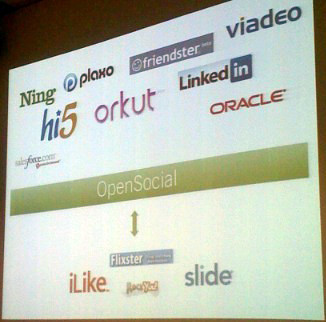
Marc Andreessen, founder of Ning (not to mention Netscape), has an excellent overview of the new standard. TechCrunch has their own overview, as well as a preview gallery of applications built using OpenSocial.
Search Engine Optimization Basics
A pretty useful article on SEO basics.
While the nature of marketing web sites has continually evolved from a focus on optimizing text to include an array of media optimization such as images, audio, video and content delivery formats like RSS and mobile, there continues to be a significant value in basic SEO.
In many cases, small businesses or small web sites especially, there’s a lot the site owner or webmaster/developer can do to improve the search engine friendliness of the site, i.e. fundamental content optimization, before pursuing outside help. However, those that do end up outsourcing on-page optimization and link building often do so because of a lack of resources or the desire to leverage expert experience to avoid big mistakes that can end up costing more to fix than a SEO consultant in the first place...
http://www.toprankblog.com/2007/10/search-engine-optimization-basics/
Web Users Now Spend Half Their Time Visiting Content, Far Outpacing Time Spent With Search, Communications And Commerce
| An interesting article that came out a few months ago shows that internet users today are spending nearly half their online time visiting content, a 37% increase in share from four years ago. |
If you see below, the index is basically showing that over the last four years, the primary role of the Internet has shifted from communications to content

| ||||||||||||||||||||||||||||
* 2007 includes January through May.
More people seem to be going to the internet now for news, weather, and information rather than more traditional means (newspaper, TV, radio, etc). Internet speed and search quality are also likely factors in more people searching for content online.
http://64.13.250.16/newsletter.php?newsId=242&newsType=pr
The Ads You Won't Take Home To Mom?
There were a couple of interesting articles in October highlighting studies about which advertising mediums earn the greatest trust by consumers. Seems like as online ads continue to grow and newspapers, magazines and TV scramble to keep their business models afloat, the true value of an ad is being overlooked. According to Nielsen, the tradional forms of ad messaging far outscore their new online counterparts. Obviously there are probably lots of reasons for this discrepancy. First, as mentioned in class, online advertising is both blessed and cursed by its low barrier to entry. Almost any sized company selling virtually any type of product can get its ads placed on 1000s of websites. The cost of TV and print advertising on the other hand is quite expensive and has a much tighter supply of inventory so the companies that can utilize these ad channels are basically pre-qualified as "legitimate" brands. Within the online advertising inventory I am sure that name brands from auto companies, big name retailers and large media companies earn as much trust as their offline counterparts. It's just when evaluating online advertising as a whole, there is tremendous trust dilution from the myriad of ads from small unknown brands and out-and-out fraudulent scams.
One positive highlight of the study was that among all online messaging, recommendations from other consumers was the most trusted form of "advertising." So can companies leverage customer recommendations to build brand awareness and buzz for its products? Maybe so, but it better be careful how it does it. Another study in October by WPP Group PR shop Burson-Marsteller indicates that online "influencers" - those most likely to recommend a product to friends - are beginning to distrust the opinions they find on product review sites and forums. There is growing skepticism by these brand advocates over the credibility of positive reviews with 30% believing that fake reviews are becoming a significant problem.
That being said, brands should still focus on building positive online "word of mouth" through legitimate means. Viral applications and user generated content are two ways that companies can provide customers a positive brand experience that they will share with others. If you have a good product then raising awareness through these types of user-focused campaigns can be a real winner among influencers and the rest of us alike.
Visit the following links to read the full articles referenced above:
"Do Web Ads Lack Credibility?", AdWeek, 10/02/07 (http://tinyurl.com/2bhh4m)
"Caveat: Influencers Growing Wary of Fakes", AdWeek, 10/23/07 (http://tinyurl.com/2699ye)
Is illegal downloading prevalent enough to impact the demand for the long tail in music, movies, games and books?
After reading "The Long Tail" by Chris Anderson, my first thought was "Is illegal downloading prevalent enough to impact the demand for the long tail in music, movies, games and books?" Most of the people I know are savvy enough to download any popular entertainment product from the last 10-15 years and if not, they get it from a friend. (Disclaimer: I DO NOT DOWNLOAD ANYTHING!) If this holds true for others outside of my sphere, then potentially, the demand for the long tail has increased significantly because people are reallocating their demand for popular products (because they get it for free) to more obscure products. Why then is there still a demand for popular products? Those are the people who are less computer savvy or more ethical. So is the demand for the long tail of entertainment products really a result of availability or because of the shift in consumer demand due to illegal dl'ing? Thoughts?
Yes, you can has cheezburger
Internet memes are amazing. They are micro bits of pop reference that evolve into a major cultural phenomenon for a particular in-group. It combines the best of user-generated content and Darwinism to generate a perfect storm on the internets.
It all started with All Your Base Are Belong to Us and probably had something to do with the Star Wars Kid as well. However, the most legendary has been the timeless LOLCats.
If you have no idea what I’m talking about, your friends don’t really like you….
“O RLY?” you ask?
The only acceptable answer is “YA RLY”.
This phenomenon is very difficult to reconstruct. While viral videos can be produced and I Love Bees can be launched, most people who deliberately try to construct them only end up with a big ol lemonparty…
How to monetize the Meme? We are do for another good one at any moment...
Hold on, let me get the graaaawwaaaahhh
the more you watch it, the funnier it gets:
http://www.omfg.info/wp-content/uploads/ATT287869.gif
http://www.omfg.info/wp-content/uploads/ATT287869.gif

Tuesday, October 30, 2007
Why "SPAM" is here to stay.
Some of you may define SPAM as the Rolex and Viagra emails that don't actually seem to be selling anything and are chock full of misspellings. I've always looked at it with a much broader scope to include the barrage of emails from retail companies that you get every day at like 3:23am because you once bought something from them and had to include your email address to complete the transaction. I realize that's fairly pessimistic, especially as someone who fully intends to do marketing for a major retailer when I graduate! That said, I've often wondered why J.Crew bothers to send me 4 different emails a day when the most I'll do is click one a month to check out what's new - and then I came across this article, "E-Mail ROI High, Response Rates Low".
While interactive marketers are clearly using metrics beyond ROI, no matter how you cut it, email still makes sense (or cents!) - in fact over $45 for every $1 spent - and generates leads. That was shocking to me until I remembered my last internship, where I (an unpaid intern) was responsible for the creative, which the company then emailed out to current customers - all pretty much for free. Email marketing is cheap, almost free, and therefore relatively effective and here to stay...
While interactive marketers are clearly using metrics beyond ROI, no matter how you cut it, email still makes sense (or cents!) - in fact over $45 for every $1 spent - and generates leads. That was shocking to me until I remembered my last internship, where I (an unpaid intern) was responsible for the creative, which the company then emailed out to current customers - all pretty much for free. Email marketing is cheap, almost free, and therefore relatively effective and here to stay...
Monday, October 29, 2007
Blog from another Blog - URL Lengths and Click Throughs
I saw the below blog on the Marketing Sherpa website. It basically details a study that was done on click through rates based on URL Length. It appears that the shorter the URL length in a list of returned items, the more likely it is to be clicked on, especially when a short URL length follows a longer URL Length.
In wondering why this might be, I imagine that the longer a URL, the further embedded in a website a page might be and this may lead people to believe that it's not worth reading if you have to go further to find it.
Blog Link:
http://www.marketingsherpa.com/article.php?ident=30181
Blog Text:
By Anne Holland, Content Director at MarketingSherpa
Search pay per click (PPC) URLs are fairly short because of the nature of the beast. You are not given much room to type in a long URL.
So, the hot search PPC testing tactic is specific wording and capitalizations. Example: Should your text ad say www.ClickHere.com, or will you get better response with www.ClickHERE.com, or perhaps www.ClickHereFREE.com?
As all experienced search marketers know, organic search results get the lion's share of traffic instead of PPC ads.
Naturally, your first concern must be to make sure your site or blog gets high organic rankings for critical keywords in your marketplace. For seven years now, in fact, when marketers debated SEO-tactics, practically all anyone talked about was rankings, rankings, rankings.
But once you get high rankings, what's next?
Are you even tracking your click rate for those SEO ranks?
And, once you've measured your organic click rates, are you running any tests to optimize them? Most marketers aren't.
I think that's partly because marketers perceive SEO-driven traffic as "free" so why invest in it? Also, testing SEO listings involves some risk; if you tweak inexpertly, you might damage your ranking. And, lastly, testing SEO listings often means involving your IT and Web departments, which means get in line and take a number.
If you are one of the super-lucky marketers who can measure and run tests to optimize SEO-driven traffic, however, the payoff could be enormous. Just look at how much traffic you get from organic search today and do the math -- how much more would you get if your tests raised clicks 50%?
A 50% lift in organic traffic sounds insane, doesn't it? But it's based in new lab tests. Here's how:
MarketingSherpa ran lab tests this year for our newest Search Marketing Benchmark Guide asking real-life business professionals to conduct Google searches. Among other results, we discovered that executives are 250% (yes 250%!) more likely to click on an organic listing if it:
(a) had a fairly short URL and
(b) appeared directly below a listing with a long URL.
So, in SEO, keeping your URLs as short as possible can be an enormous competitive advantage.
Why not search for your company or brand online right now by a super-competitive keyword? Look at how long your organic listing URLs are compared to the URLs of your competitors on the page. How does your URL stack up?
If your company is considering a new microsite, blog, Web content management system or revamped site for SEO purposes in 2008, please add to your specs list: "Must make short page URLs." I bet you it's a factor your IT department won't think of. Marketing has to bring this type of knowledge to the meeting.
Want documentation? Here's a free PDF link to the Search Benchmark Guide's Executive Summary, which includes color heatmaps of the lab tests I just mentioned:
http://www.marketingsherpa.com/exs/Search08Excerpt.pdf
Facebook...Facebook...Facebook
Dear Little Class,
Forgive me for the lack of originality, but I must begin by discussing Facebook and then question myself or even contradict myself. So here are my thoughts:
Microsoft bought Facebook equity at a $15B value. This is a mind boggling fact, one which I personally find insane. Not to say that Gates and Co. don't have a clue to what they're doing, but does anyone believe that FB would generate future cash flows of $15B? Think about it - Google is worth around $157B, Apple is worth over $160B. Is FB worth 10% of these two ginormous entities, or is this just the newest mutation of the internet bubble? Let's call it the Social Network Bubble...
So what makes Facebook so attractive to the world? As mentioned in class, Facebook offers the complete Big Brother experience, one which enables advertisers and marketers to reach all of us more effectively than ever, as they snoop into our demo-techno-psycho-AndEverythingElse-graphics. This does not only enable marketers to send us pinpoint targeted messages to the extent of replacing our personal assistants in reminding us of our anniversaries (which we were about to forget and for which they would be handsomely rewarded), but also helps President W types to get all of the information they need about any of our terrorist friends. I just hope FBI agents don't come knocking on my door due to a blog.
I will summarize and say:
Indeed, Facebook offers a unique opportunity for advertisers, one which only a few years ago did not exist. But just as Facebook busted into the scene as the biggest thing since Chicken Noodle Soup, more or less out dating MySpace, as MySpace did to Friendster, who says that MyHotFriends.com, a futuristic social network for people who want even more intimate relationships with their communities, would not do the same to Facebook.
So is Facebook really here to stay? The answer is probably yes.
$15,000,000,000 has lots and lots of 0's. In my opinion, a few too many.
Monday, October 08, 2007
Facebook Fatigue?
Just in case you don't read all of your industry e-newsletters, here's a compilation of articles about Web 2.0 superstar Facebook. Once an also-ran to the MySpace juggernaut, it has gained tremendous momentum in the past 9 months and is clearly being viewed as the company to beat in Social Networking. Here's just a sample of what's being reported on and speculated about the company:
Facebook: New Threat to LinkedIn? (Just An Online Minute)
http://blogs.mediapost.com/online_minute/?p=1576
Facebook Charges Forward (USA Today)
http://www.usatoday.com/money/industries/technology/2007-10-02-facebook-suitors_N.htm
Facebook "Barnacles" Find Success (The New York Times)
http://www.nytimes.com/2007/10/04/technology/04facebook.html?pagewanted=1&_r=1&ref=technology
Three Warnings For Facebook (Wired)
http://blog.wired.com/business/2007/10/three-potential.html
Facebook Grabs Fed-Up MySpace Users, Lifting Value (Bloomberg)
http://www.bloomberg.com/apps/news?pid=20601087&sid=a8RinPzEzIPQ
Facebook Initiative Will Help Define Digital Future (MediaDailyNews On Media)
http://blogs.mediapost.com/on_media/?p=18
Facebook Targets Musicians (Just An Online Minute)
http://publications.mediapost.com/index.cfm?fuseaction=Articles.showArticleHomePage&art_aid=68803
Would love to ready anyone's predictions on the future of the Social Networking space. Will Facebook topple both MySpace and LinkedIn? Will Microsoft value the company at over $10B? Can Facebook actually develop a sustainable business model?
Tuesday, August 28, 2007
Heineken Viral Video
A little example of viral video from my client Heineken - check it out!
Heineken Draught Keg URL: http://heinekendraughtkeg.com/embed/?justwatch=true
Heineken Draught Keg URL: http://heinekendraughtkeg.com/embed/?justwatch=true
Thursday, August 16, 2007
"Bloggers are Monkeys"... Linkbait?
An interesting ad campaign for a Brazilian newspaper has hatched a Catch-22 discussion. It seems the newspaper humorously referenced bloggers as a pack of chimps cutting and pasting random text on the internet, then directing readers to its new, presumably more reputable site. The firestorm of pissed off bloggers linking to the site has generated another, very interesting question...
The ad in question - Bloggers are Monkeys...
Was it deliberate linkbait? That is - were the ad people smart enough to GOAD the blogosphere into giving the ad that much more impact? Knowing people, I doubt it... but it's a very interesting thought...
The ad in question - Bloggers are Monkeys...
Was it deliberate linkbait? That is - were the ad people smart enough to GOAD the blogosphere into giving the ad that much more impact? Knowing people, I doubt it... but it's a very interesting thought...
Subscribe to:
Posts (Atom)