Friday, March 22, 2019

Need to Find Leads and Accurate Contact Info at Your Target Accounts?

Do your Sales and Marketing teams need contacts at your target accounts? How can you collect contact information for your key buyers and ensure data accuracy? AdRoll recently acquired Growlabs, a company that offers a platform to help with this. The image below illustrates the Chrome extension which enables you to search for specific contacts (e.g., Sales Manager) at accounts and retrieve their contact information. Growlabs also features an app within your CRM so that you can find and add contact information all while logged into your CRM.

According to the TechCrunch post, Growlabs contains a database of 12 million companies and 320 million business identifies. "Growlabs has not only build one of the largest B2B data-sets, but more importantly they have developed a number of industry leading techniques to ensure that the data is accurate," said AdRoll's CEO Toby Gabriner. These contacts can then automatically be sent initial e-mails and triggered follow-up e-mails from your sales reps (e.g., one month after initial e-mail and your recipient having opened the e-mail 5 times). Once your contacts reply, their e-mail responses are automatically analyzed using artificial intelligence. Only interested and qualified leads are sent to your sales reps' inbox, so your team can focus on closing deals. The tool also empowers your team to follow up on leads through multiple channels including phone calls (e.g., via notifications to call leads who have opened an e-mail), ad-retargeting, chat bots and social media. Finally the analytics capabilities allow you to view which sequences are performing best and the built in optimization automatically optimizes using machines learning and A/B testing.


Facebook does it again and it's ...... not good

Last fall, Facebook failed to secure personal information for 30 million of users and following non-stop backlash from sharing personal messages with advertisers - the lesson should be clear, value your customers and foremost. Another story from today disclosed that anywhere from 200 to 600 million users' passwords were not encrypted, which is one of the most basic security features that any low-level IT consultant will advise on the first day.
I think it's telling that someone with so much data, power and very limited competition, especially when it comes to targeted social media advertising - not only drops the golden ball but somehow manages to drop it, jump on it and keep ignoring the issue. So maybe let's keep using as a model for how future digital marketing will be shaped as they might be few years where all the customers and government turn against them and more viable alternative is coming. Personally, I would jump at any opportunity to move to any other viable social platform (and not lose my pictures, stories, etc) just to stop using Facebook.

When is Digital Marketing Worth The $?

A lot of companies are looking into digital marketing and trying to find out when and how much to add to their budget. The question is, when is a startup ready to start spending and allocating money to that purpose? They want to get the most bang for their buck, but also do not want to start before they think it will result in decent returns. I think early-stage companies are struggling to find when the time is right to spend. Once they agree the time is right, how do they assess how much to spend? This is the problem many companies face early on before they have experienced growth. When do we start?


Millennial Spending Habits in 2019


Millennials, also referred to as Generation Y, are currently between the ages of 17 and 36 and one of the first generations to spend their formative years online. At 83 million people, Millennials account for a quarter of the population of the United States, making them the largest living generation.

Millennials average yearly expenditures are around $47,011. And in total, Millennials spent roughly $600 billion in United States in a year. As many Millennials are graduating from college with financial responsibilities, including debt, they have a growing obligation to act more responsible with their money and spending habits. Millennials are expected to accrue more wealth by the year 2020 where they are trended to spend $1.4 trillion. As Millennials pay off loans and get better jobs with higher salaries the spending habits are expected to change. It's projected that Millennials will be the leading generation in E-commerce and online shopping by 2020. A lot digital marketing campaigns are now focusing on age 18-36 as they trying to establish brand loyalty with the Millennials.

DM for B2B Companies (4)

Another important channel for B2B Companies is social media. Social media is becoming increasingly important for B2B companies to consider as many of the  decision makers at potential clients are active on social media. This was likely not as prominent 5-10 years ago. For example, if you are an HR-focused software company, there is a good chance that the person in HR who can make a purchasing decision is active or at least has social media accounts and checks them. B2B companies can think about the social media channel as a way to control digital real estate and continue to promote the brand. Facebook is known to be the most effective social network to use to target clients on the B2B side. Instagram is starting to become more important as well. The social channel will only gain importance in the future as a means for B2B companies to use to acquire clients. 

Instagram is a new e-commerce channel

On Tuesday March 19 Instagram announced of a new feature in-app checkout. Isn’t it exciting? Now you don’t have to go to another website of a brand to make a purchase, but can seamlessly do it on IG. Now this function is only available in a testing regime for 23 business in the US, but expected to expand soon enough. 

Now businesses have a whole new selling channel, which gives them access to more than 1 billion users. Moreover, it addresses one of the pain points that is a website creation. For a small business it might be long, expensive, and cumbersome to create a whole new good e-commerce website and make people to go there. When the feature is launched for the big audience, they will only need to create an Instagram account. 

What is interesting, that at the rise of Instagram nobody expected it to be such a great business/advertising platform. Maybe someone did... It seems that IG slowly moves towards WeChat politics of "all in one". Now we have not only option of posting pictures & videos, but also of watching IG TV, chatting, and even buying items. The more services, the more people are attracted and tied up to the app, the larger is potential customer base. 

What I do believe in is people’s laziness. Customers do really appreciate products/services that make their life easier. When on brands’ websites cart abandonment rates are high, they are going to be lower for IG potential buyers, because the procedure is easier. 

It is expected that with this novelty a whole new bunch of advertising techniques will emerge on Instagram. Companies will start to think not only about number of followers and engagement level, but also conversion rate, some kind of cart abandonment levels, etc. Definitely instagram will leverage this opportunity!

Why Companies Fail at Digital Marketing

Digital is supposed to make executing anything, especially marketing easier, right?... Wrong.

Consumers only see the end result of all the turmoil a company has to go through to send them an email, set up an on-line ad campaign, make sure the right content and message is sent to the right person at the right time but for many companies, it feels like moving a mountain to do some of the most basic things consumers expect and they still get it wrong.

I'm currently leading a project for my firm at a very well established consumer goods company based in New Jersey.  They make a product for a category that's been around hundreds of years and will continue to be relevant.  The product itself is considered the best in its industry.

Over the last 10 years or so, the company stopped investing in it's Marketing Technologies (MarTech), and kept buying multiple system and tools to address needs instead of looking at the eco-system as a whole.  The unfortunate truth is that almost any established institution approaches technology this way.  They have data silos, duplicate systems, paying for functionalities they're not using, and the biggest culprit - people in roles without the skill sets for the roles.   To give you an example, one of the senior leaders in their Digital Marketing organization ordered the company to stop investing in paid and organic search because they don't see any value in it.  When I heard this, I had to put my hand over my mouth to hide my facial expression. 

The interesting thing is, they see startups as their biggest threat because they are setting up their technology infrastructure right from the start, have marketing strategies, integrated marketing plans,  across channels, automated marketing push multi-channel activation and a content strategy!  All these terms - are like a foreign language to most established companies. 

The reason most companies fail at Digital Marketing is because they don't keep their people relevant and if their people are not educated on what it is, why its important and how to do it right, they can't understand the value and will not have the right skill sets to execute it well.

Attribution in Traditional Media


In a recent article, AdAge describes how attribution has become the buzzword in the marketing industry as companies try to quantify their return on marketing spend. Given the wide array of options available to reach and engage consumers, the TV ad business is on a mission to prove that running spots on television actually drives business value for marketers and should continue to be a large part of marketing plans.

With the focus on attribution, major TV players have introduced new ad products that will guarantee business outcomes. TV ads traditionally guaranteed that a certain demographic would see the ad, but in recent years the focus has shifted to more granular targeting, and now there are ad buys that guarantee you’ll reach a certain household income or even interest in buying a new car. In 2018, several TV network groups took it a step further and began guaranteeing business outcomes such as ticket sales for a movie or increase in store traffic.

While this is certainly a step in the right direction for TV networks, I think there’s still a lot of work to be done in order for TV to truly compete in a digital marketing world. With digital marketing, data is constantly flowing, allowing marketers to make real-time optimizations as they learn what’s working and what’s not. This approach of “guaranteeing performance” sounds great, but it is very passive in nature. I think that if networks aren’t able to offer the ability to optimize throughout the lifetime of campaign, they will continue to see a contraction in their business as large digital players like Facebook and Google capture a larger portion of marketing campaign budgets.

News on "Last Touch" Attribution

With the increase and expansion of novel technology, the task of conversion attribution has become much too complicated. In fact, pinpointing which one source or channel (e.g. SEO, display)  influenced or triggered the purchase is deemed nearly impossible to tell, so much so that 'last touch' attribution has become the norm for businesses.

Last touch, as the name suggests, accredits the sale to the point of contact (or "opportunity") directly preceding the conversion. For example, say a person attended a makeup workshop at Sephora which was showcasing Rihanna's new face powder. After the session is over, the person returns home and receives an email from the store, one, asking for feedback and , two, giving the client a special 15% off discount. The person swiftly ignores the feedback query and jolts the cursor over to the browser to write sephora.com/rihannapodwer/where/I-need-now. Shortly after, the purchase is made. According to last-touch attribution, the source responsible for the purchase is the email sent out by the store.

This model, while convenient, is often inaccurate. As such, google ads among other players started to move to a multi-touch attribution model. Specifically, "Google will likely emphasize its multi-touch attribution reporting, and in particular Data-Driven Attribution (DDA), which uses algorithmic attribution to credit sales across Google’s ad properties" writes Marketingland.com. One such way, Google reveals, is to use Multi Channel Funnel Reports within Google Analytics. This approach is still in its trial-and-error phase and it would be interesting to see if a simple yet quality tool comes out to help businesses pinpoint what drives the most sales.

Pinterest's New Head of Engineering Bolsters Visual Search Prospects

A recent Marketingland article reveals that Jeremy King, a previous e-commerce tech from Walmart and VP of engineering at Ebay, joins the social media web and mobile application, Pinterest. In recent months, Pinterest has made several moves to expand their e-commerce capabilities, with ad spaces and product tagging tools to make items shoppable in images. This new addition to the team hopes to "build a visual discovery engine for all." While the enthusiasm is great and the opportunity is definitely there, other giants such as Instagram and Snapchat are quickly jumping to the race and creating ways to make a purchase nearly immediate. In IG, you can now checkout and pay for items through the app itself, often simply by clicking on the product tag in a particular image. I wonder what will happen next as more developments unravel and novel technologies increase. Whatever it is, companies should remember that an idea is not novel forever and others are similarly craving for their next money maker. Better patent all that you can asap.

Brand loyalty is a thing of the past for digital native consumers


Brand loyalty has always been crucial to maintain and enhance sales for most companies. However, with the advent of digital channels it has become increasingly difficult for brands to keep their loyal customers. Digital native consumers who have grown up using devices are constantly exposed to a wide range of messaging. This barrage of information makes it difficult for one brand to remain top of mind when these consumers are making buying decisions. With the speed of information today brand image can change in a matter of hours. Public perception of a brand that could have taken years to change in the past can now be damaged almost instantly. A recent example is Papa John’s Pizza. Sales dropped about 10% after reports that founder John Schnatter used a racial slur during a conference call got out. How people relate to brand can change very quickly. 

The level at which brands need to connect with people has become much deeper. Superficial tactics that have worked well in the past, such as having an ad with a catchy jingle that sticks in your head no longer work. Consumers are exposed to so much sensory data that nothing sticks for too long. For a brand to be embedded in the consumer psyche it must somehow align with their values in a much deeper way. Apple, for example, has been a poster child for brand loyalty even with intense competition. Although they may complain about price, most people gravitate towards Apple products because of their reputation for user centric design and innovation. The difference between an iPhone and many other Android phones in terms of apps and features offered is now almost non-existent. Yet Apple consumers prefer sticking to their iPhones because they feel a stronger connection with the brand rather than the product itself. Maintaining this deeper connection with consumers is becoming increasingly difficult and will continue to be a challenge as people get easily “influenced” by social media and digital content. Marketers will need to keep innovating new strategies if they want to keep their consumer's brand loyalty intact.

Thursday, March 21, 2019

Small Tech firms to take TV ad dollars

One of very surprising developments have been the large amount of money spend by the smaller tech firms on TV advertising. Couple of things are working in the favor of growing spending by these smaller tech firms - where a lot are able to measure impact more accurately and looking to make customers aware of the product. The companies like Peloton increased their spending increase their TV ads to almost $100 million in 2017, an increase of 65% from prior year. Other companies like Refin, TripAdvisor, etc significantly upped their ad spending as well.
Two significant takeaways from this that TV ads might be making a comeback after all, especially as the power of Google and Facebook continues to grow and the opportunities for cost-effective ads become pricier and companies looking for brand awareness chose to go TV route, instead of Google and Facebook where consumers are less loyal and more deal oriented.

Looking for a 360 Degree View of Your Customer?

If you're looking for a 360 degree view of your customer, then it might be time to invest in a Customer Data Platform (CDP). Gartner defines the technology as a "marketing system that unifies a company's customer data from marketing and other channels to enable customer modeling, and optimize the timing and targeting of messages and offers." I recently learned more about Tealium which offers CDP solutions to help gather fragmented customer data across disparate touch points including wearable technology, in-home AI personal assistants and smart appliances. What about your data on customers and their engagement that can be stored across many different vendor system silos you ask (e.g., Salesforce for CRM, ExactTarget for e-mails)? Enter the Tealium Universal Data Hub which allows you to capture data at digital and in-person customer experiences and combine customer data across sources through over 1,000 client-side and server-side integrations.

Tealium AudienceStream enables businesses to gather data across your marketing technology stack. You can then build rules using this customer data and setup triggers to do things like send e-mails from your e-mail provider when certain scenarios occur. As an example use case, you might use AudienceStream to do the following:

  1. Create a Customer Lifetime Value variable that tracks the amount of spend a customer has with you to date.
  2. Assign a "VIP Badge" to customers who have a Lifetime Value of over $500.
  3. Create an audience of customers who have been assigned a VIP Badge and abandoned their cart on your website.
  4. Build a rule to send an e-mail to customers in this audience using your e-mail tool (e.g., ExactTarget). You can even leverage e-mail templates that you have built in ExactTarget.
All of the above steps can be done right through Tealium AudienceStream giving you one view of your customer and a single platform where you can build targeted marketing campaigns using your existing marketing technology stack. For more information on Customer Data Platforms, you can refer to the below infographic and download the Gartner report here.


Wednesday, March 20, 2019

Programmatic Ad Buying Solves All Problems, Until It Creates New Ones


You weren’t the only one who was freaking out last week when Facebook’s servers were down; advertisers were also caught without access to their programmatic ad settings. For most advertisers, the servers being down for an extended period meant that there was dramatic decline in their daily spending. Other advertisers weren’t as lucky; as the servers came back online the programmatic bidding algorithms aggressively competed against each other for the scarce users as they attempted to hit their daily targets, paying up to 300x the normal price.

The problem was a result of an unusual supply shortage which caused the demand to skyrocket. Without access to disable the programmatic buying advertisers could only watch as ads were being served at a rate which was well beyond their ROI targets. This should be a cautionary tale to digital marketers as programmatic ad buying becomes more prevalent - in addition to setting a daily spend allowance it would also be wise to set a cap on how much can be spent on a single ad.

Facebook’s News Deserts Should Worry All Of Us


Facebook has put a major focus on supporting local news over the last two years.

However, this week it shocked (but perhaps did not surprise) many in the media industry by announcing that there are a huge number of “news deserts” across America: communities defined as those that do not produce enough locally reported stories to support any reasonable kind of news service.

Some commentators immediately lambasted Facebook, accusing it of patronizingly trying to solve a problem it has itself created.

But this is only partly correct. True, Facebook has certainly accumulated a lot of media power over the past 5-10 years as its giant aggregator has come to dominate the news consumption of hundreds of millions of Americans.

Most notably, Facebook’s impact on news was felt during the 2016 US Presidential campaign when any number of strange or downright false narratives found their way into the newsfeeds of the ordinary user of the service. Many of these so-called news outlets, as it turned out, had a dubious provenance.

However, the decline of local news in America is a trend of at least thirty 25 years in the making and certainly predates Facebook’s assumption of a stranglehold over news aggregation and dissemination.

Some 1,800 newspapers have closed in the United States over the last 15 years, according to the University of North Carolina. Newsroom employment has declined by 45 percent as the industry struggles with a broken business model caused partly, but not entirely, by the success of online news providers, including Facebook.

Facebook’s local news service, called "Today In ," collects news stories from various local outlets, along with government and community groups.

The social network deems a community unsuitable for "Today In" if it cannot find a single day in a month with at least five news items available to share.

began testing Today In, a separate destination for local news within its flagship mobile applications, in January 2018, in six U.S. cities.

Facebook added 25 more U.S. cities to the test last March and last November it said Today In was available in over 400 U.S. cities.

But its efforts to roll out the service led the company to discover the hundreds of communities with little or no local reporting.

Facebook’s findings show that there is no easy answer to this issue, which has implications for many areas of commerce and civic life, including online marketing to those communities with no local news operations; as well as how voters are satisfactorily informed ahead of local elections, or around major issues affecting communities.

The company admits there are no easy solutions.

In some ways, the problem is analogous to the struggles of a generation ago to roll out broadband  Internet across rural communities: it is, indisputably, a public good that can add huge value but it is not commercially viable on a standalone basis.

Facebook admits there are no easy solutions. But at least it hasn’t given up yet.

Jury Out on Instagram's Giant Step in Online Retail


This week Instagram announced that it will, for the very first time, begin offering so-called “shoppable ads”: meaning that is users will be able to make purchases of some products directly within the app.

The Facebook-owned photo-sharing network unveiled a first wave of consumer facing brands which will feature their ads on the platform. The group of around 20 advertisers includes more established brands like Nike and Zara, as well as those launched more recently, such as Warby Parker and Outdoor voices.

This is a really interesting move by Instagram as it aims to show whether it can translate its success as a stylish but indirect promoter of cool brands into a direct purchase model.

Of course, the platform is already well known for enabling people to discover new brands and products through striking visuals and the endorsement of famous influencers. So, in many ways, this move toward direct e-commerce traffic is a natural progression.

But, will it work out?

In many ways, there is no digital parallel to what Instagram is trying to achieve with its new rollout. Traditional online models driven by search, and, of course, Amazon are driven by a more mundane marketing funnel: consumers generally purchase when they arrive knowing what they are looking for.

By contrast, rather like glitzy product placements in Hollywood blockbusters, Instagram’s new service will attract the impulse, whimsical buy – the purchase that the consumer did not necessarily set out to make, but which they couldn’t resist when seeing a young influencer wearing that new pair of sunglasses.

On the face of it, it may seem as though there is no downside to Instagram. But the big question for its top dogs who are putting their necks on the line is, will it dilute the brand and what Instagram is famous for.

Rather like the high end fashion magazine of years past which may have eschewed overt commercialization around its “editorial” content, Instagram has made its name as something that can be classy and visually striking. That may be put at risk with many of the goods now able to purchased directly just a click away. It could cheapen the look.

So, the jury will be out on the new strategy for some time to come.

Tuesday, March 19, 2019

IG Beats YT as Top Influencer Platform


Instagram has topped YouTube as the number one platform for influencer content – with brands portraying themselves as more honest versions of there partnerships online.
In a research study, Instagram was cited by 65% of those polled as where they most follow influencers, beating YouTube (62%) and Facebook (62%).
When it came to preferred content, video – cited by 64% of those polled – and images (61%) naturally beat out the written word (38%) according to survey respondents. More than half of those polled (53%) said they discovered new influencers on social media platforms themselves, ahead of friends and family (48%). One in three (32%) said they were influenced by giveaway offers.
90% of those polled said they share some form of content. Two thirds (66%) said they shared content because it was interesting and different, while half said they shared to refer a friend to a brand or product.
The research also explored how influencers helped continue the journey to purchase. Globally, four in five consumers said they had made a purchase recommended by an influencer by clicking on the link or image that was shared. While previously, marketers believed influencers were good for building awareness, now, consumers are ready to click through and buy if the product is right.
“Influencer marketing has come a long way and understanding from consumers, brand and influencers themselves has grown,” said Anthony Capano, Rakuten managing director EMEA. “People increasingly appreciate the work and financial investment involved in making great daily content. However, this level consumer savviness comes at a price: if influencers are promoting products that aren’t a natural fit, audiences will switch off.
“It’s about being authentic,” Capano added. “Brands must prioritise partnering with influencers that align with their brand values. Influencers must prioritise promoting products that align with their own ‘brand’ or risk losing their audience.”


Advertising Overkill on Websites

I was searching for a topic for this classes blog and thought I would look for something related to voice search as it is something I don't know much about but Professor Kagan has talked about in several lectures. 
I googled "voice search trends 2019" and was pleased to see an article on Forbes titled
"12 Ways To Optimize Marketing Content For Voice Search."  As I started to scroll down the page 2 ads popped up as well as a video in the bottom left of the screen.  I then decided I needed to change my topic from voice search to an advertising overkill on websites.  
Between Forbes and the Dailymail I am not sure who is worse, however their websites have become unbearable.  
I am sitting here at my desk looking at a copy of my Forbes March Edition and wonder what the breakdown is between online advertising revenue and magazine subscriptions, i am not a betting man, but think it's probably 70/30 if not more!  

Wechat marketing in China


In general, marketing in China is is not as easy as here in US. The dominant searching engine Baidu is not used often compare with Google. However, people intend to shop more on Wechat and Taobao, an aggregated platform composed of thousands of online individual stores. 

Wechat is the most popular social media in China, it's a combination of Facebook messager, Instagram and paypal. You can message friends, post pictures and make payments. WeChat counts over one billion active monthly users – a threshold it crossed in the early days of 2018. As of the third quarter of that year, it was up to 1.08 billion. In a league table of the world’s most popular messaging apps, this puts it behind only WhatsApp and Facebook Messenger.

Advertising on WeChat is a booming trend: the platform has a long history of protecting users and forbidding entry from advertisers, but it is now slowly opening up. This is a huge opportunity for marketers trying to advertise in China. However, adverse on Wechat is not cheap, the minimal entry price (both foreign companies and Chinese companies)is 50,000 RMB (equal to 8,000 USD). It's both an opportunity and a challenge. 

Facebook Cracks Down on Discriminatory Advertising


Facebook has initiated a new policy for advertisers targeting housing, employment and credit card offers in the United States: you can no longer use age, zip code, or gender to target your ads. This applies to Facebook, Facebook Messenger, and Instagram.

This policy change isn’t entirely out of the goodness of their heart, it’s a result of a lawsuit settled with the ACLU, NFHA, and CWA. These groups felt that Facebook was allowing discriminatory practices in their advertising. Detailed targeting will still be allowed in certain categories and for protected classes.

Additionally, not only did they announce that these categories can no longer be used, but they are preparing to launch a tool that will allow all users to search for ads in these categories on the various platforms.

This kind of change is absolutely critical in removing biases and promulgating injustice. The ethics of advertising are certainly at play here – by being targeted so specifically, how much are we lifting up those who are already wealthy or supported by society and how much are we keeping down those who are not?

Instagram Announces In-App Checkout


On March 19, 2019 Instagram announced in-app checkout with 20 major brands. This feature, as expected, allows users to click on an ad within Instagram and directly purchase the item they are looking at. It allows them to review sizes and colors (among any other distinguishing features) before purchasing. From there they will enter their billing and shipping information, which of course will be stored for future purchases, and they simply hit a button to complete the checkout process.

Instagram, already a huge revenue producer for Facebook through ad sales, continues to push the boundaries of tying actual revenue to advertising. While Facebook has supposedly taken harder lines on privacy and security, this would certainly seem like a push in the opposite direction. It could go either way in terms of people’s comfort sharing their private information with Instagram. On the one hand, seamless checkout is a priority in the fast-paced world we live in and people are willing to share their data for that. The other side is that it doesn’t seem significantly more secure to share your personal information directly with Nike as opposed to with Instagram.

Adidas, Burberry, Michael Kors, Prada, H&M, and KKW are among the brands to be part of this beta launch.

Sunday, March 17, 2019

Boeing's Social Media Response to Ethiopian Airlines Crash

On March 10, an Ethiopian Airlines flight crashed shortly after takeoff, with eerily similar characteristics to a LionAir crash on the exact same make of aircraft 5 months earlier.  The aircraft, a Boeing 737 Max 8 is a derivative of it's best selling 737 Aircraft.  As an aircraft enthusiast and now a Digital Marketing enthusiast I was curious to see how Boeing would handle the crash and aftermath that would ensue. 

Boeing's first response on social media was at 1:27AM on March 10 via Twitter where they issued the following tweet "Boeing is aware of reports of an airplane accident and is closely monitoring the situation." This tweet received 898 retweets and 2100+ "likes" - an odd thing to do especially given the massive loss of life.

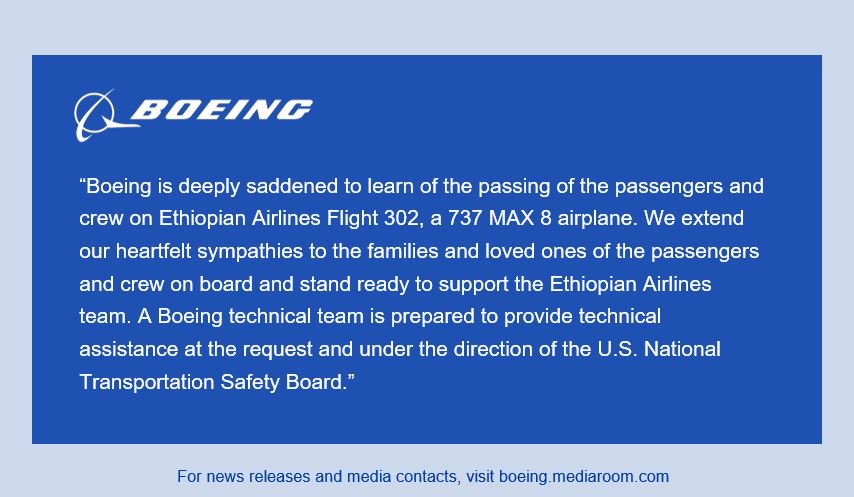
Nearly 3 hours later, Boeing issued their second tweet which was below:


This tweet received

Since the accident on March 10th, Boeing has only released 3 tweets with one mentioning that they would be doing no PR fanfare  for their 777X aircraft which launched on March 13th with no broadcasts or social media announcements. 

Boeing's decision to limit their social media activity following the Ethiopian Airlines crash seems to have been the right thing to do in this instance. 


Wednesday, March 13, 2019

Qantas Airline Cleverly Taps into Viral Marketing


A 10-year old boy wrote a letter to Alan Joyce, the CEO of Qantas airline, asking Joyce for advice about starting his dream to start his own airline. Joyce wrote the young CEO back a thoughtful letter which quickly received a lot of traction on Twitter, with over 42,000 likes and retweets within the first 24 hours. Additionally, the story was picked up by many of the major news outlets where the brand gained further exposure.

Aside from Joyce looking like a great guy and making the young boy’s day, the letter was able to spread a tremendous amount of awareness about the brand in an extremely positive light. Many of the replies indicated how highly they thought of the brand for its actions. Below are some of the comments.

The second, perhaps more hidden angle, was that Qantas was able to use the letter as a cleverly disguised ad to reinforce its positioning. The letter mentions Qantas commitment to passenger safety and gives a plug for their new non-stop route from Australia to London. It is perhaps cynical to think that the brand only did this from the PR benefits and exposure, but it would be naive to think that Qantas did not consider the added benefits.


Tuesday, March 12, 2019

Amazon is coming for your ad dollar

Both Facebook and Google growth had slowed up drastically (in-mid teens for Google and about 20% for Facebook), Amazon has been growing at 120% annual growth since passing over $1 billion mark in 2016. First off, it's important to acknowledge Amazon's growing presence and a first website for many users to visit. The Amazon advertising muscles is further highlighted by it's growing reach with the clouding services and streaming video services.
A growing number of buyers go directly to Amazon to do their shopping, bypassing Google altogether, and the "stickiness" is unlikely to go away anytime soon, as Amazon reported more than 100 million Prime subscribers worldwide. The online ad market is estimated at almost $300 billion in 2018, where the majority of this growth was captured by Google and Facebook, but Amazon is projected to eventually start taking away market share from both tech giants. The growth is likely to growing rapidly with Amazon's growing reach as an e-commerce giant where ad money will come via paid searches and "sponsored' product ads. 

How to find niche influencers

Majority of brands prefer to work with micro influencers that have a specific niche because such influencers have better engagement rates that lead to higher conversion. But finding right influencers can be a tough task.
To find niche influencers a brand needs to come up with a list of relevant keywords and hashtags. Tools like KWFinder or just simple trend search on Google can help with finding relevant keywords. After finalizing the list of hashtags, a brand should follow them on Instagram and/or Twitter and start monitoring all the posts to select relevant bloggers with high engagement rates, frequent posts and suitable aesthetics.

A brand can also use influencer platform tools to identify right influencers. At the bare minimum such platforms should have a database of influencers with basic information such as geographic and industry niche, reach and scoring. More advanced platforms offer services like creating lists, negotiating bids, creating and publishing content across social media, tracking performance and fulfilling payments. Some of the examples of useful tool include BuzzSumo, Klout, Iconosquare, Traackr, Prezly, Klear , Discoverly, Markerly, Upfluence and etc.

Monday, March 11, 2019

Influencer marketing is becoming the fastest growing channel for consumer brands

Influencer marketing is becoming the fastest growing channel for emerging and incumbent consumer brands, beating organic and paid search and email marketing in terms of growth. Worth $2B in 2017 influencer marketing is expected to reach $10B by 2020. The key reason is trust that influencers build with their followers. Around 80% of women before purchasing are seeking advice on social media. Half of them make a purchase due to influence post (and I am one of them!). Teenagers claim that they trust influencers more than celebrities and that their favorite influencers understand them better than friends.
Influencer marketing has also demonstrated a very good return on investment. According to Tomoson (influencer marketing platform), businesses earn $6.50 for each dollar spent on influencers with the top 13% earning $20 or even more. Influencer marketing not only allows to decrease CAC but also attract higher quality consumers. Therefore, an average budget for influencer campaigns for small-to-medium brands have grown to $25-50k and it’s expected to increase.

There will be more widespread use of influencer digital marketing tools and platforms that help to create and realize campaigns, measure and analyze results and manage relationships between brands and influencers. Some of the examples of such platforms include companies like AspirelIQ, Upfluence, NeoReach, Mavcrk, Traackr, Speakr, Famebit, Webfluential. Obviously, Pixlee, Tomoson, etc.

Saturday, March 09, 2019

State of Emerging Markets - Social Media and Mobile Phones Are Pervasive and Facebook Rules

March 9 2019

It's probably not a surprise to most that social media has permeated every continent and most of the countries on Earth.

However, the totality of this permeation is stark. The smart phone has now over-taken, by a wide-margin, the choice of phone type across emerging economies.

More striking is the use of smartphones per age group for these countries. 90% of 18-29 year-old's in Vietnam reported using smart phones compared to just 67% of the total population that claimed to use smart phones. This indicates that smartphones are cheap enough to be ubiquitous, and it's consumer behavior that is limiting even wider-spread adoption.

Facebook and WhatsApp are reported to be the most popular apps in this study, which is interesting when comparing trends in America, which is showing a decline in Facebook usage in young people.

Lastly, most people don't have access to a computer or tablet.

What can we learn or take away from this?

First, that Facebook isn't going anywhere. If it becomes the point of entry to the internet to a generation of teenagers and young adults across a diverse group of emerging countries then its appetite to sell attention can be satisfied by all these new users.

Second, smartphones will only become more ubiquitous in emerging economics while tablets and desktop usage declines. This will inform how entire generations interact with technology and their real and digital worlds, which will be distinctly different than the American experience. A good comparison would be to consider how China uses technology differently, especially with regards to payments and transactions.

Third, if Facebook is everywhere in the emerging world and if everyone is using smartphones then perhaps the next evolution of mobile advertising will be aimed at emerging economies. If a large percentage of Facebook's future revenue will be derived from these new users, how will it go about capturing this opportunity?


Zuckerberg's 180

It appears that Mark Zuckerberg is finally waking up to a world where privacy matters. This week, the Facebook CEO proclaimed that he would be shifting the social network towards an encrypted and privacy-focused platform where users everywhere can rest assured that their information and communications remains restricted. Zuckerberg’s blog post, reflecting a 180*-turnaround from his previous stance around open-sharing, which the Company’s business model depends on for advertising and targeted marketing efforts. While it’s certainly possible that the new strategy is steering the Company in a different direction, it’s also likely that the approach timely coincides with the onset of expanding privacy regulation and heightened legislative scrutiny around consumer data protection. Regardless of the ‘real’ reason for Zuckerberg’s about-face, it’s clear that the medium and long-term consequences are not immediately visible.

That said, some obvious questions are being raised, such as: 1) How will Facebook replace the $56B in revenue reported last year; 2) How will Facebook monetize ads appearing in private communications versus in open-sharing newsfeed?; and 3) What are Facebook’s plans to leverage WhatsApp, Instagram, and Messenger for financial transactions, similar to capabilities within WeChat, PayPal, or Venmo?

For example, WhatsApp is the world’s biggest messaging platform, with over 1.5B users, including 200M in India. Facebook has yet to charge a penny for the free messaging service, but that could change suddenly once the realities of its evolving business model set in. 

Augmented Reality, Virtual Reality & Digital Marketing

"Virtual reality" as well as "augmented reality" are well known to us as buzz words of 2017-2018. But does it mean that these technologies are not on the rise anymore? As for me, I would argue that these technologies have not reached their peak yet and are going to become more influential over the next years. Same is argued in Statista forecasts that predict the market to rise by 845% from 2019 to 2022.
We have to think what does it mean to Digital Marketing. 25% of professionals in the field stipulate that virtual reality will be the technology that will drive the most change in the coming two years. But how exactly these technologies can be used? They were already used by Coca-Cola that launched an AR campaign in China in 2018. That time in 2 weeks 6.6 million people viewed the animation. Somehow we are still do not use these technologies enough. I suppose it is due to society being resistant to habit change. I do still remember myself thinking that social networks is something new and useless and was trying to postpone registration as long as possible. But now almost no one can imagine his/her life without Facebook and/or Linkedin, right?

One strong reason to believe that VR & AR are going to be popular is the trend of people be more and more engaged with video and easily consumable content. While AR & VR have the same benefits, they are also even more fun. Moreover, they help customer to interact with the brand more and make purchase decisions easier. Ikea sees an opportunity in this field and helps people see a piece of furniture in their current interior by using VR. You do not have to overuse your imagination anymore.

Additional rational is that users appreciate and even expect to have personalised experience. AR & VR definitely made to provide immersive and controlled experience that can easily be tailored on the basis of preference. 

However, there is at least one challenge for expansion of VR, which is the need to have a particular equipment to be able to be engaged. AR on the other hand, is in a great position, because mobile device is enough to be able to be involved. And we know for a fact that mobile usage is rising.
x

Amazon Influencer Program


Amazon launched it's affiliate program called Amazon Influencer Program. It allows you to get your own page on Amazon with an exclusive vanity URL to showcase the products you recommend to your followers on Instagram, Youtube and Facebook. Promote your URL, make it easier for your followers to shop your recommendations and earn money on qualifying purchases while doing it.

Amazon influencer program came up with something that Google and Facebook could not: a direct link to commerce. People who love and trust a blogger or YouTuber is going to ask them what products they like. The influencer is going to want to make it easy for their followers to buy those products by sharing the link. If they can drive a bunch of people to purchase a brand or item, this program definitely give Influencers the opportunities to earn decent amount of money.

Will Amazon Influencer Program be leading the game? It's not exactly a win-win game. The biggest fear about the program was the concern that influencers would try to create a virtuous circle by gaming Amazon’s platform. They would supposedly do this by posting rave reviews about a product, promoting said product on their website, and then making affiliate dollars when people clicked through to buy the products through the influencer’s Amazon page. This would set off a chain of events where reviews would no longer be trusted, influencers would then no longer be trusted, and the whole program would fail.

Impact of Youtube Marketing


Is Youtube a great digital marketing strategy for your campaign?
Youtube have more than 1.5 billion active users per month from 43 countries across 60 languages. Over 4 billion hours of video was watch each month on youtube and average Youtube users spend 900 seconds everyday. Roughly every 2mins each Youtube users will encounter advertisements, with that being said, on average each Youtube users watches 7-8 ads per day.

Beside that, Youtube is the 2nd largest search engine right behind Google. And mostly of the time, video is better than picture or words when it comes to advertisement. Plus Youtube ads allow you to target specific topic, demographics and even specific account. If you have a great visual content, Youtube is definitely your top platform to start your advertisement.

Google Moving to First-Price Auction Model

Google recently announced that it will be making a significant change to its programmatic exchange, moving from a second-price auction to a first-price auction. According to AdAge, this change will have a significant impact on the $48 billion programmatic landscape. 

In the short term it is estimated that publishers will reap the benefits of this change, increasing their revenues as demand side buyers modify their algorithms and platforms to adjust their bidding strategy. Below is a great excerpt from the article that explains the difference between first- and second-price auctions: 

"Google previously operated on a second-price auction model, which generally speaking, is similar to winning something on eBay. For example, if the highest bidder bid $5 for an ad, and the second highest bidder bid $3 for the same ad, then the highest bidder would pay $3.01 — just a smidge more than the second highest bid. Now, however, what someone bids is what they pay. Because Google is so critical to how digital ads are bought and sold, the implications of the change will be felt across the industry."

While this change will certainly have a major effect on the industry, I think once it is fully adopted by media buyers the new landscape will slowly revert back to current prices. As with any exchange of goods and services, buyers have a willingness to pay that drive prices in the marketplace, and once companies adjust their algorithms and bidding strategies to the first-price model, ad space will eventually normalize to a fair market price. 

DM for B2B Companies (3)

I am continuing to explore the importance of Digital Marketing for B2B companies. In addition to SEO/SEM, paid search is also a key channel for B2B companies. Paid search allows for a company to show up in the top couple of ads when entering a search into google. This is important as potential customers will almost always begin with a google search when they are looking for a B2B service. I have previously discussed the fact that most initial business will come from referrals, but once a B2B company grows, there is the opportunity for inbound web inquiries and paid search is an important way to capture those leads. A B2B company should buy keywords associated with the service they are providing and the company should also buy keywords associated with competitors in the space.

Brands Partner with Snapchat to Bring Promotions to Life


At South by Southwest, Snapchat recently shared that they are teaming up with companies like Amazon and HBO to bring promotions to life with its unique lens. According to AdAgeSnapchat is deploying what it calls "marker" technology, which is a next-generation QR code that brands put on their packaging and outdoor ads so people can bring them to life in the app. For example, Game of Thrones has posters for the show that can animate using AR to bring the poster to life. Using this technology, Snapchat is continuing to find ways to differentiate their value proposition for advertisers as competitors such as Facebook, Google and Apple have encroached their social space in recent years. 

In my opinion, I think this technology is a fantastic way to activate what would be considered more traditional marketing tactics, print and outdoor as a for instance, and leverage modern digital marketing techniques to engage and inspire target audiences. Although I'm not sure this will truly become a competitive advantage for Snapchat given that other companies are also within the AR space, I am impressed that they have continued to find ways to stand out in a very crowded field. 

Ice Cream. You scream. We all scream for ice cream.

When I look back on my childhood, ice cream was definitely a part of it and always associated with positive feelings of joy.   As we get older, ice cream and other pleasure foods have gone from being associated with celebrations to either rare treats or emotional binge eating to drown your sorrows.

Halo Top, which has become well known for making great tasting ice cream with fewer calories and fat which adults have gravitated to.  Their first national ad campaign, by 72andSunny, brings to the front of discussions the flip in sentiment and association that adults have with ice cream versus children. 

The commercial brilliantly hits on the trend of using the emotional connection with the target audience in an entertaining yet oxymoronic approach as the storyline is sad, but the colors, music and setting are happy.  The children are confused as to why they can't get Halo Top ice cream, but the adult man in the story was able to get ice cream and the explanation circles around the realities of life for adults and the subtle innuendo to eat away your emotions or turn to ice cream when things get back.

The commercial is entertaining and distinguishes the Halo Top brand from any other ice cream product out there.  Ice cream for adults - who would have guessed!


Harness the Power of AI for Your Customer Service Needs

Do you or your customer service departments ever feel like you are drowning in a never ending queue of requests? In this day in age there must be a better way to meet these demands, right? The eBook published by msg.ai (available here) offers insights into how you can leverage artificial intelligence to further empower and enable your customer service personnel.

"As Forrester points out in its Predictions 2019: Customer Service and Sales report, “Companies need to retain human talent in customer service...as customer needs become more complex.” A strategy that relies solely on AI will fail; AI needs to be used in tandem with human agents to deliver exceptional support. Focusing on one, and not the other, will be a detriment to your customers and your agents."

Based upon this research, it's clear that AI and humans need to work together in order to be successful in serving customer needs. Solely relying on AI would diminish the customer experience and ultimately result in dissatisfaction. msg.ai recommends using AI as a workforce multiplier by delegating only the issues that AI can handle with high accuracy. This requires identifying specific issues that can be resolve in an automated fashion easily with relatively lower levels of risk and exceptions. Furthermore, AI should learn from historical cases to maximize the chances of successful resolution.

Would you like experience this technology in action? Check out https://www.facebook.com/westjet/ and click send a message. I tried booking a flight to India and you can see my chat results below. When prompting me for information such as my preferred airport, the chat both would give me button options that I could click on (e.g., one button for LGA and another for JFK). Furthermore, when you start the chat it provides you with information on how you can request a live customer agent at any time by typing "customer service" at any time. The technology looks promising and I can see how it can help expedite customer requests or at the very least some of the tasks an agent must complete today (e.g., determine customer intent, request more information).


What Can Apple Do with Data Tiger?

Apple reportedly acquird UK-based marketing startup Data Tiger in February. Combined with its recent launch of Apples News and Stocks and an expected lauch of a new video streaming product in April, the acqusition seems to signal Apple's intent to sell more services and provide more personalized content. 

On Apple's current advertising and privacy page (https://support.apple.com/en-us/HT205223), it says: "Ads that are delivered by Apple’s advertising platform may appear in the App Store on iOS, Apple News, and Stocks. The following contextual information may be used to serve ads to you,...... Apple News and Stocks: The type of article you read is used to select appropriate ads."

Then let's see what Data Tiger does. According to Bloomberg, Data Tiger's technology can "optimize the marketing journeys" of customers by using data to more accurately send materials to consumers as well as push notifications. DataTiger’s services could help Apple better understand what people want to consume on their devices, and target the right content to them. And then the articles people actually read will be used to select the relevant ads shown to them. It would be interesting to watch how Apple's advertising strategy pans out. 

Friday, March 08, 2019

Takeaway from Scentbird CMO about Digital Marketing

I attended a breakfast talk with Rachel ten Brink, co-founder and CMO of Scentbird last week. A veteran in the beauty industry, she leveraged her personal and professional connections from her previous jobs at Elizabeth Arden and Estee Lauder to build an online perfume subscription business Scentbird. The e-commerce subscription company has raised a total of $28.4 million so far. 

She mentioned a couple of things that I found interesting: 

1. Traditional advertising used in the right way is still useful for online businesses. When asked about the ads in New York City subways, she says those ads actually helped boost Scentbird's status in the early days. When she went to meet with executives at those big beauty companies, they would say to her, "Oh, I saw your ads in the subways". Subway ads shown physically to viewers make them perceive the business/brand as more established and doing well. 

2. Take digital marketing into consideration when designing your product. Scentbird's products are perfume sample sprays from both designer brands and niche brands. It's harder for an influencer to market perfumes in a video than makeups because the perfumes are colorless and viewers cannot smell them through the screen. So Scentbird uses a colorful perfume case to hold the vial, which also makes opening a perfume more fun and visual to watch. 

3. Podcasts are on the rise but performance is uneven. It has been becoming more expensive to advertise on Facebook. Although Scentbird still has to advertise on the platform, they tried to find new ways to reach users. One way is podcasts. She found midroll ads especially effective because the messages sound more genuine and natural from a host whom the listeners already like. But it involves a lot of testing to find out which hosts or influencers are effective. 


How to Handle Ad-Blockers


Who doesn't love Adblockers? They limit your interruptions, make your overall online experience smoother and faster, and help you avoid irrelevant ads that can often lead to embarrassing talks with your parents when they think the game site you're on isn't very appropriate for an eleven year old when there's an advertisement for boosting your sex drive (or was I the only incredibly unfortunate one?). 

Every marketer, given their choice, would want to sell ads on their page if people let them. Unfortunately, the choice is now moving in the consumers' hands - who make it very clear that ads are disruptive. The growing number of ad blockers is putting pressure on marketers to improve their online advertising structure and advertising as a whole. 40% of all users use adblockers on their desktop while 75% of people use at least one form of adblocking every single day. 

Marketers are put in a bind: how to balance their duty to earn meaningful engagement and maintain revenue without sacrificing user experience. After souring the inter webs for tips on how to circumvent these, three main methods seemed to make the most sense: 

  1. Beg to be whitelisted, which may seen transparent but I think you really need to build that connection and loyalty with the consumer to get them to do this. The only website I willingly whitelisted for citethisforme.com - the real MVP and sole reason I submitted 99% of my college essays in on time. 
  2. Block your own content - although this strategy would only work for websites where traffic is heavy and content is continuous so demand is consistently high. This, along with the fact that subscription based services are on the rise make this a good tactic - although you do risk people losing people who were turned off by the wall and bouncing.
  3. Incorporate new advertising forms. Native advertisement are the new answer to ensure the user experience isn't interrupted while still making your advertisers happy. Native ads aren't always blocked by adblockers. They can, however. sacrifice the integrity of your site, but if you were transparent and honest about the content policies, this shouldn't bother you too much. Native advertising is a very selective game: the content needs to be as relevant to your audience as the content on your page.


All in all, ad blockers are not going away. The worst thing you can do is be unprepared for the potential impact they can have on your user experience.

Morning Brew’s secret to success – focus on a single target persona


While marketers generally try and break down their target demographic into multiple personas, some successful startups have gained major traction following the opposite strategy. Morning brew the popular newsletter company recently hit 1 million subscribers. According to its founders Alex Lieberman and Austin Rief one of the major reasons for this success is their focus on one persona. 

The demographic they decided to go after was the one they best understood because this persona was a lot like themselves. The newsletter is designed for young business professionals. It’s also delivered in a very convenient and consumable way that a busy urban professional would like. An email is sent out to subscribers each morning. It contains a few short briefs on the most important business news of the day and a small section with lifestyle content. It provides a quick update on latest business and tech news.

The advantage of this focus on a single persona is the resulting content which is extremely relatable.  The strong brand that Morning Brew has built is largely based on word of mouth due to their great content. In April 2018, three years after its launch at the University of Michigan, it had 180,000 subscribers. By November, that number had shot up to more than 700,000. A plan to launch a new line of specialized industry focused newsletters is being crafted to expand on their success so far. Knowing their audience intimately and strong focus on producing relatable content rather than pursuing multiple distinct personas has turned out to be a winning strategy for startups like Morning Brew.

Amazon Takes a Crack at Solving the Attribution Problem


Amazon’s Attribution program aims to provide brands with data on which ads are best converting to sales on the Amazon platform. This information will allow brands to allocate funding between search, display, and video channels. The program is still under beta and enrollment has closed but will be unveiled to opened up to more brands in the future.

Brands are able tracking pixels on other sites which would redirect the user to Amazon and Amazon is able to let the brand know who ended converting, who left an item in the shopping cart, or who did not make it past the product page.

Although the Amazon Attribution program is a nice step forward in the attempt to close the last mile attribution gap but for digital marketers, it is not the holy grail which many marketers. For example, the classic attribution program remains where any level of prior engage the consumer had with other ads from the brand are not accounted for. Additionally, due to their rivalry Amazon is not able to gain access to whether a consumer was shown a display add on Facebook and then decided to browse to Amazon.

With Amazon, Facebook, and Google are all fighting for ad revenue, will they ever want to share their data to give the advertisers a complete picture of the attribution problem?

Tesla is closing stores, shifting all sales online


I recently had my car serviced and as the lease is up in 2 months, rather than take a loaner vehicle I thought it made sense to hang around the dealership and look at the most recent offerings.  I spent nearly 2 hours checking out vehicles, sitting in the backseat, trying the automatic trunk, all of this work, without even a test drive.  Maybe I am old school, but for a car I plan to have for 3 years, I want to make sure it’s the right one….

Never mind I intend to purchase a vehicle, it would likely take me much longer to come to a decision on a vehicle and I certainly wouldn’t do it without a test drive.  This makes the decision for Tesla to shutter most of their stores and go to a mostly online platform an odd one, at least in my eyes.  I can’t imagine purchasing a car online, but then again, I don’t really do many things online, such as purchase a mens suit. 

One could assume that most people buying Tesla’s are likely far more tech saavy than me, so perhaps they are more open to this, however it certainly seems like a desperation move than one that they think most customers would prefer to purchase a car online.  Only time will tell but this is one of the stranger decisions I have seen in the digital space lately.  

The New Facebook – 2 types of Digital Platforms:


“The future of communication, will increasingly shift to private, encrypted services where people can be confident what they say to each other stays secure.”  Mark Zuckerberg put out a 3200 page memo on Wednesday afternoon laying out the future for the Facebook companies and potentially all of social networks. 

Zuckerberg argued that there will be 2 types of platforms going forward, one more open like a town hall which would be like Facebook and Instagram, the others more private like Whatsapp and Facebook Messenger.  Zuckerberg mentioned that there will still be ways to monetize the private side of the business but did not give any details into how to do so, and what form that would take. 

My initial thinking is that no matter what Facebook does there will be an element of distrust into how private the information is, but at the same time, does anyone actually think their data is private anymore?

DM for B2B Companies (2)

For B2B companies, Digital Marketing is very important. The channel mix is not is not exactly the same as B2C companies, but B2B companies need to have a strong digital presence in order to win new business and maintain market share with existing clients. Through some research, I have found that the most important channel for B2B companies are SEO/SEM. For B2B companies, at least initially, most new business comes through founder networks and through referrals. When a potential client hears about a B2B company/solution, the first action they take is to Google the B2B operation. It is very helpful if the company in question comes up high on Google. This is where SEO/SEM comes in to play. A strong content strategy and link building helps a B2B company show up high on Google. Examples of content that a company can product to increase their Google rank include publishing white papers, blogs, and other articles that receive views and traction digitally. In subsequent blog posts, I will explore some of the other channels that B2B companies should explore to increase their awareness in the marketplace.